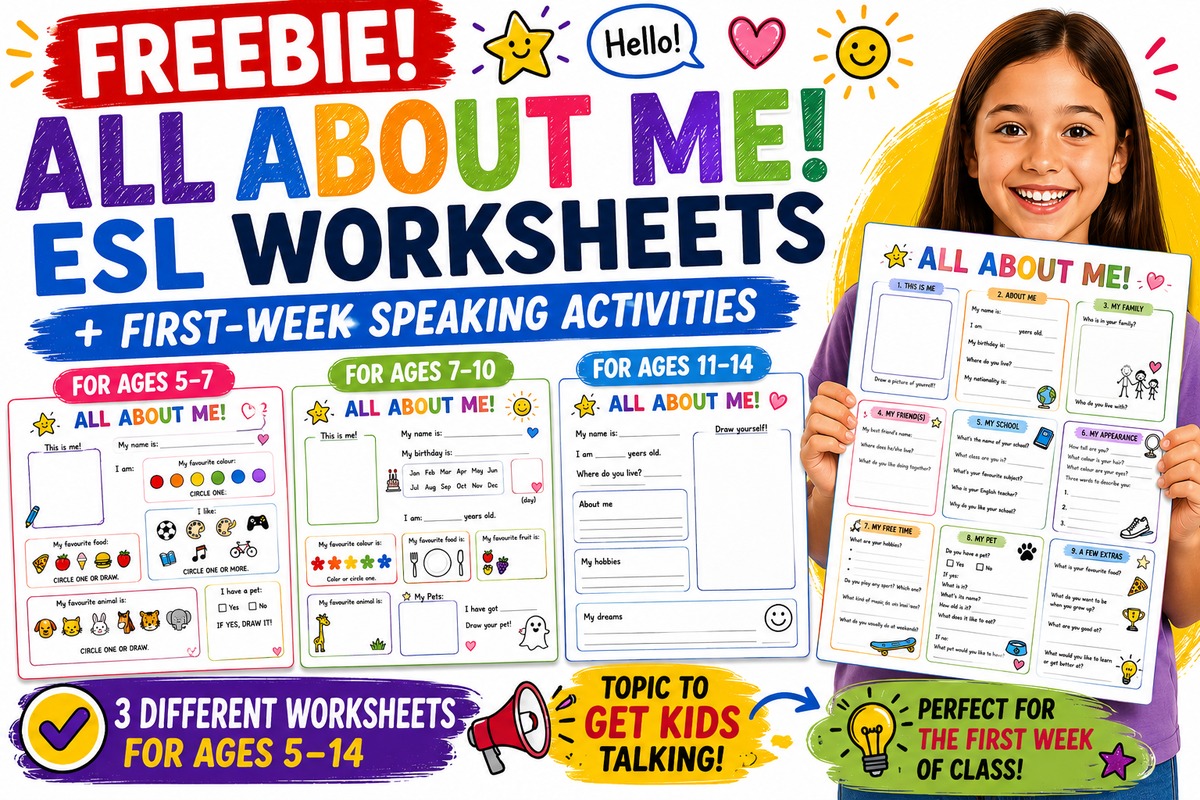
FREEBIE! All About Me ESL Worksheets + First-Week Speaking Activities
The first English lesson after the holidays doesn't have to begin with a grammar review or vocabulary test. Start with something every student already knows a lot about: themselves. An All About Me activity is one of the easiest ways to get children speaking English again. Students can talk about their age, family, favourite things, appearance, hobbies, pets, school and dreams without first having to learn a completely new topic.
And for the teacher, it is a simple way to see how much English students can actually use. We've prepared three FREE All About Me ESL worksheets, adapted for different age groups: Ages 6–8: Circle, Draw and Talk Ages 8–10: Draw, Write and Describe Ages 11–14: Write, Explain and Discuss But don't let the worksheet become the whole lesson. The worksheet is the visual prompt. Speaking is the lesson.
🎁 FREE All About Me ESL Worksheets
The same topic can work with a five-year-old and a fourteen-year-old, but the language expectations should be completely different. That's why the freebie includes three versions.
Ages 6–8: Circle, Draw and Talk
For younger children, keep writing to a minimum. Let students draw themselves, circle answers, choose pictures and talk about what they see. The worksheet can introduce questions such as:
What's your name? How old are you? What's your favourite colour? What's your favourite animal? What's your favourite food? What do you like? Who is in your family? Do you have a pet? A child might simply circle a dog, but that's only the beginning. Ask: What's this? Do you like dogs? Have you got a dog? What colour is it? Is it big or small? One little picture can generate an entire conversation.
Ages 8–10: Draw, Write and Describe
Children in this age group can start producing more language themselves. They can complete short sentences and write about their favourite things while still using pictures and drawings for support. Try questions such as:
When is your birthday? What's your favourite food? What's your favourite drink? What's your favourite animal? Have you got a pet? What do you like doing? What's your favourite sport? What are you wearing? Then build on their answers. A student writes: My favourite food is pizza. Continue: What kind of pizza do you like? Do you like cheese? Do you like mushrooms? How often do you eat pizza? Or: I like football. Ask: Do you play football? Who do you play with? Where do you play? What's your favourite team? The goal is to move from: word → sentence → question → conversation
Ages 11–14: Write, Explain and Discuss
Older students need questions that give them something meaningful to talk about. Their worksheet can include sections such as: About Me My Family My Friends My School My Appearance My Free Time My Pet My Future Ask more open questions: Where were you born? What's your nationality? Who do you live with? What do you look like? How would you describe your personality? What's your favourite school subject and why? What do you usually do in your free time? What are you good at? What would you like to get better at? What is your dream job? Why?
At this age, don't be satisfied with one-word answers. If a student says: “I want to be a doctor.” Continue: Why? What subjects do you need to be good at? Would you like to work in a hospital? Do you know anyone who is a doctor? The personal information becomes a springboard for real communication.
Turn Every Answer Into Another Question
This is probably the most important part of the activity. Don't treat a student's answer as the end of the exchange. If you ask:
What's your favourite animal? and the student says: A dog. Don't immediately move on. Try: Have you got a dog? What's its name? How old is it? What colour is it? What does it like to eat? The same principle works with older students. What do you do in your free time?
I play basketball. Continue: How often do you play? Where do you play? Who do you play with? Are you in a team? Who's your favourite player? You don't need another worksheet. You need another question.
Connect All About Me to Visual English
One of the best things about All About Me is that almost every answer naturally connects to another English topic. This makes the freebie an ideal starting point for continuing the conversation with Visual English. Instead of teaching personal information as an isolated first-week lesson, follow what your students tell you.
“How are you?”
Start with feelings and emotions. Continue the topic with: Visual English Book 1, Unit 4: How Are You? Students can practise recognising and talking about how they feel.
“What's your favourite colour?”
If a child tells you their favourite colour, you've already opened another conversation. Is your school bag blue? Are your shoes black? What colour is your bedroom? Continue with: Book 1, Unit 6: What Is Your Favourite Colour?
“How old are you?”
A classic first-lesson question for young learners. Continue with: Book 1, Unit 7: How Old Are You? It is an easy way to combine personal information with numbers and question-and-answer practice.
“Tell me about your family.”
Family is naturally personal, which makes it perfect for an All About Me lesson. Have you got a brother? Have you got a sister? Who do you live with? Continue with: Book 1, Unit 5: My Family For older students, move beyond naming family members and encourage descriptions and longer answers.
“What does your hair look like?”
Appearance can begin very simply. I've got brown hair. Then expand: Is it long or short? Is it straight or curly? What colour are your eyes? For younger learners, continue with: Book 1, Unit 10: I Have Crazy Hair! For students ready for more detailed descriptions: Book 3, Unit 12: What Do You Look Like? The same personal topic grows with the learner.
“Do you have a pet?”
If the answer is yes, there are immediately more questions to ask. What pet have you got? What's its name? How old is it? What colour is it? No pet? Ask:
What pet would you like to have? Continue with: Book 1, Unit 13: Do You Have a Pet?
“When is your birthday?”
Students can move from simply giving their age to talking about dates and birthdays. Continue with: Book 2, Unit 10: When Is Your Birthday?
“What are you wearing?”
Use what students are actually wearing in the classroom. I'm wearing a blue T-shirt. She's wearing black trousers. Continue with: Book 2, Unit 4: What Are You Wearing? Clothes
“Where are you from?”
Personal information can also lead into countries and nationality. Continue with: Book 2, Unit 17: Where Are You From? Then, as students progress: Book 4, Unit 1: What Is Your Nationality?
“What do you like doing?”
This question can grow with students across several Visual English levels. For younger learners: Book 3, Unit 4: Free Time Then: Book 4, Unit 16: Free Time Activities And for more advanced learners: Book 6, Unit 8: Free Time The vocabulary becomes richer, but the core question remains personal: What do YOU like doing?
“What's your favourite sport?”
Younger learners can continue with: Book 2, Unit 14: Sports Students can later expand the topic with: Book 3, Unit 16: Sports and Equipment And older learners can work with: Book 7, Unit 10: Sports
“What do you want to be?”
For younger students, dreams about the future can be simple and fun: I want to be a vet. I want to be a teacher. I want to be a footballer. Continue with: Book 2, Unit 7: What Do You Want to Be? Older learners can discuss their ambitions in more depth with: Book 7, Unit 9: My Dream Job Again, the topic hasn't really changed. The depth of the conversation has.
One Student, Many Visual English Topics
This is where an All About Me lesson becomes particularly useful. Imagine a student tells you:
I'm 9. My favourite colour is purple. I've got long brown hair and I've got a dog. I love football and drawing. My birthday is in May. I want to be a vet.
You now have natural connections to: How Old Are You? What Is Your Favourite Colour? I Have Crazy Hair! Do You Have a Pet? When Is Your Birthday? Sports Free Time What Do You Want to Be? Instead of deciding, “Today we are learning Unit X,” the conversation can begin with the child and naturally lead into the language they need. Start with the student. Follow their answers. Build the conversation.
5 Speaking Activities to Use with Your FREEBIE
Once students have completed their worksheets, don't put them away. Use them.
1. Ask a Friend
Put students into pairs. Younger learners can ask: What's your name? How old are you? What's your favourite colour? Have you got a pet? Older students should add their own follow-up questions. The objective isn't to race through the worksheet.
It's to keep the conversation going.
2. Find Someone Who...
Ask students to find someone who: likes pizza, has a pet, plays football, likes the same colour, has a brother or sister, has a birthday in the same month, enjoys gaming, or wants an unusual future job. Students must find the information by asking questions in English.
3. Guess Who?
Choose one student without revealing their name. Give clues: This person has got a dog. Their favourite colour is blue. They like basketball. They have got brown hair. Students ask: Is it Alex? Now they have a reason to listen to what their classmates said.
4. Hot Seat
One student sits in the Hot Seat. The rest of the class asks questions. For younger learners, provide starters:
What's your...? Do you like...? Have you got...? Can you...? Older learners can create their own questions.
5. Same or Different?
Put students into pairs and ask them to discover three things they have in common. We both like pizza. We both have a brother. We both play football. Then find something different: I like cats, but Mia likes dogs. It's simple, personal and communicative.
Use the First Lesson as a Natural Speaking Assessment
While students are completing these activities, listen. Can they understand your questions? Do they need visual support?
Can they answer with a full sentence? Can they understand a follow-up question they weren't expecting? Can they ask another student a question?
Can they explain why? Can they describe something when they don't know the exact English word? You can learn a lot about a student's real English ability without giving them a formal first-day test.
And don't feel that every mistake needs to stop the conversation. If a young learner says: “My favourite animal dog.” You can respond naturally: “Your favourite animal is a dog? Me too! Have you got a dog?”
You've modelled the correct language without turning a conversation into a grammar lecture.
A Simple 45-Minute First ESL Lesson
Here's one way to use the freebie: 5 minutes: Greetings and warm-up questions 10 minutes: Complete the age-appropriate All About Me worksheet 10 minutes: Teacher-led speaking using students' answers 8 minutes: Ask a Friend 7 minutes: Find Someone Who... 5 minutes: Guess Who? or Hot Seat
You can then choose a Visual English unit based on the language your students need to practise next.
One Topic, Three Age Groups
The topic stays the same. What changes is the language students can produce.
Ages 6–8
See → Circle → Draw → Say Use plenty of pictures, very little writing and lots of short questions.
Ages 8–10
See → Draw → Write → Answer → Describe Move from vocabulary towards sentences, descriptions and simple follow-up questions.
Ages 11–14
Read → Write → Explain → Ask → Discuss Encourage longer answers, reasons, opinions and student-generated questions. A five-year-old might say: “I like dogs!” A nine-year-old might say: “My favourite animal is a dog because dogs are funny.” An older learner might explain: “I'd like to become a vet because I love animals and I'd like to work with them in the future.” Same topic. Much more language.
Download the FREE All About Me ESL Worksheets
Choose the worksheet for your age group
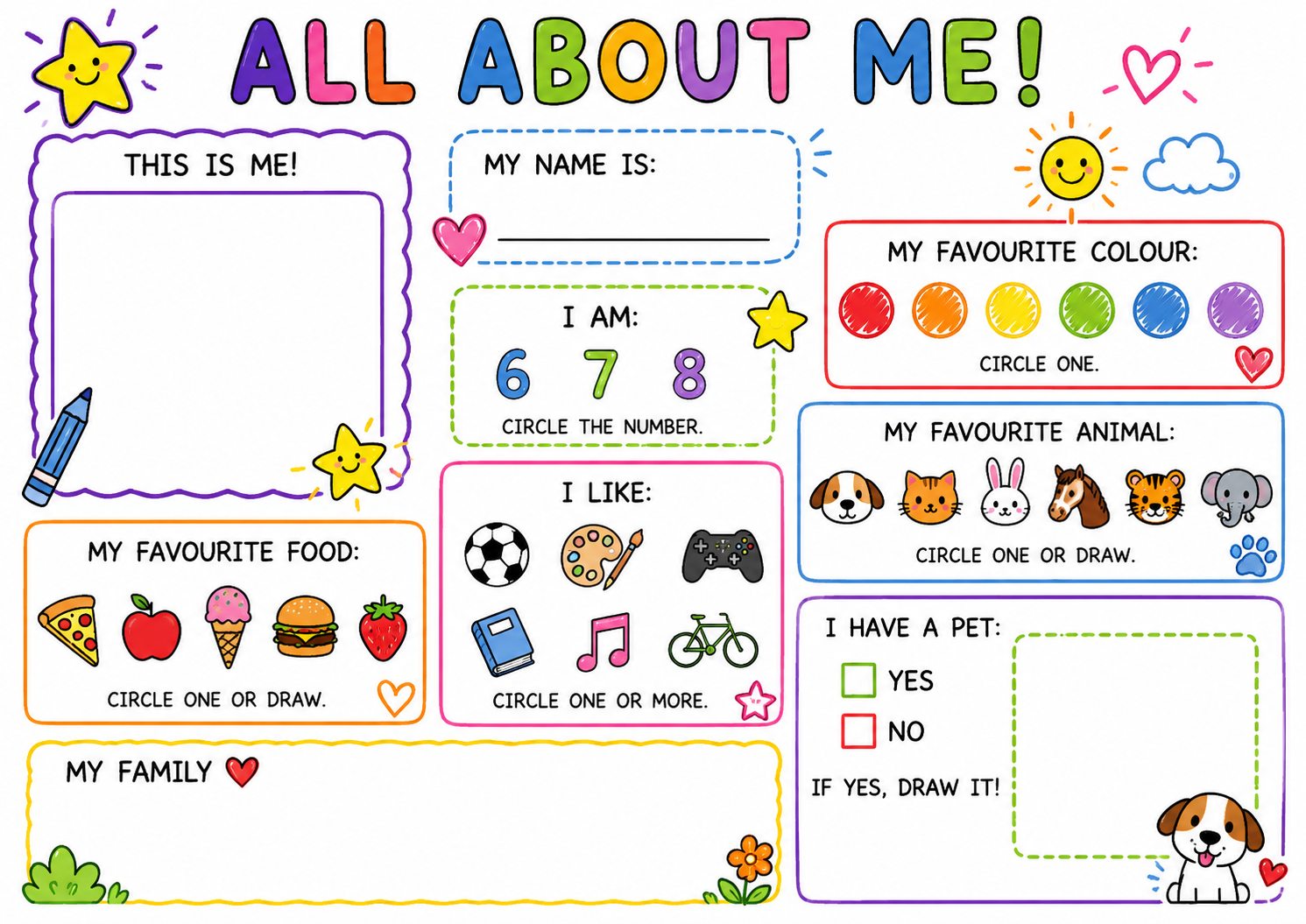 ⬇️ Download worksheet — Ages 6–8
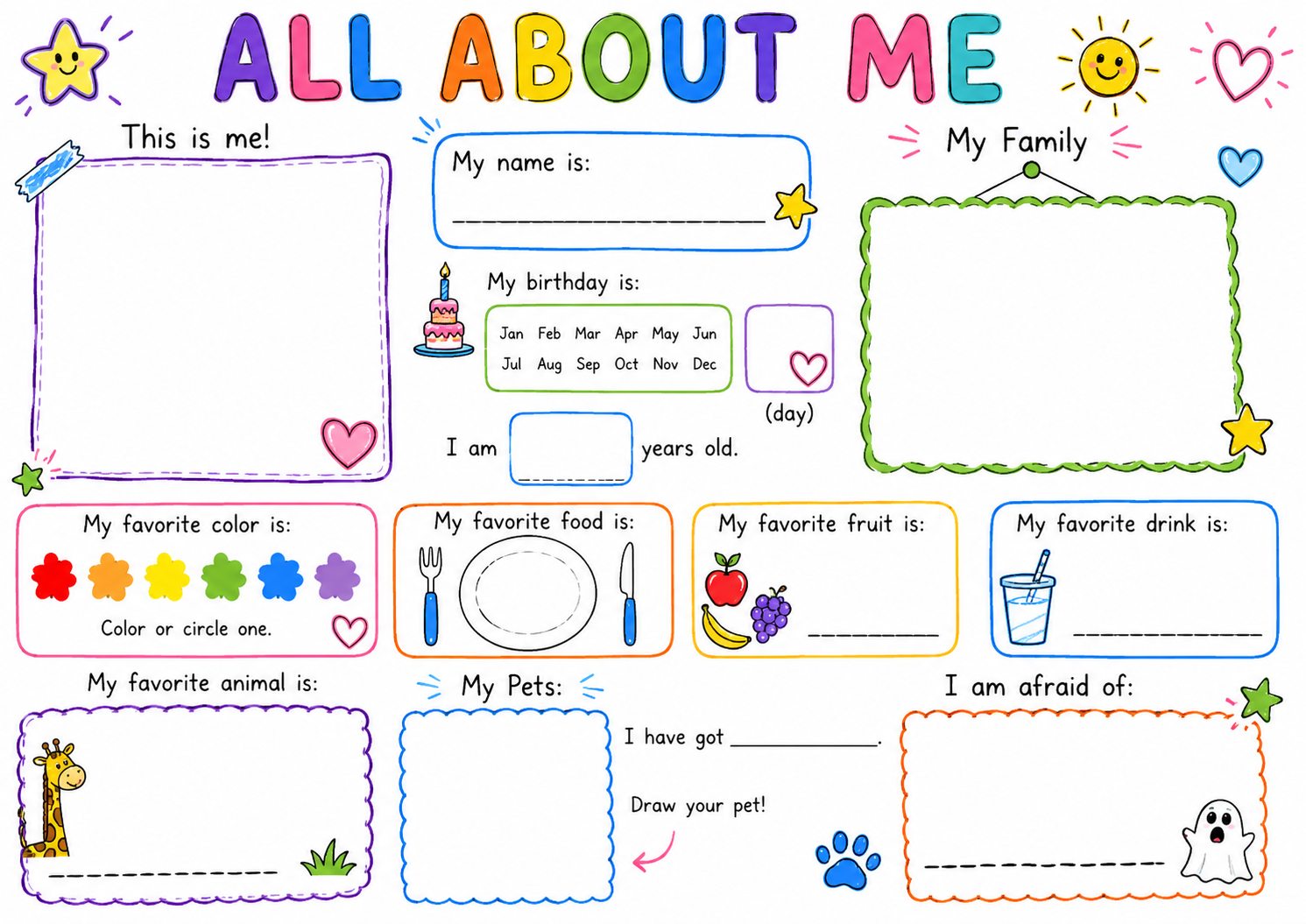 ⬇️ Download worksheet — Ages 8–10
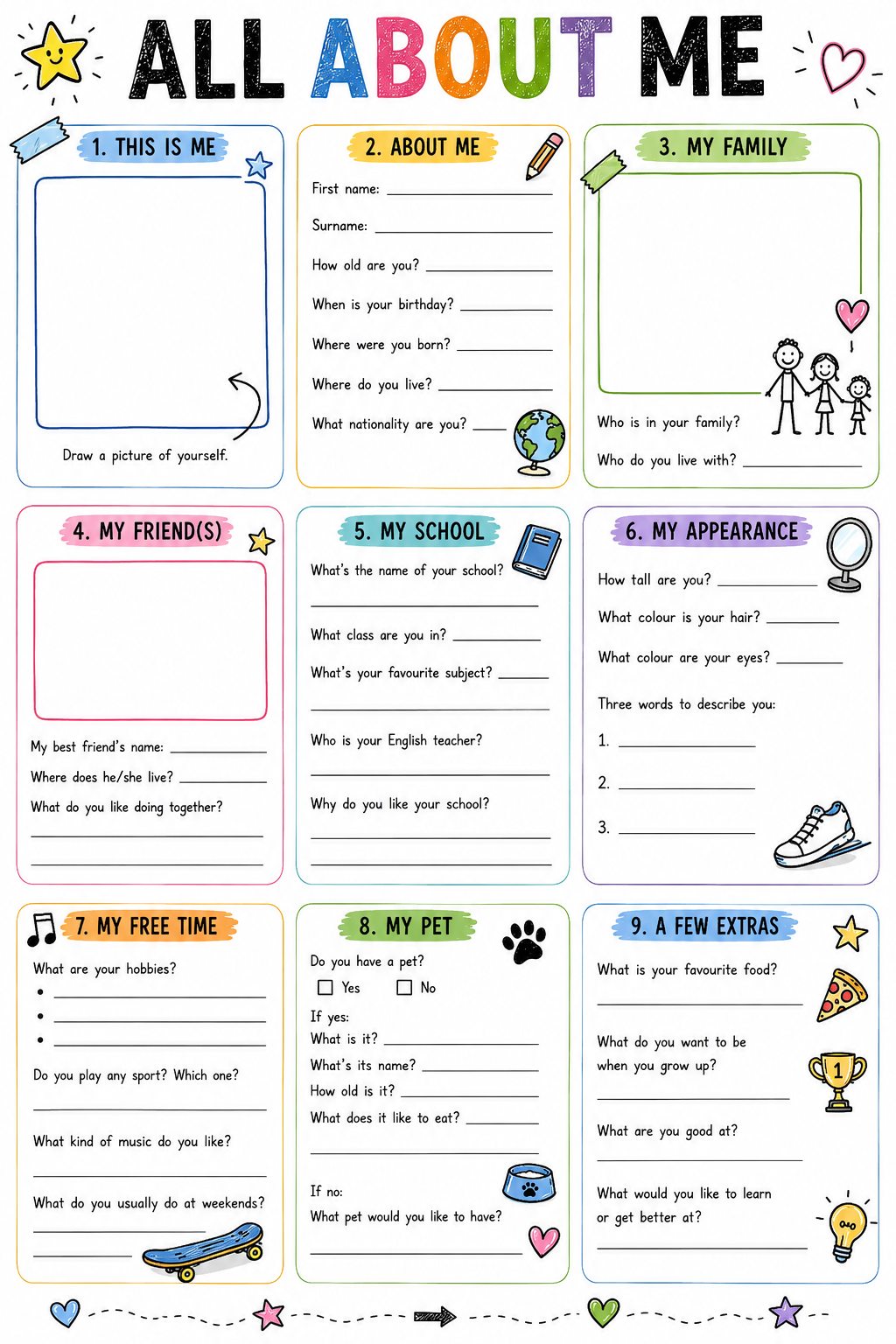 ⬇️ Download worksheet — Ages 11–14
Use the three worksheets with ages 6–8, 8–10 and 11–14, then turn their answers into questions, games and real conversations. And when you're ready to continue, the same topics can be explored through the ready-made visual lessons in Visual English Books 1–7. One child. One worksheet. Hundreds of possible questions.
Because the goal isn't to fill every box. The goal is to turn every box into a conversation.