How to Teach Natural Disasters in ESL: Vocabulary, Passive Voice and Roleplay
Table of contents(8 sections)ShowHide
Natural disasters make a strong ESL topic for intermediate students. The vocabulary is vivid, the grammar is genuinely useful, and students have plenty to say. Here is how to build a lesson around it.
Why Natural Disasters Work in the ESL Classroom
Students already know what an earthquake or a flood is, so they can focus on the English instead of the idea. The topic also pulls in two grammar areas intermediate learners need: the passive voice for describing what happened, and modal verbs for giving advice.
Core Vocabulary
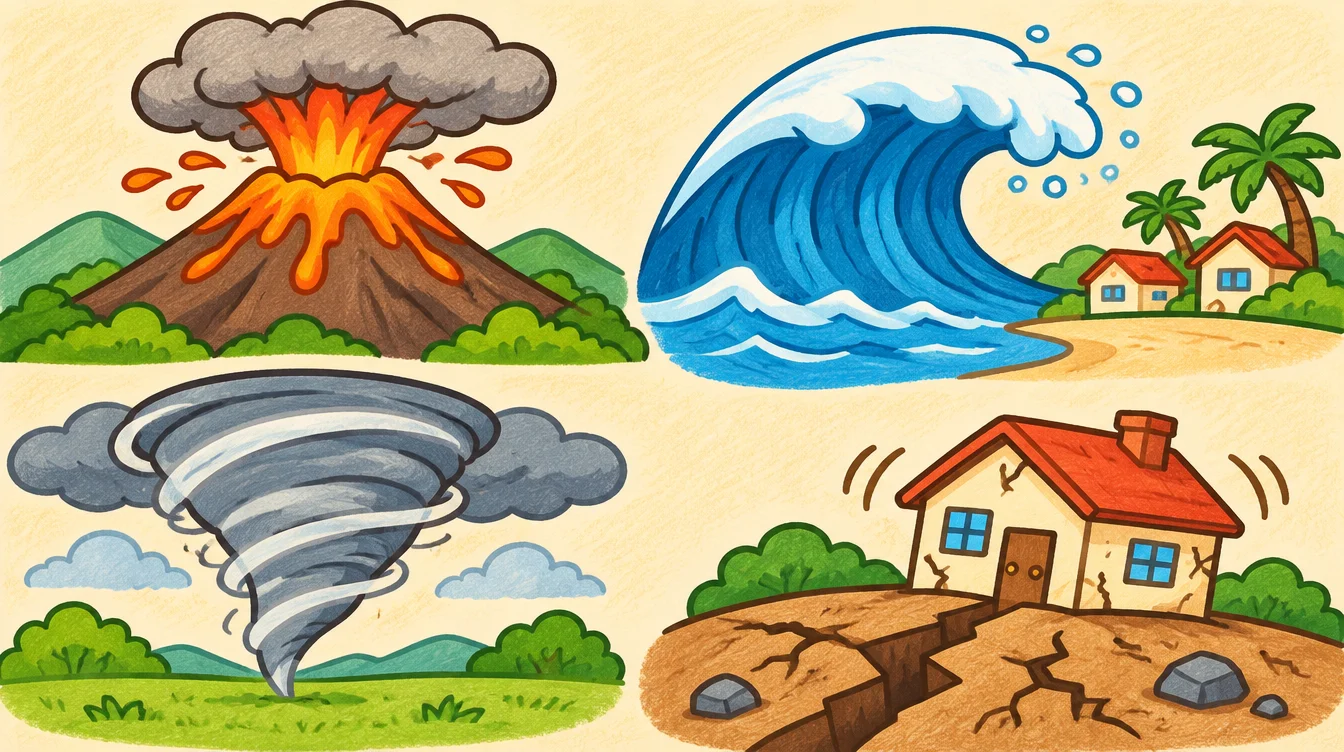
Start with the events themselves: earthquake, tsunami, hurricane, flood, volcano, eruption, tornado, wildfire and avalanche. Then add the words students need to talk about them: emergency, evacuate, damage and climate change. Teach each word with a picture first. A short quiz where students name the disaster from an icon is a quick warm-up, and it needs no translation.
Grammar 1: The Passive Voice for Describing Damage
News reports about disasters are full of the passive: "The bridge was destroyed." "Hundreds of people were rescued." "The survivors are being treated." A simple routine:
- Show a picture of a flooded street.
- Ask what happened. Students usually say "The water destroyed the houses."
- Rewrite the sentence together in the passive: "The houses were destroyed."
- Students convert more active sentences into the passive in pairs.
Grammar 2: Should, Must and Mustn't for Safety Advice
Safety advice is the most natural place to practise modals of advice and obligation.
- You should stay away from windows during an earthquake.
- You must evacuate when the alarm sounds.
- You mustn't use the lift in a fire.
Ask "What should we do in an earthquake?" and let students build the advice themselves before you correct it.
Speaking Activities That Work
1. Emergency sound match. Play emergency sounds and have students decide which disaster each one belongs to. 2. What should we do? advice drill. Give a disaster and have pairs give three pieces of advice with should, must or mustn't.
3. Survival story. Students write a short story about a disaster they imagine, saying what happened and what they did. 4. Rescue-team call roleplay. One student is a survivor calling for help, and the other is the rescue team asking questions. It practises the vocabulary and the question forms under a little pressure.
A Note on Sensitivity
Some students may have lived through a flood, a fire or an earthquake. Keep the discussion questions optional, and let students talk about imagined situations instead of personal experiences if they prefer.
Common Mistakes to Watch For
- Forgetting the past participle in the passive ("The house was destroy").
- Using "must" for gentle advice where "should" is more natural.
- Mixing up "mustn't" (forbidden) with "don't have to" (not necessary).
Ready-Made Lesson
The Visual English lesson Natural Disasters covers all of this: disaster vocabulary, active-to-passive conversion, should/must/mustn't advice, a survival story and the rescue-team roleplay. For a lighter version of the same ideas, see Are You a Survivor?, or try the ESL Survival Games as a speaking activity. Related reading: How to teach weather vocabulary.
Frequently asked questions
How do I teach natural disasters to ESL students?
Start with pictures of the main events (earthquake, flood, hurricane, tsunami), teach the vocabulary, then practise the passive voice to describe damage and should/must/mustn't to give safety advice. Finish with a roleplay such as a call to a rescue team.
What grammar goes with natural disasters?
The passive voice (the bridge was destroyed, people are being rescued) and modal verbs of advice and obligation (should, must, mustn't).
What level is this topic suitable for?
It suits intermediate students. In Visual English it is Book 7, Unit 11, an Intermediate level lesson.
Is it appropriate for students who have lived through a disaster?
Keep personal questions optional and let students speak about imagined situations if they prefer.