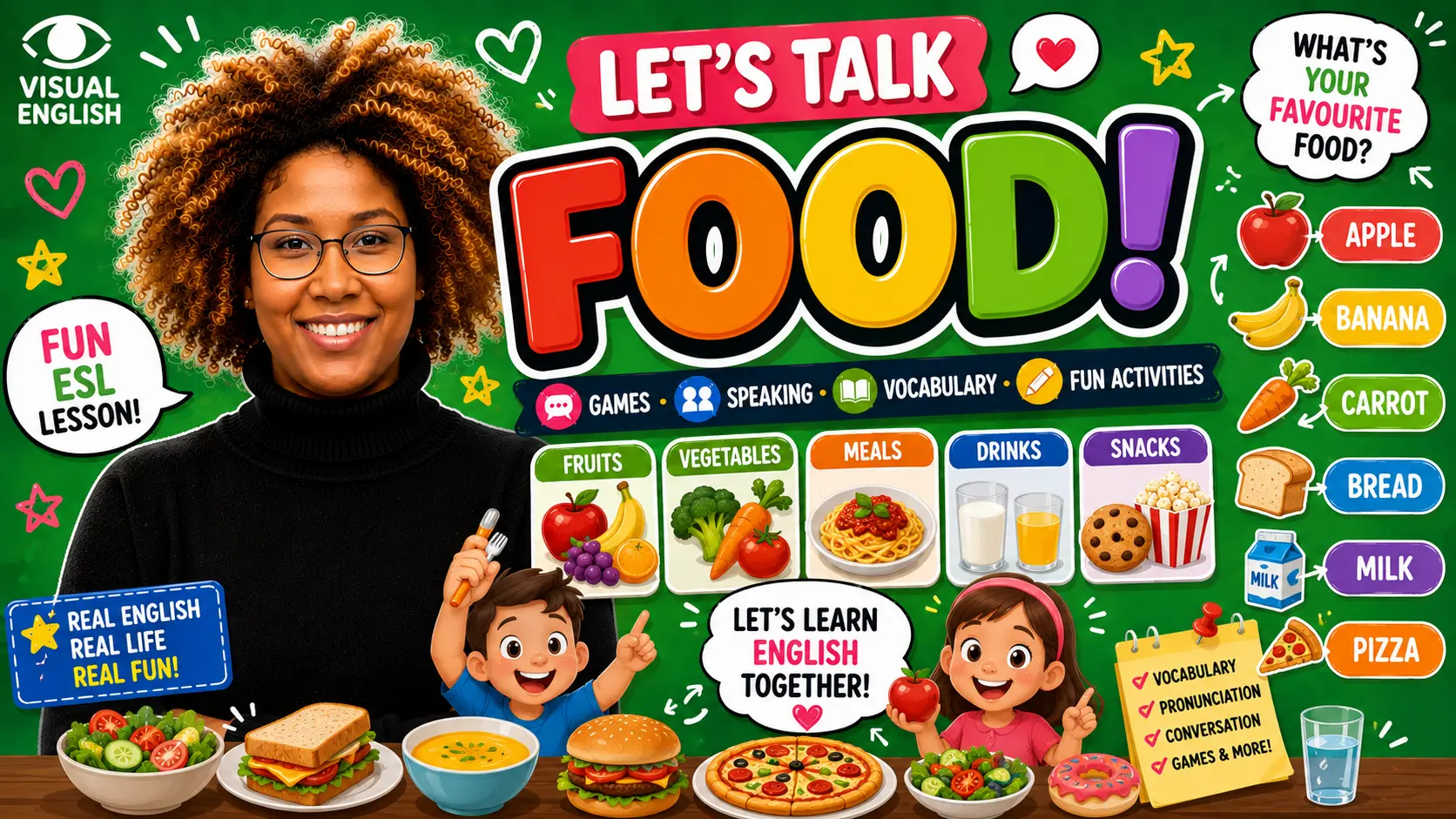
How to Teach Food Vocabulary in ESL Classrooms (2026)
Table of contents(7 sections)ShowHide
Food is one of the most durable topics in any ESL curriculum -- students never run out of opinions about it. From naming fruit as a beginner to debating unusual snack flavours as a stronger student, it scales across the entire course.
Why Food Works So Well
Every student has genuine preferences, so questions like "Do you like...?" always get a real, opinionated answer -- never a blank stare. It's also one of the few topics where taste, smell, and memory all reinforce vocabulary retention.
Core Vocabulary
Start concrete: apple, banana, bread, milk, water, chicken, rice. Build outward into categories -- fruit, vegetables, drinks -- once basics are solid, rather than teaching everything at once.
The Grammar That Pairs Naturally
Food is the natural home for likes and dislikes: "I like apples," "I don't like broccoli." It also supports countable/uncountable nouns well later on ("an apple" vs "some rice"), and question forms like "Would you like...?" for polite offers.
Speaking Activities That Work
1. Like or don't like survey. Students poll classmates on a set of foods and report results -- combines speaking with light data-gathering. 2. Build a meal. Students choose items to build a plate or menu, then describe it aloud.
3. Taste test guessing. Describe a food by taste/texture without naming it; classmates guess. 4. Would you eat it? Present unusual food combinations and have students answer "Yes, I would" / "No, I wouldn't" with reasons -- great for stronger students.
Common Mistakes to Watch For
- Countable/uncountable confusion ("a bread" instead of "some bread" or "a loaf of bread")
- Overusing "like" for polite requests instead of "would like" ("I like a pizza" instead of "I'd like a pizza")
- Mixing up "taste" as a verb and noun ("It tastes good" vs "It has a good taste")
Ready-Made Food Lessons
Visual English covers food extensively across the curriculum:
- Fruit and Vegetables -- Book 1, core food vocabulary
- Yummy Yucky -- Book 0C, likes and dislikes for beginners
- Let's Eat Out -- Book 3, restaurant vocabulary
- Eating Out -- Book 7, dining opinions for older students
See the full set on the Food topic page.
Conclusion
Food is a topic that grows with your students rather than staying static -- simple naming for beginners, real opinions and debate for advanced learners. Few topics offer that much runway in a single theme.
Frequently asked questions
Should I avoid food allergies or sensitivities in class activities?
Worth a quick check with parents/school beforehand if any tasting or handling of real food is involved -- for vocabulary-only lessons using pictures, it's not usually a concern.
What's the best way to sequence food across a full course?
Start with naming (Book 1 level), move to preferences ("I like/don't like"), then to opinions and restaurant language for older students.
How do I keep vocabulary from feeling repetitive across many food-themed units?
Vary the angle each time -- naming, preferences, health, restaurant ordering, and taste description are all distinct enough to avoid repetition fatigue.