How to Teach Body Parts Vocabulary to Young ESL Learners (2026)
Table of contents(7 sections)ShowHide
Body parts vocabulary has a built-in advantage no other topic has: every word can be physically pointed at. That makes it one of the easiest topics to teach through Total Physical Response (TPR) -- students learn by doing, not just listening.
Why Body Parts Works So Well
Students don't need pictures or translation to understand "touch your nose" -- they can just look down and do it. This makes body vocabulary ideal for:
- Absolute beginners, including students with zero prior English
- High-energy classes where students need to move
- Quick warm-ups and transitions between activities
Core Vocabulary
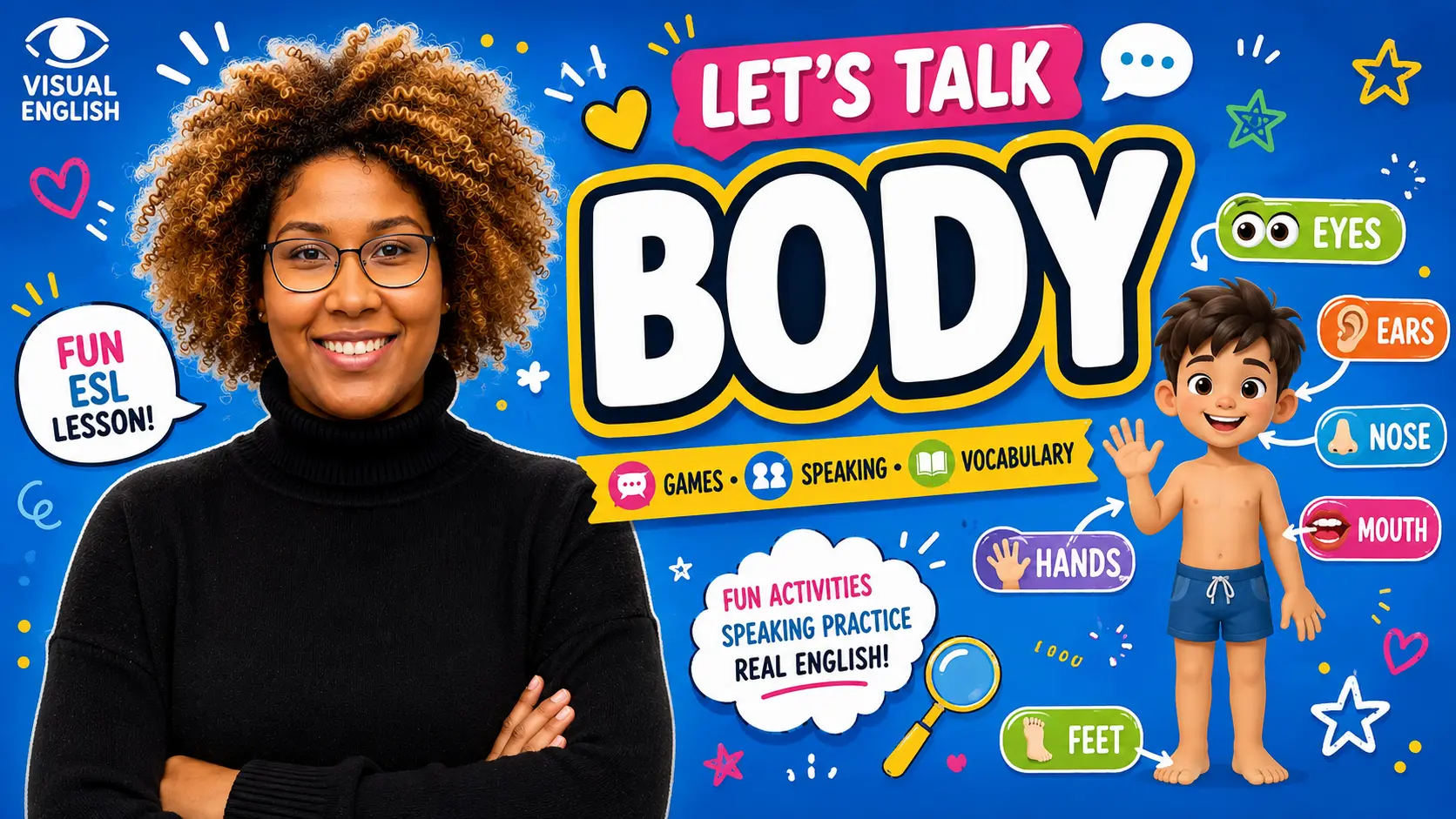
Start with the parts students can point to immediately: head, eyes, nose, mouth, ears, hands, feet, arms, legs. Add facial features (eyebrows, cheeks, chin) once the basics are solid -- they're a natural second layer since they build on "face" vocabulary students already have.
The Grammar That Pairs Naturally
Body parts pairs well with imperatives ("Touch your head," "Point to your nose") and simple descriptions ("I have two eyes," "My hands are big"). For older students, it's also a natural entry point for describing appearance ("She has curly hair," "He has a big nose").
Speaking Activities That Work
1. Simon Says. The classic for a reason -- "Simon says touch your ears" gets 100% of the class physically engaged and self-correcting in real time. 2. Head, Shoulders, Knees and Toes. The song works because the physical repetition cements vocabulary faster than flashcards alone.
3. Describe and draw. One student describes a face ("big eyes, small nose") while a partner draws it without seeing the original -- genuinely tests whether the vocabulary landed. 4. Robot body. Students build a "robot" out of body-part flashcards or drawings, labelling each part -- useful for reinforcing spelling alongside speech.
Common Mistakes to Watch For
- Mixing up "ear" and "year" in pronunciation (a frequent one for several L1 backgrounds)
- Confusing plural body parts ("foots" instead of "feet," "tooths" instead of "teeth")
- Overusing "is" instead of "has" ("My nose is big" is fine, but "I is a big nose" shows up often)
Ready-Made Body Parts Lessons
Visual English has body vocabulary built into multiple books at increasing levels of detail:
- My Face -- Book 0A, facial features for the youngest learners
- Make A Face -- Book 1, facial features and expressions
- My Body -- Book 2, full body vocabulary
- Our Amazing Body -- Book 6, internal body systems for older students
See the full set of body-themed lessons across every book on the Body topic page.
Conclusion
Body parts is the rare topic where the realia is free and built in -- every student already has one. Anchor lessons around TPR and physical games, and you'll get engagement levels that vocabulary-only topics can't match.
Frequently asked questions
What age is body parts vocabulary appropriate for?
It works from the very first lesson a student ever has -- there's no prerequisite vocabulary needed.
Do I need props or realia?
No -- students' own bodies are the realia. That's what makes this topic so low-prep.
How do I keep it fresh across multiple lessons?
Layer complexity: start with pointing and naming, move to describing others, then to health-related uses ("My head hurts") in later lessons.