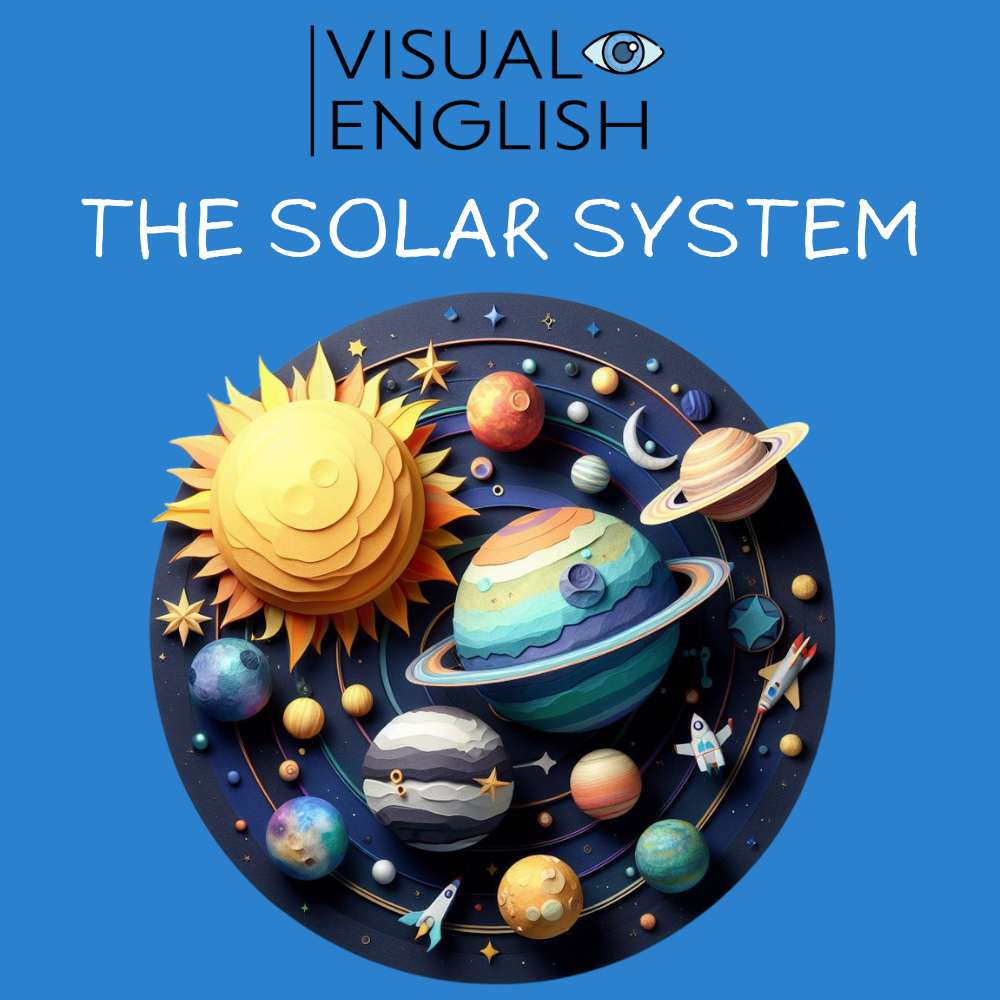
The Solar System
This solar system ESL lesson introduces the planets through songs, movement, visual prompts and map-ordering activities. Learners ask and answer questions about planet names, positions, colours and sizes. They invent a planet, record its details in a Planet Passport and present it before completing a planet-jump review game.
7-day trial · Card required · €0 today · Cancel before renewal
Lesson format
2 × 45 minutes
Level
Elementary
Age group
Ages 8–11
Main focus
Speaking first
What students will learn
Lesson flow
Children act out the sun, moon and a rocket blast-off, sing a planets song pausing to name Jupiter and Mars, and reorder planet flashcards from Mercury to Neptune. The second lesson interviews a partner playing a planet character, makes a Planet Passport inventing their own planet with colour and fun fact, and races to jump to named planets on the floor.
Target language
- • 'What planet is this?'
- • 'How many planets are there?'
- • 'Is this the sun?' Yes/No
- • 'Bigger than / next to'
Key vocabulary
- sun
- moon
- earth
- Mars
- Jupiter
- Saturn
- Venus
- planet
- star
- orbit
Speaking questions students answer
- • What planet is this?
- • Which one is red?
- • Is Saturn bigger than Mars?
- • Are you hot or cold?
- • What's the first planet?
Recommended teaching contexts
Why this lesson works
The lesson follows a clear progression: Act out space movements in a warm-up game, order the planets and compare their sizes, make a Planet Passport and play a planet-jump game. Teachers can open the materials and start immediately, while students move from supported vocabulary practice to purposeful spoken English.