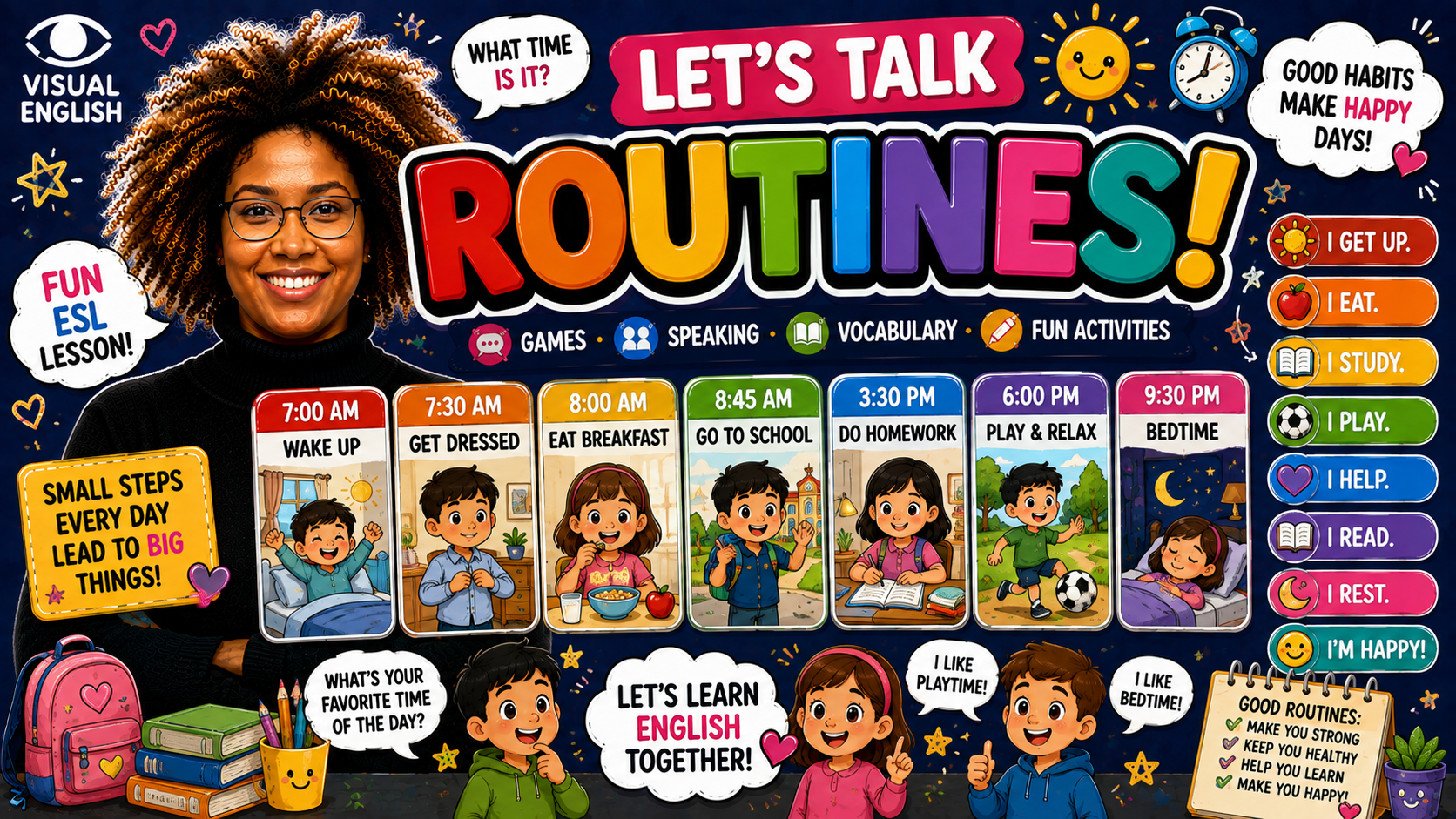
How to Teach Time and Daily Routine Vocabulary in ESL (2026)
Table of contents(7 sections)ShowHide
Time is a deceptively large topic -- it covers clock time, days of the week, months, and daily routines, each with its own vocabulary and its own common errors. Taught in the right order, it becomes one of the most practically essential parts of the curriculum.
Why Time Works So Well
Every student already has a daily routine and a real relationship with clock time, so the content is inherently personal and checkable -- there's a real, correct answer to "What time do you wake up?"
Core Vocabulary
Start with days of the week and simple clock expressions (o'clock, half past). Add daily routine verbs (wake up, get dressed, have breakfast, go to school) once time-telling basics are solid.
The Grammar That Pairs Naturally
Time is the classic home for present simple with routines: "I wake up at seven o'clock," "She goes to school by bus." It's also where third-person -s gets its most natural, repeated practice.
Speaking Activities That Work
1. My daily routine timeline. Students sequence and describe their real daily routine using time expressions. 2. What time is it? clock drill. Show a clock face; students say the time aloud -- quick, repeatable, and easy to vary.
3. Guess my routine. One student describes parts of their routine without saying the activity name directly; classmates guess. 4. Compare routines. Pairs compare their daily schedules, practising "I... but she..." contrast structures.
Common Mistakes to Watch For
- Third-person -s omission with routine verbs ("She wake up" instead of "She wakes up") -- one of the most persistent errors in the whole curriculum
- Preposition confusion with time ("in seven o'clock" instead of "at seven o'clock")
- Mixing up "half past" and "half to" when telling clock time
Ready-Made Time Lessons
Visual English covers time extensively:
- What Time Is It? -- Book 0B, first clock time
- Days Of The Week -- Book 2, days and routines
- My Daily Routine -- Book 3, full routine vocabulary with present simple
See the full set on the Time topic page.
Conclusion
Time is a foundational topic that quietly supports huge amounts of later grammar, especially present simple routines. Sequence it carefully -- clock time, then days, then full routines -- and the payoff shows up throughout the rest of the course.
Frequently asked questions
What's the right order to teach time-related sub-topics?
Clock time and days of the week first, then routines once students can already form basic present simple sentences.
What's the best grammar entry point?
Present simple with routine verbs -- it's the structure students will use constantly once time vocabulary is in place.
How do I fix persistent third-person -s omission?
Explicit, repeated contrast drilling ("I wake up" vs "She wakes up") works better than one-off correction -- this error tends to need sustained attention across many lessons.