How to Teach Shapes Vocabulary to Young ESL Learners (2026)
Table of contents(7 sections)ShowHide
Shapes is one of the smallest vocabulary sets in the curriculum, but it punches above its weight -- it's visual, hands-on, and often overlaps with what very young learners are already being taught in their first language, making transfer to English feel natural rather than brand new.
Why Shapes Works So Well
Shapes can be pointed at, drawn, cut out, and physically manipulated, which suits the shortest attention spans in the curriculum. It's also a topic with almost no ambiguity -- a circle is a circle in any context.
Core Vocabulary
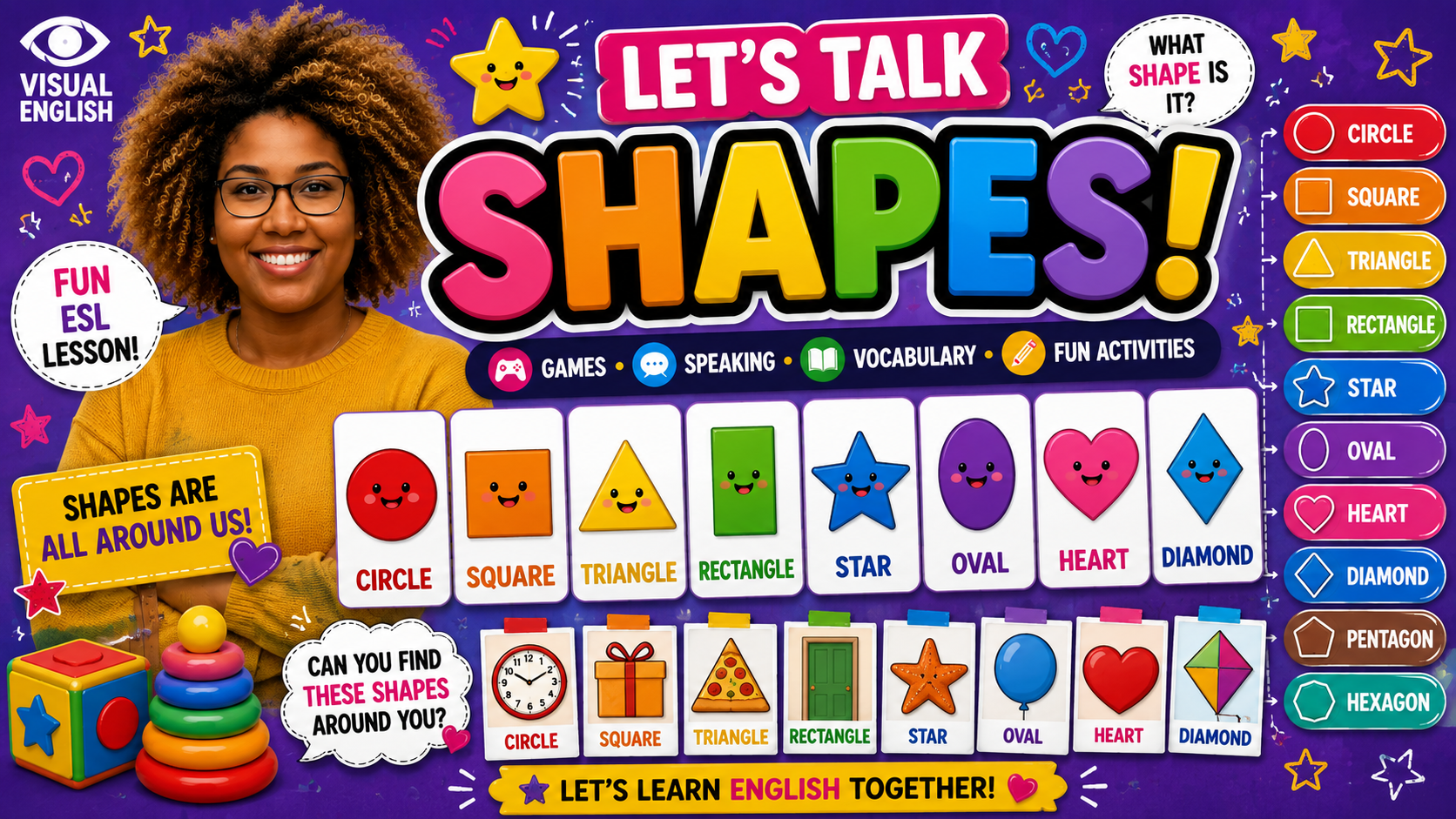
Start with the basics: circle, square, triangle, rectangle. Add star, heart, and oval once the core four are solid -- these tend to be more motivating for young learners since they connect to drawing and craft activities.
The Grammar That Pairs Naturally
"What shape is it?" / "It's a circle" is the core pattern. Once solid, shapes combine naturally with colours ("a red square") for simple two-word description practice.
Speaking Activities That Work
1. Shape hunt. Find real shapes around the classroom (a round clock, a square window) and name them aloud. 2. Draw and name. Students draw a shape when named, or name a shape once drawn -- works both directions for variety.
3. Shape + colour combo. Once both topics are taught, combine them: "Draw a blue triangle." 4. Shape craft. Cut-and-glue activities using paper shapes reinforce vocabulary through a tactile, memorable task.
Common Mistakes to Watch For
- Confusing "square" and "rectangle" -- worth directly contrasting since the visual similarity causes real confusion
- Article errors ("It's circle" instead of "It's a circle")
- Overgeneralising -- calling any four-sided shape a "square" regardless of proportions
Ready-Made Shapes Lessons
Visual English introduces shapes early in the curriculum:
- Make A Circle -- Book 0A, first shape
- Shapes -- Book 0C, core shape vocabulary
- Shapes -- Book 1, full shape set with description practice
See the full set on the Shapes topic page.
Conclusion
Shapes is compact but genuinely useful as a first step into visual description. Keep it hands-on and physical, and even a small vocabulary set delivers a satisfying, confidence-building lesson for young learners.
Frequently asked questions
What age is this topic best suited for?
It's most commonly taught to the youngest learners, though the vocabulary remains useful whenever geometry or description comes up later.
Should shapes be combined with colours immediately?
Not at first -- teach shapes alone until solid, then combine with colours for a natural two-word description step up.
How do I keep such a small vocabulary set from feeling thin?
Lean on hands-on activities (drawing, craft, hunts) rather than repeating flashcard drills -- the topic is small, so variety in activity type matters more than variety in vocabulary.