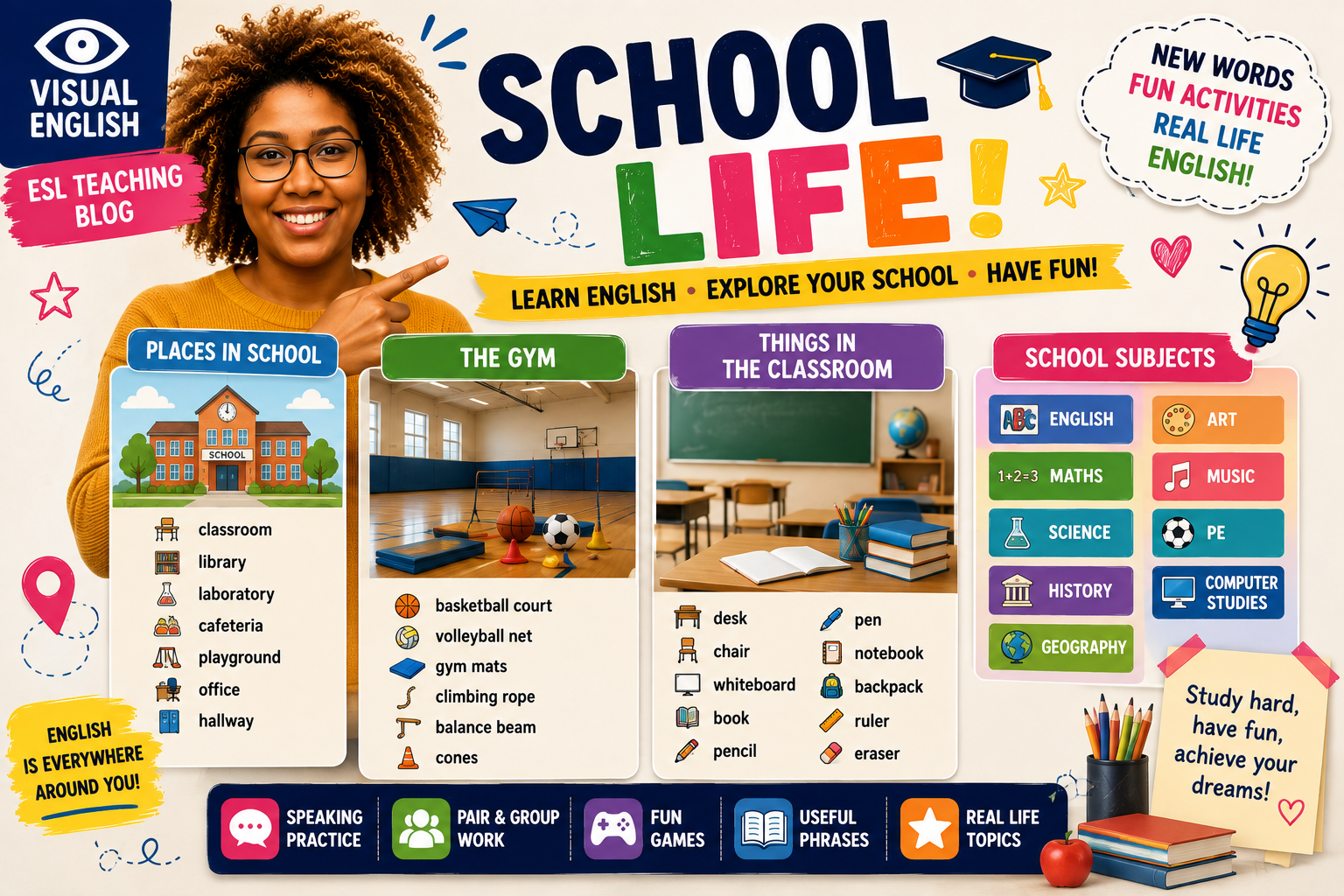
How to Teach School and Classroom Vocabulary in ESL (2026)
Table of contents(7 sections)ShowHide
School vocabulary has a rare double function: it's both a topic to be taught and language students can use immediately, every single lesson, inside the very room they're learning in. That immediacy makes it stick faster than most other topics.
Why School Works So Well
Students don't need to imagine a classroom scenario -- they're sitting in one. Objects, routines, and rules are all visible and available for real-time practice.
Core Vocabulary
Start with classroom objects: pencil, book, bag, ruler, eraser, desk. Add classroom language ("May I borrow...?", "Can I go to the toilet?") and simple rules vocabulary (listen, sit down, be quiet) once objects are solid.
The Grammar That Pairs Naturally
School vocabulary pairs with "I have a..." and polite requests ("May I borrow your...?", "Can I have...?"). It's also the natural home for classroom imperatives and simple rules ("Don't run," "Please listen").
Speaking Activities That Work
1. What's in your bag? Students name and describe real items from their own school bag. 2. May I borrow...? chain. Practise polite requests by actually borrowing classroom items from each other.
3. Classroom rules poster. Students help write simple classroom rules using "Please" and "Don't," reinforcing both vocabulary and classroom buy-in. 4. School subjects survey. For older students, discussing favourite and least favourite subjects with reasons.
Common Mistakes to Watch For
- Confusing "borrow" and "lend" (a very common direction mix-up: "Can you borrow me your pencil?" instead of "lend me")
- Overusing "give me" instead of the more polite "May I have...?" or "Can I borrow...?"
- Article errors with classroom objects ("I have pencil" instead of "a pencil")
Ready-Made School Lessons
Visual English builds classroom and school vocabulary from the earliest units:
- My School Bag -- Book 0C, first school objects
- May I Borrow Your...? -- Book 1, polite requests
- Class Rules -- Book 1, classroom behaviour language
- My Favourite Subject -- Book 3, school subjects and preferences
See the full set on the School topic page.
Conclusion
School vocabulary is uniquely practical -- it's language students can put to use the moment they learn it, in the very room they're sitting in. Lean into that immediacy, and it becomes some of the most naturally reinforced vocabulary in the whole course.
Frequently asked questions
Why teach classroom language explicitly rather than just picking it up?
Explicit teaching means students can actually use polite requests and classroom routines in English from early on, rather than defaulting to their first language for real classroom needs.
What's the best grammar entry point?
"May I borrow...?" -- it's genuinely useful immediately and teaches polite request structure naturally.
How do I extend this for older students?
Move into school subjects, comparing schools or education systems, and more complex classroom discussion language.