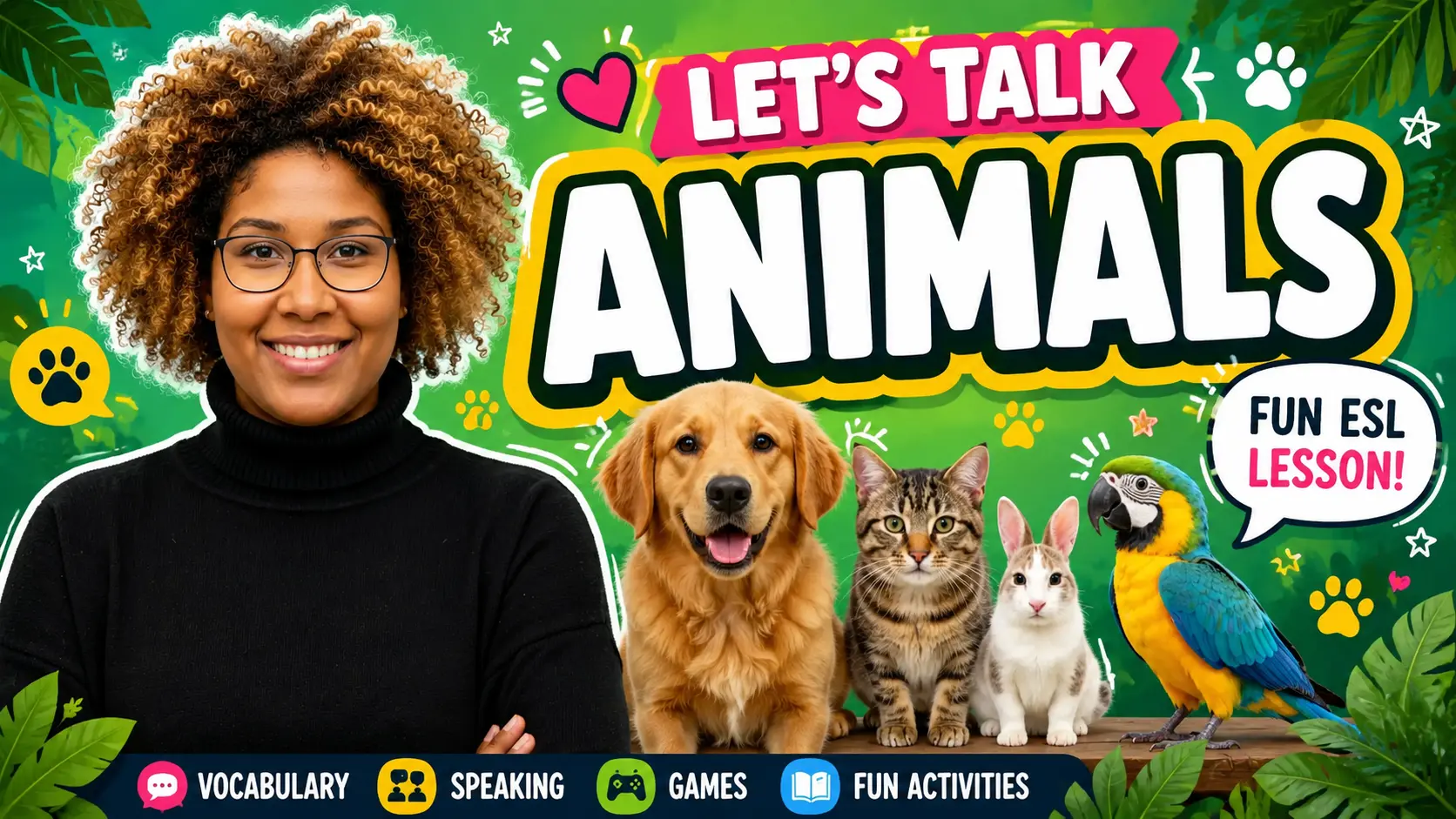
How to Teach Pets Vocabulary to Young ESL Learners (2026)
Table of contents(6 sections)ShowHide
Pets is one of the easiest topics to get a quiet classroom talking. Every student has an opinion — a dog at home, a goldfish, a cousin's cat, or a pet they desperately want. That built-in motivation is what makes it such a reliable ESL topic, from complete beginners through to more confident young learners.
This guide covers the core vocabulary, the grammar structures that pair naturally with it, and speaking activities you can run with little to no preparation.
Why Pets Works So Well as an ESL Topic
Unlike more abstract topics, pets connects directly to something personal. Students aren't just naming objects — they're describing something they care about. That personal stake means:
- Higher participation, even from shy students
- Natural opportunities for real (not scripted) answers
- Easy differentiation — a beginner can say "I have a dog," a stronger student can describe its colour, size, and habits
Core Vocabulary
Start with the animals students are most likely to actually have or want: Common pets: dog, cat, fish, rabbit, hamster, bird, turtle, guinea pig Descriptive words: big, small, fluffy, spotted, friendly, noisy Action words: feed, walk, play with, take care of, brush Keep the first pass small — six to eight words is plenty for one lesson. Adding turtle, parrot, and guinea pig too early tends to overload beginners without adding much conversational value.
The Grammar That Pairs Naturally: "Have Got"
Pets is one of the best contexts for introducing or reinforcing "have got" questions and answers:
- Have you got a pet?
- Yes, I've got a dog. / No, I haven't.
- What have you got?
Because the question has a genuine answer (not a drilled one), students actually listen to each other's responses instead of just waiting for their turn — which is where real conversation practice starts.
Speaking Activities That Work
1. Pet or no pet — quick poll. Ask "Have you got a pet?" around the room. Tally yes/no on the board. Takes two minutes and immediately gets every student talking.
2. Describe and guess. One student describes a pet ("It's small, it's fluffy, it says 'meow'") without naming it; classmates guess. Works well as a warm-up or filler.
3. Dream pet. For students without a pet, ask what pet they'd want and why. Removes the "I don't have one so I have nothing to say" problem entirely.
4. Pair interview. Students interview a partner about their pet (or dream pet) — name, colour, what it eats, what it does — then report back to the class in third person ("Anna has got a cat. It's black.").
Common Mistakes to Watch For
- Confusing "has got" and "have got" with third-person subjects
- Overusing "is" instead of "has got" ("My dog is a ball" instead of "My dog has got a ball")
- Mixing up "it" and "he/she" when pet gender is known — worth addressing once, not worth over-correcting in a speaking activity
Ready-Made Pets Lessons
If you'd rather skip building slides from scratch, Visual English has pets and animal-themed lessons built into multiple books, each with visual prompts already sequenced for conversation:
- Do You Have A Pet? — Book 1, beginner level, "have got" question practice
- Where Is The Spider? — Book 1, prepositions with animals
- Animal Planet — Book 6, pre-intermediate, wildlife and habitats
- Wild Animals — Book 3, elementary level
See the full set of animal and pet-themed lessons across every book on the Animals topic page.
Frequently asked questions
Do I need realia (toys, pictures) to teach this topic?
It helps but is not essential -- most students can picture common pets easily. Visual prompts (photos or illustrations) work just as well and are easier to prepare consistently.
What age group is pets vocabulary appropriate for?
It works from complete beginners (ages 5-6) through to elementary level. The vocabulary stays simple; what changes with age is the complexity of the questions and follow-up discussion.
How do I include students who do not have pets or are afraid of animals?
Lean on the dream pet framing rather than requiring a real one. It keeps the activity inclusive without diluting the language practice.