How to Teach Hobbies and Free Time Vocabulary in ESL (2026)
Table of contents(7 sections)ShowHide
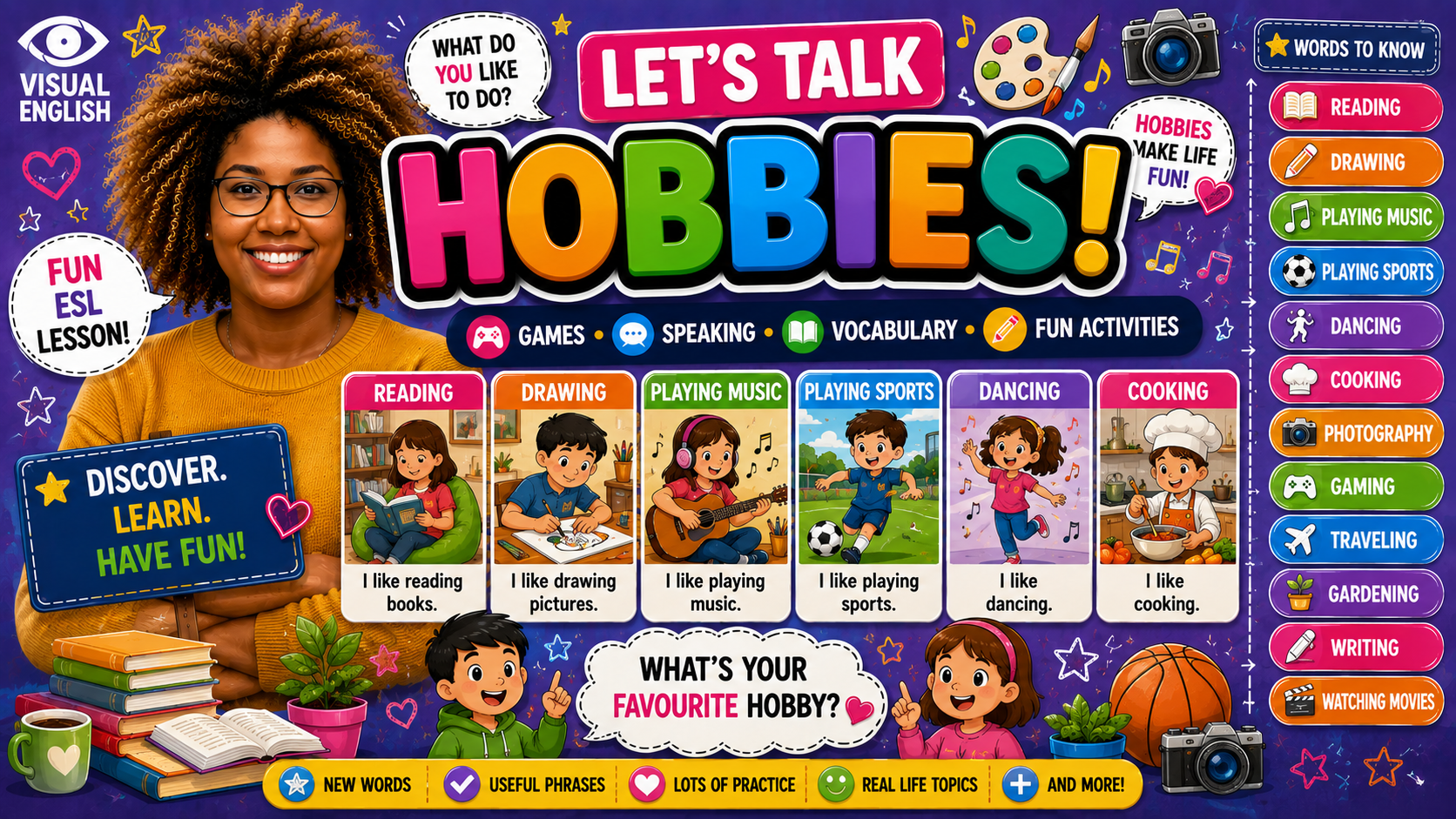
Hobbies is a topic where students are motivated before the lesson even starts. Everyone has something they would rather be doing than sitting in class, and this is the lesson where they finally get to talk about it in English.
Why Hobbies Works So Well
Unlike vocabulary tied only to objects or routines, hobbies vocabulary connects with personal identity and enjoyment. Students tend to speak more—and more willingly—when the topic is something they have chosen for themselves. Begin with a simple question:
What do you like doing in your free time? Then build the conversation with follow-up questions such as How often do you do it?, Who do you do it with? and Why do you enjoy it?
Core Hobbies Vocabulary
Start with familiar activities:
- reading and drawing
- playing football or basketball
- playing video games
- dancing and swimming
- collecting cards, stickers or toys
- listening to music
Group the vocabulary by natural verb patterns from the beginning:
- play football, basketball, video games or the piano
- go swimming, cycling or skating
- do karate, yoga or crafts
- read, draw, dance and collect without an extra verb
This helps students learn useful phrases instead of isolated words.
The Grammar That Pairs Naturally
Hobbies provide a natural context for the present simple:
- I play football on Saturdays.
- She reads every night.
- We collect football cards.
Once students can make basic sentences, introduce frequency expressions such as always, usually, sometimes, hardly ever and never. Keep the grammar connected to real information. A class survey is more meaningful than completing unrelated gap-fill sentences.
Four Speaking Activities That Work
1. Hobby Survey
Students ask several classmates what they enjoy doing, how often they do it and who they do it with. They then report one interesting answer to the class.
2. Guess My Hobby
One student mimes an activity. The others guess using a complete sentence: You like playing tennis or Your hobby is dancing.
3. Weekend Plan
Students explain what they plan to do at the weekend using hobbies vocabulary. Stronger groups can extend this into future forms and reasons.
4. Collections Show and Tell
Students describe a real or imagined collection of cards, stickers, toys or books. Ask them how the collection started, which item is their favourite and what they would like to add next.
Common Mistakes to Watch For
- Confusing verb patterns: play football, play the piano, but go swimming.
- Overusing do as a generic verb: do swimming instead of go swimming.
- Placing frequency adverbs incorrectly: I sometimes play rather than I play sometimes.
- Giving one-word answers instead of extending them with a reason or example.
Correct the pattern briefly, model the natural sentence and keep the conversation moving.
Ready-Made Visual English Hobbies Lessons
Visual English develops hobbies and free-time language progressively across several levels:
- My Toys — Book 0A: play, toys and favourite activities
- Free Time — Book 3: hobbies and leisure vocabulary
- My Collections — Book 4: describing personal interests and collections
- Are You a Gamer? — Book 5: gaming and modern hobbies vocabulary
You can also browse all hobbies lessons to choose the right topic for your students.
Conclusion
Hobbies is a topic where motivation does much of the work. Students want to talk about the activities they enjoy, so use that interest to move from vocabulary to complete answers, follow-up questions and real conversations. Teach the natural verb pattern, connect it to present simple habits and give every student a reason to speak.
Frequently asked questions
What if a student says they have no hobbies?
Reframe the question as "What do you like doing in your free time?" -- broader phrasing usually surfaces something, even if it's not a formal "hobby."
What's the best grammar entry point?
Present simple with frequency ("I play football every weekend") -- it's natural, personal, and reusable across many other topics.
How do I extend this for older, more advanced students?
Move into opinions and comparisons ("I prefer swimming to running because...") and discussing hobbies as part of identity or career interest.