Hello Autumn! Creative ESL Activities for Kids + 3 Free Worksheets
Autumn might be one of the easiest seasons to turn into a real English lesson. Leaves are changing colour. Acorns and chestnuts are appearing on the ground. The mornings are getting colder. Children are arriving in jumpers and jackets. Umbrellas are coming out, and there are puddles everywhere.
So instead of only showing children pictures of autumn...
Go outside and find it.
First, introduce the language with Visual English. Then take that vocabulary outside and let children discover it for themselves. A leaf is no longer just a picture on a screen.
Children can pick it up, tell you its colour, feel its texture, compare it with another leaf and try to work out which tree it came from. A weather lesson isn't only sunny, rainy, windy. Children can look outside and tell you what the weather is actually doing.
And a clothes lesson suddenly has a purpose when it's cold and rainy outside. In this article you'll find autumn ESL ideas for different ages, plus 3 free printable worksheets: 🍁 My Autumn Hunt, for younger learners 🌳 Autumn Nature Hunt, for older children 🔎 All About My Leaf, for little nature detectives We'll also make an Autumn Treasure Chest, create crazy Autumn Leaf Hair, explore autumn colours, take photographs, compare the seasons and decide what to wear for different autumn weather.
👁️ Start With Visual English, Then Take the Lesson Outside
The nature hunts work much better when children already know some of the English they're going outside to find. That's why I recommend combining the outdoor activities with the appropriate Visual English units. The progression is simple:
SEE IT → SAY IT → FIND IT → TALK ABOUT IT
First, use Visual English to introduce vocabulary visually and practise questions and answers. Then go outside. Now children aren't just ticking pictures on a scavenger hunt.
They're recognising English vocabulary in the real world. And the same autumn theme can work at completely different levels. A four-year-old might say:
Red leaf!
A six-year-old:
It's a red leaf.
An eight-year-old:
I found a red leaf under the tree.
An older learner:
I found a small red leaf near the playground. I think it's a maple leaf.
Same leaf. More English.
🍁 Autumn: Visual English 0A, Unit 4
Best for ages 3–5
Continue with: 0A · Unit 4: Autumn For our youngest learners, start with autumn itself. Introduce simple autumn vocabulary and descriptive language: leaf • red • yellow • orange • brown • green • big • small Then practise very short questions: What is it?
It's a leaf.
What colour is it?
It's yellow.
Is it big or small?
It's big.
Can you find a red leaf? For this age group, seeing, pointing, touching and naming are important parts of learning. This unit is a natural starting point before the My Autumn Hunt, Autumn Colour Hunt or Autumn Leaf Hair craft later in this article.
☔ Rain Rain Go Away: Visual English 0B, Unit 13
Best for ages 4–6
Continue with: 0B · Unit 13: Rain Rain Go Away Autumn isn't only about leaves. It's also the perfect season for rainy-day English. Introduce or revise language connected with rain and rainy weather.
Then look outside. Is it raining? Do you have an umbrella? What colour is your umbrella? Are you wearing boots? Can you see a puddle? If there's actually a puddle outside, even better. The vocabulary children learned in the classroom has suddenly become something they can see.
🌦️ How's the Weather?: Visual English 0C, Unit 10
Best for ages 4–6
Continue with: 0C · Unit 10: How's the Weather? Autumn gives us plenty of opportunities to talk about weather. Practise language such as: sunny • rainy • cloudy • windy • foggy • warm • cold Then make one question part of your classroom routine:
How's the weather today?
Look outside together. Is it sunny? Is it cloudy? Is it windy? Is it cold? Do we need an umbrella? It takes only a couple of minutes, but repeating the same language throughout autumn gives children a genuine reason to remember it.
🌳 Seasons of the Year: Visual English Book 1, Unit 11
Best for ages 6–9
Continue with: Book 1 · Unit 11: Seasons of the Year For slightly older learners, autumn becomes part of a bigger idea. Compare: spring • summer • autumn • winter Talk about colours, weather, clothes and what happens outside during each season. Ask:
What season is it now? What happens to the leaves in autumn? What colours can you see? What do you wear in autumn? Is autumn usually warm or cold? What comes after autumn? What's your favourite season? Why? This unit works especially well with the Four Seasons Tree activity later in the article.
🌧️ How Is the Weather?: Visual English Book 1, Unit 17
Best for ages 6–9
Continue with: Book 1 · Unit 17: How Is the Weather? Now students can move beyond simply naming the weather. Instead of:
Windy.
encourage:
It's windy today.
Then:
It's cold and windy today. I'm wearing a jacket.
Weather also gives us a natural bridge into another useful autumn topic:
What are you wearing?
🧥 Add a Visual English Clothes Unit
Autumn is a perfect time to combine your Visual English clothes lessons with autumn and weather. Why? Because clothes now have a reason.
It's cold. It's windy. It's raining.
So what should we wear? Revise useful autumn clothing such as: jumper • jacket • coat • trousers • boots • wellington boots • raincoat • scarf • hat And, of course: umbrella Now connect the clothes directly to the weather:
It's raining. I need my raincoat and boots.
It's cold. I'm wearing a jumper and a jacket.
It's windy today. I need my coat.
Instead of teaching Autumn, Weather and Clothes as completely separate topics, connect them.
🍂 AUTUMN → 🌧️ WEATHER → 🧥 CLOTHES
That's how we use language in real life too.
🌿 Mother Nature: Visual English Book 4, Unit 10
Best for ages 8–11
Continue with: Book 4 · Unit 10: Mother Nature With older children, autumn can develop into a much broader nature topic. Instead of only asking: What can you see? start asking: What changes in nature during autumn? What happens to the trees? What is the weather usually like? Which animals can you see? How is autumn different from summer? What do you like doing in autumn? Students are no longer simply naming vocabulary. They're observing, describing, comparing and giving opinions.
🍂 Build Your Own Autumn Theme With Visual English
You don't have to teach every unit. Choose the ones that suit your students and combine them into your own autumn mini-project.
| Visual English lesson | Connect it with |
|---|---|
| 0A Unit 4: Autumn | leaves, colours, size, texture |
| 0B Unit 13: Rain Rain Go Away | rain, umbrellas, rainy days |
| 0C Unit 10: How's the Weather? | autumn weather |
| Book 1 Unit 11: Seasons of the Year | autumn as a season |
| Book 1 Unit 17: How Is the Weather? | weather descriptions and speaking |
| 0A · Unit 12: Winter Snowflake | cold-weather clothes and autumn weather |
| 0B · Unit 8: Winter Clothes | warm clothes and dress-up |
| 0C · Unit 11: Winter Clothes | clothing actions and outfits |
| Book 1 · Unit 11: Seasons of the Year | clothes across the seasons |
| Book 2 · Unit 4: What Are You Wearing? | describing outfits |
| Book 4 Unit 10: Mother Nature | nature, seasons, weather and conversation |
Choose the lesson, teach the language, then take it outside.
🎁 3 FREE Autumn ESL Worksheets
To go with the lessons, I've created three printable autumn worksheets for different ages. You can use them separately or the complete Autumn ESL Mini Pack.
🍁 FREE Worksheet 1: My Autumn Hunt
Best for ages 3–6
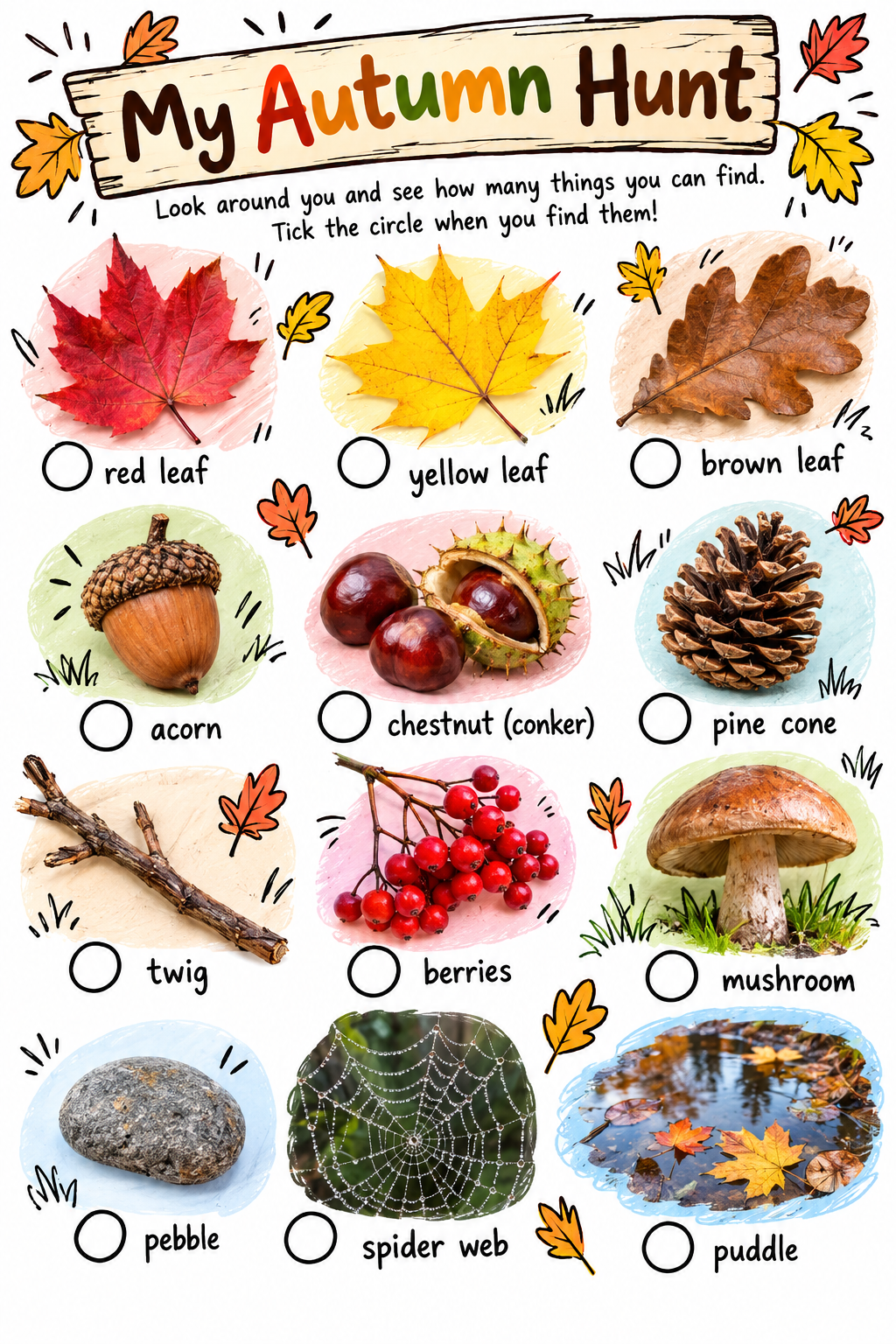
For little learners, less is more. They don't need 25 tiny pictures and lots of written vocabulary. The younger hunt uses large real-life images mixed with playful drawings, simple labels and big circles to tick.
Children look for: red leaf • yellow leaf • brown leaf • acorn • chestnut • pine cone • twig • berries • mushroom • pebble • spider web • puddle Before going outside, look at the worksheet together. Point to the pictures and say the words. Then turn it into a challenge:
Can you find a red leaf? Find something yellow! Can you see an acorn? Where's the pine cone? And when children find something, don't immediately move to the next tick. Use the moment.
Teacher: What is it? Child: A leaf! Teacher: What colour is it? Child: Red!
That's enough. For a four-year-old, that's meaningful communication.
👁️ Teach it with Visual English
I particularly recommend combining this worksheet with: 0A Unit 4: Autumn 0B Unit 13: Rain Rain Go Away 0C Unit 10: How's the Weather?
🌳 FREE Worksheet 2: Autumn Nature Hunt
Best for ages 6–11
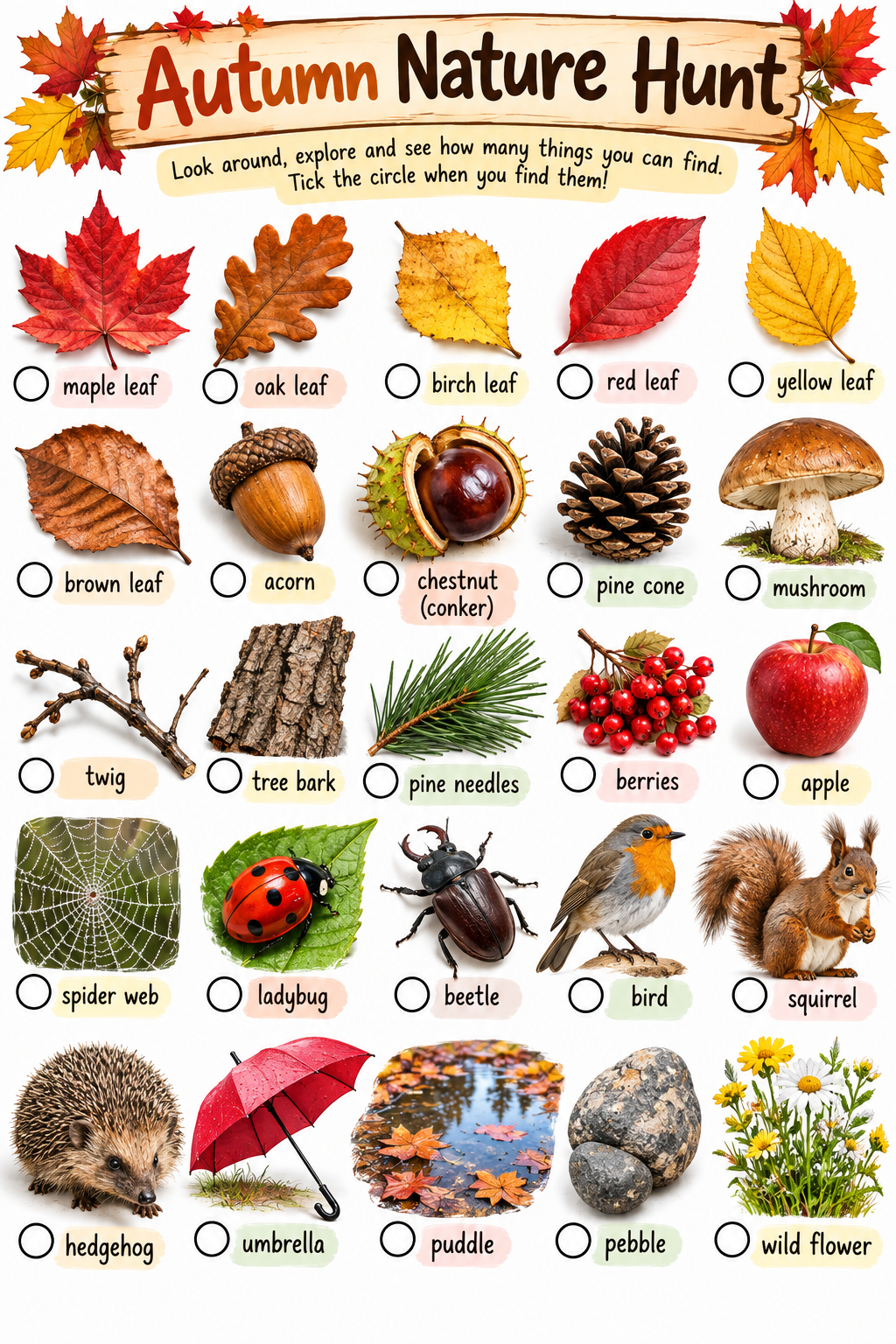
Older children can handle a much bigger challenge. Our second worksheet has 25 things to find: maple leaf • oak leaf • birch leaf • red leaf • yellow leaf • brown leaf • acorn • chestnut • pine cone • mushroom • twig • tree bark • pine needles • berries • apple • spider web • ladybug • beetle • bird • squirrel • hedgehog • umbrella • puddle • pebble • wild flower Will they find everything? Probably not.
And that's part of the fun. Before going outside, predict: Which five things will be easiest to find? Which will be difficult? Will we find a squirrel? Do you think we'll find a mushroom? Then head outside. Students can work individually, in pairs or in teams.
When they return, don't finish the activity. That's when the English gets more interesting. Ask:
What did you find? What didn't you find? What was easiest to find? What was the hardest? How many different leaves did you find? Did anybody see a squirrel? Where did you find the mushroom? Now students have something real to report:
I found a pine cone under a tree.
We found lots of yellow leaves.
I saw a bird, but I didn't see a squirrel.
We couldn't find a hedgehog.
👁️ Teach it with Visual English
I recommend combining the older hunt with: Book 1 Unit 11: Seasons of the Year Book 1 Unit 17: How Is the Weather? Book 4 Unit 10: Mother Nature
🔎 FREE Worksheet 3: All About My Leaf
Best for ages 5–11
This activity needs only one thing:
A real fallen leaf.
Ask every child to find one leaf that interests them. Not necessarily the biggest. Not necessarily the prettiest.
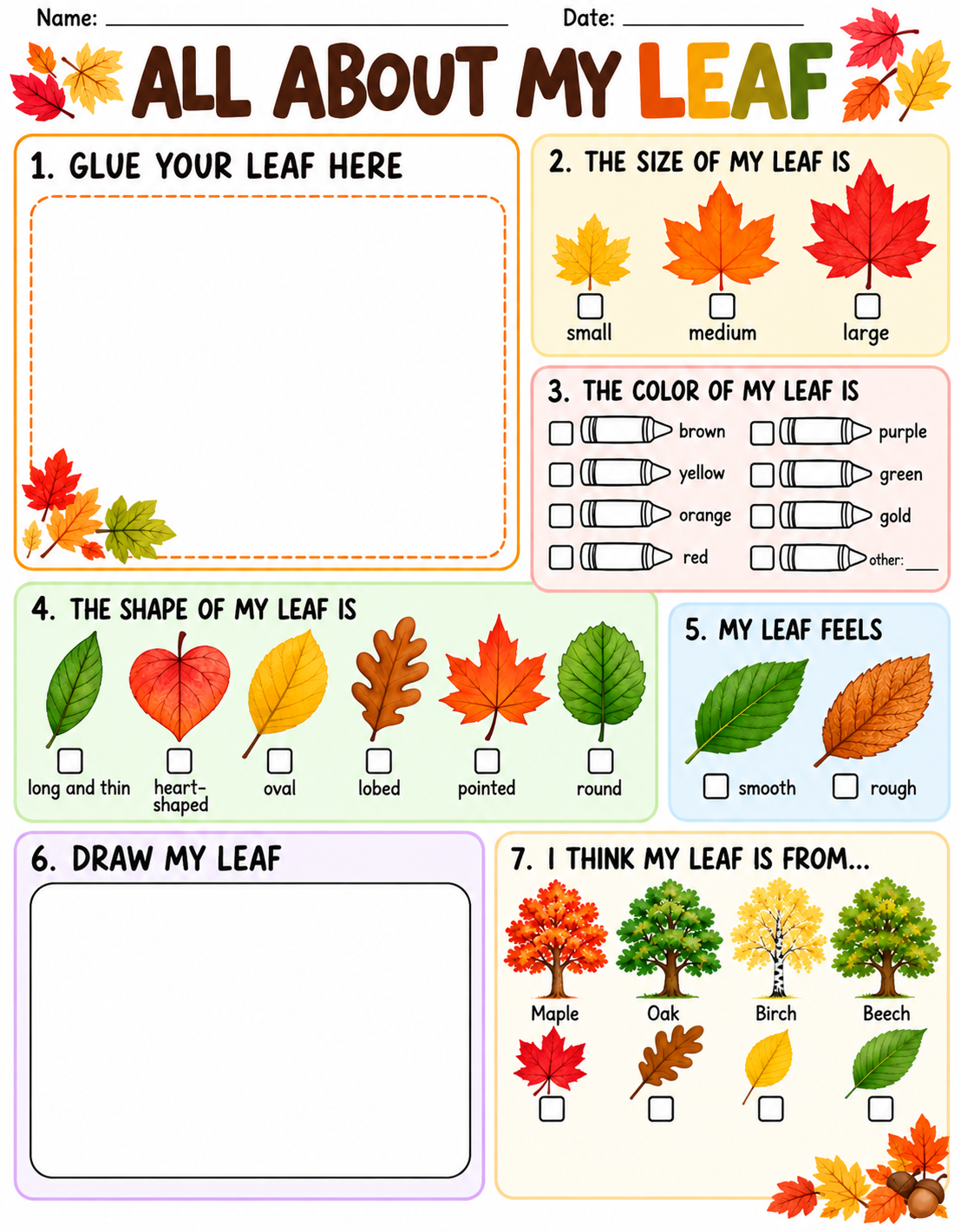
Just one leaf they want to investigate. Bring it back to class and turn your students into Leaf Detectives. The All About My Leaf worksheet helps children investigate it.
What size is my leaf?
small • medium • large
What colour is my leaf?
brown • yellow • orange • red • purple • green • gold
What shape is my leaf?
long and thin • heart-shaped • oval • lobed • pointed • round
How does my leaf feel?
smooth • rough Students can then draw their leaf and decide which tree it might have come from. Younger children might say:
My leaf is red.
A stronger learner:
My leaf is big and yellow.
An older student:
My leaf is medium-sized. It's red and yellow and it feels smooth. I found it near the playground.
🌳 Which Tree Did My Leaf Come From?
Introduce a few recognisable leaves: maple • oak • birch • beech Students compare their real leaf with the pictures. Ask: Does it look like a maple leaf? Is it similar to an oak leaf? Does it have pointed edges? Which leaf looks most similar? They don't need to know the answer with certainty. That uncertainty gives us useful language too:
I think it's an oak leaf.
I'm not sure.
It looks like a maple leaf.
👁️ Teach it with Visual English
This worksheet works especially well with: 0A Unit 4: Autumn Book 1 Unit 11: Seasons of the Year Book 4 Unit 10: Mother Nature
📥 Download the Complete FREE Autumn ESL Mini Pack
Want all three worksheets? Download them together as one printable pack.
You'll get:
🍂 My Autumn Hunt, ages 3–6 🌳 Autumn Nature Hunt, ages 6–11 🍁 All About My Leaf, ages 5–11 Use them after the appropriate Visual English lesson, then take your students outside and let them use the vocabulary for real.
Download the 3 free worksheets

Open PDF
Open PDF
Open PDF
⬇️ Download My Autumn Hunt
⬇️ Download Autumn Nature Hunt
⬇️ Download All About My Leaf
🧰 1. Make an Autumn Treasure Chest
Don't just make an autumn collection. Make it feel like a discovery. Give each child, pair or group a little box or paper bag and call it their:
🍂 AUTUMN TREASURE CHEST
During the nature hunt, children collect safe fallen treasures: leaves • acorns • chestnuts • pine cones • twigs • pebbles Back in class, open the treasure chests. Now the objects become your lesson. What did you find?
What colour is it? Is it big or small? Is it smooth or rough? How many acorns did you find? Which is your favourite treasure? Older students can choose one object and describe it:
My favourite autumn treasure is this chestnut. I found it under a big tree. It's brown, smooth and shiny.
You can even decorate the boxes and keep your autumn treasures in the classroom for future lessons.
📸 2. Go on an Autumn Photo Hunt
For older children, you don't need to bring everything back. Photograph it. Challenge students to find: 🍁 something red 🟡 something yellow 💧 something wet 🔎 something tiny 🌳 something rough ✨ something beautiful 🍂 something that has fallen 🌈 something changing colour 🌿 something still green 🍁 something that reminds you of autumn Back in class, each pair chooses three photographs. Then they present them.
We found this behind the school.
It's a yellow leaf.
It was under a big tree.
We chose it because we liked the colour.
The photograph isn't the lesson.
It's the starting point for the conversation.
👧🍁 3. Make Crazy Autumn Leaf Hair
This one is especially fun with younger children. Collect fallen autumn leaves in different: colours • shapes • sizes Give each child a simple picture of a face without hair. Now comes the fun part.
The leaves become the hair.
Children can create: 🍁 long leaf hair 🍂 short leaf hair 🍁 crazy spiky hair 🍂 a fringe 🍁 a leaf crown 🍂 huge orange and red hair Before gluing anything down, use the leaves for English. What colour is your leaf? Is it big or small? How many leaves have you got? Which colours are you using? Then glue the leaves around the face. When everyone has finished, describe the characters.
Younger learners:
Red hair!
Big hair!
Older children:
She has got long orange and yellow hair.
He has got ten leaves in his hair.
Her hair is red, brown and orange.
This is a lovely extension after Visual English 0A Unit 4: Autumn, because children are reusing the leaf, colour and size vocabulary from the lesson. And every character turns out completely different.
🎨 4. Go on an Autumn Colour Hunt
This is another easy activity for younger learners. Choose four autumn colours: 🔴 red 🟠 orange 🟡 yellow 🟤 brown Then go outside. Can you find something red?
Can you find something yellow? Can you find a brown leaf? How many orange leaves can you see? Children can point, photograph or collect safe fallen leaves. Back inside, sort the leaves by colour. You can also use them for your Autumn Treasure Chest or Leaf Hair Craft.
This works particularly well after Visual English 0A Unit 4: Autumn.
🌳 5. Make a Four Seasons Tree
This is a natural extension after Visual English Book 1 Unit 11: Seasons of the Year. Create one large tree divided into four sections: 🌸 SPRING ☀️ SUMMER 🍂 AUTUMN ❄️ WINTER Students add appropriate leaves, weather, clothes or activities to each section. Then compare:
What happens to the tree in autumn? Which season has green leaves? When does it snow? Which season is warmest? What do we wear in winter? Which season do you like best? Why? The finished tree is useful, but the real lesson happens when children talk about what they've made.
🧥 6. Dress for Autumn Weather
This is where your Visual English Weather + Clothes units work beautifully together. Give students an autumn weather forecast. For example:
🌧️ 9°C • rainy • windy
What should you wear? Or:
🌤️ 15°C • sunny • cool
What would you wear now? Students choose or draw an outfit: jumper • jacket • coat • trousers • boots • wellington boots • raincoat • scarf • hat Then describe it. For younger learners:
Jacket. Boots.
Then:
I'm wearing a jacket and boots.
Older learners can explain why:
I'm wearing boots because it's raining.
I need a jacket because it's cold.
Stronger students can give advice:
You should take an umbrella because it might rain.
You can also create a simple:
☀️ SUMMER or 🍂 AUTUMN?
clothes sorting game. Show a clothing item and students decide where it belongs. Flip-flops?
Summer! Raincoat? Autumn! Jumper?
Autumn! Then ask:
Why?
Now clothes, weather and seasons are all connected in one conversation.
🍂 One Autumn Theme, Different Ages
One of the reasons I love autumn as an ESL topic is that you can use the same real-world experience at completely different levels.
Ages 3–5
SEE → POINT → NAME
Leaf!
Ages 4–6
NAME → DESCRIBE
It's a red leaf.
Ages 6–9
DESCRIBE → COMPARE → REPORT
I found three yellow leaves.
Ages 8–11
OBSERVE → DESCRIBE → EXPLAIN
I found this leaf under a tree near our school. I think it's a maple leaf because of its shape.
You don't always need a completely different activity for every age. Sometimes you simply need to change the language around the activity.
💡 My Recommended Autumn ESL Lesson Sequence
If you want to turn these ideas into a complete autumn lesson or mini-project, this is the sequence I recommend.
1. TEACH IT 👁️
Choose the appropriate Visual English unit. Teach autumn, nature, seasons, weather or clothes depending on your students' age and level.
2. SAY IT 💬
Use the Visual English pictures, questions and activities to practise the language.
3. FIND IT 🔎
Choose one of the free Autumn Nature Hunt worksheets and go outside. Let students search, observe, collect and photograph.
4. EXPLORE IT 🍁
Choose a follow-up activity: Autumn Treasure Chest All About My Leaf Autumn Leaf Hair Autumn Colour Hunt Four Seasons Tree Autumn Clothes & Weather
5. TALK ABOUT IT 🗣️
This is the important part. Ask questions. Describe.
Compare. Count. Give opinions.
Tell the class what happened.
Visual English gives children the language. The real world gives them a reason to use it.
🍁 Don't Just Teach Autumn. Go and Find It.
Sometimes the best visual prompt isn't on the interactive whiteboard. It's lying on the ground outside your classroom. Pick up a leaf.
Find an acorn. Look at the clouds. Spot a spider web.
Jump over a puddle. Collect an autumn treasure. Make crazy leaf hair.
Decide whether you need your raincoat. Then bring those experiences back into your English lesson. Because the goal isn't for children to memorise a vocabulary list containing leaf, acorn, pine cone, mushroom, rainy and jacket.
The goal is for them to recognise those words in their own world and have enough English to shout:
Look! I found one!
And then tell us something about it.
Teach it. Find it. Talk about it.
That's an autumn English lesson children are much more likely to remember.