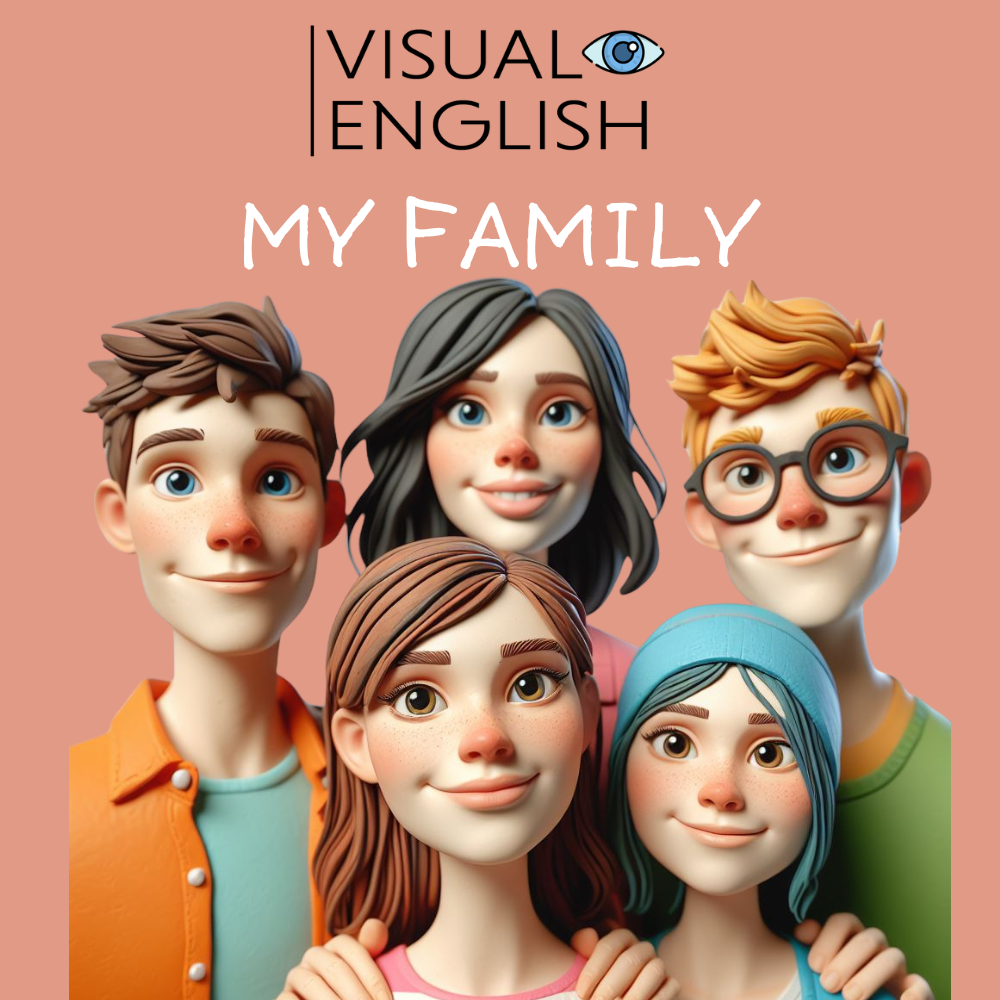
My Family
This family and appearance ESL lesson helps learners describe relatives using family words and physical adjectives. Students build a family tree, guess people from clues and practise 'Who is she?' and 'What does she look like?' They create a family mini-book and roleplay a reporter interview about three relatives.
7-day trial · Card required · €0 today · Cancel before renewal
Lesson format
2 × 45 minutes
Level
Elementary
Age group
Ages 8–11
Main focus
Speaking first
What students will learn
Lesson flow
Students guess family members from descriptions ('He is tall. He has short brown hair'), build a family tree with vocabulary like uncle, aunt and cousin, and drill 'Who is she? She is my sister.' The second lesson practises appearance adjectives (long/short hair, blue/green eyes), writes a family mini-book describing three relatives, and roleplays a reporter interview asking about family and appearance.
Target language
- • 'Who is she/he?'
- • 'What does she look like?'
- • Have/has for appearance
- • Family and appearance vocabulary
Key vocabulary
Family Members
- • grandmother
- • grandfather
- • cousin
- • nephew
- • niece
- • stepmother
- • stepfather
- • aunt
- • uncle
Describing People
- • relative
- • relationship
- • portrait
Speaking questions students answer
- • Who is in your family?
- • What does your sister look like?
- • Is your dad tall?
- • Who has short hair?
- • Who is the sister?
Interactive activities in this lesson
Cross-curricular connections
- • Personal, Social and Health Education (PSHE)
- • Citizenship
- • Art & Design
Support
- • Provide the sentence frame 'She/He is my ___' / 'She/He has ___ hair'
- • Keep family and appearance picture cards visible throughout
- • Allow students to point to a family-tree diagram while answering
Challenge
- • Describe two family members and compare their appearance
- • Describe a family member without naming them for classmates to guess
- • Ask three follow-up questions in the reporter-interview roleplay
Home challenge
Students draw or photograph two family members and write two to three sentences describing each one, then present it at the start of the next lesson.
Recommended teaching contexts
Why this lesson works
The lesson follows a clear progression: Guess family members in a Who Am I? warm-up, describe appearance using hair, eyes and height adjectives, build a family mini-book and roleplay a reporter interview. Teachers can open the materials and start immediately, while students move from supported vocabulary practice to purposeful spoken English.