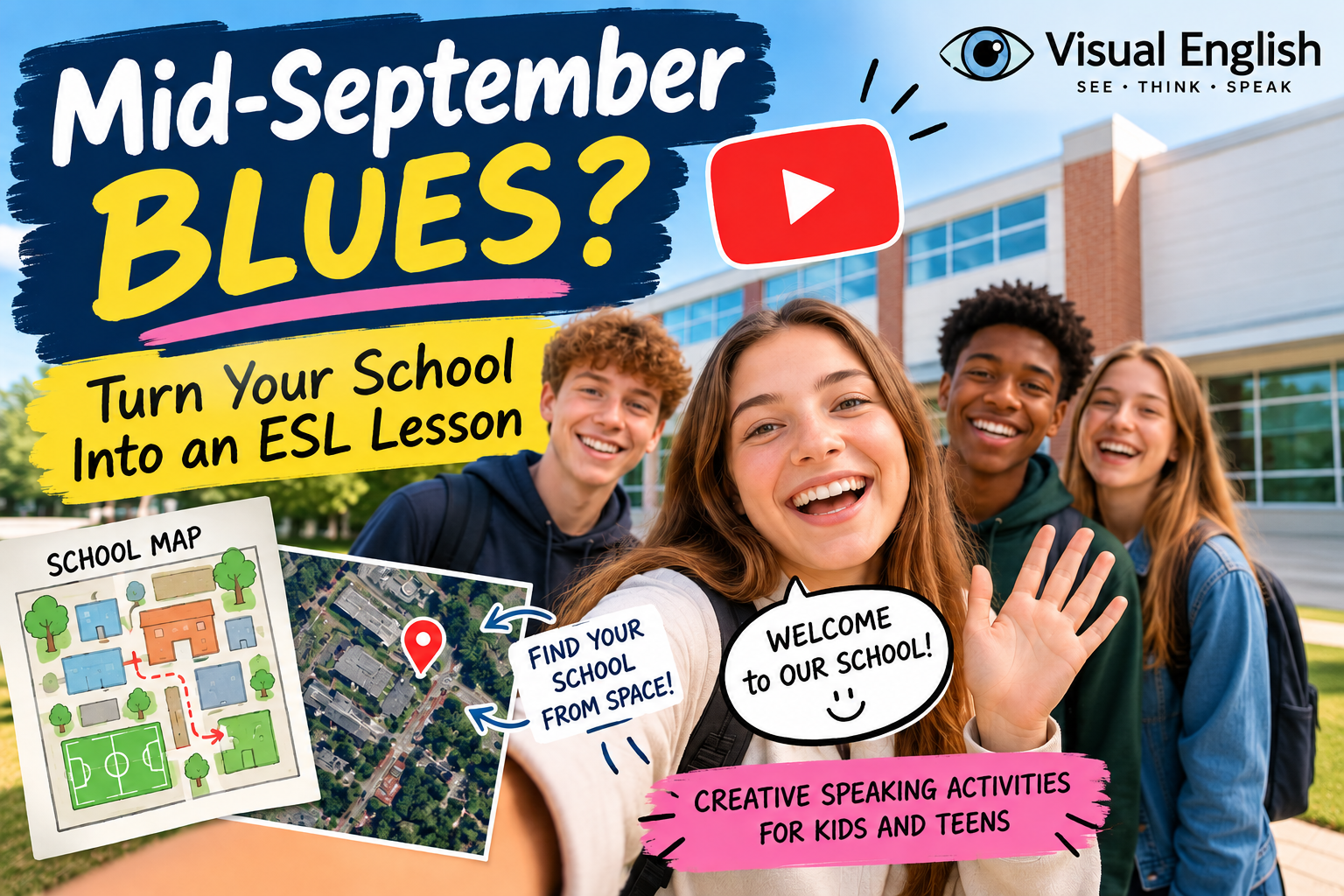
Mid-September Blues? Turn Your School Into an ESL Lesson
Table of contents(16 sections)ShowHide
Visual English school lessons + creative speaking projects for kids and teens
It's mid-September. The excitement of the first week has started to disappear. Students know where they sit, they know their timetable, they know which teacher gives the most homework, and they have already worked out exactly how many minutes it takes to get from the classroom to break time.
The brand-new pencil cases aren't quite so new anymore. And sometimes the energy in the English classroom starts disappearing too. This is usually the moment when we start searching for another game, another worksheet or a completely different topic.
But there is a huge speaking topic sitting right in front of us: the school itself. Their subjects. Their classroom. The gym. The canteen. Their teachers. School clubs. Rules. Homework. Breaks. Favourite places. And, especially with older students, everything they would immediately change if somebody put them in charge.
So instead of fighting the mid-September blues with another random worksheet, let's turn school into the lesson.
👁️ Start With Visual English: One School Theme, Three Levels
The idea behind Visual English is simple:
See it. Understand it. Talk about it.
A picture gives students something concrete to react to. Instead of learning a list of words and moving on, students can identify something, answer a question, describe it, compare it with their own life and gradually have a real conversation about it. And school is a perfect example because the topic develops across several Visual English levels.
For this September theme, we can move through three different stages: Book 3 → subjects, teachers and timetable Book 5 → the school itself and places around school Book 7 → school life, clubs, rules and opinions So choose the level that fits your students and start there.
🎒 Book 3: What Is Your Favourite Subject?
With younger learners, start with something they already talk about every day:
What's your favourite subject?
Visual English Book 3, Unit 10: What Is Your Favourite Subject? introduces school subjects including English, Polish, Art, Geography, History, IT, Maths, Music, PE, Science, Religion and Technology. But students don't simply name the subjects. The visuals lead into questions such as:
Is English easy or difficult? Is Maths interesting or boring? Do you love or hate Art? How many PE lessons do you have a week? Who is your English teacher? And then the conversation expands into their actual school day: What class are you in? Where do you go to school? What time do you start? What time do you finish? How do you go to school? Students can also work with a timetable, matching activities, videos and online school-subject games within the unit. Explore Visual English Book 3: My Favourite Subject →
Extend it
After the Visual English lesson, don't change the subject immediately. Ask students to create their real timetable in English. Then compare:
Which day is the easiest? Which day is the hardest? How many English lessons do you have? Which subject would you like to have more often? Which subject would you remove from Friday afternoon? That last question usually produces a few opinions.
🏫 Book 5: Take a Tour of the School
Once students can talk about their subjects, expand the conversation into the whole school. Visual English Book 5, Unit 1: Schools goes much further into school facilities. The unit includes the staffroom, office, gym, library, canteen, tuck shop, vending machines, after-school care, cloakroom, classroom, sports field, playground, art room, computer lab, music room, assembly hall and swimming pool.
Students don't just identify them. They answer questions about their own school: Is there a library in your school? Do you visit the library often? Is your gym big or small? What lessons do you have in the gym? Do you eat in the canteen or bring a packed lunch? Is there a playground? Do you have a computer lab? Is there a swimming pool in your school? Then the lesson moves into general school conversation: What school do you go to? What class are you in? How do you go to school? What time do you start school? What time do you finish? How long are your lessons? How long are your breaks? How many pupils are in your classroom? And there's something particularly useful for this article:
Visual English Book 5 already includes Describe Your Crazy School.
It also includes a places-in-school labelling activity, school videos and online games covering places and school subjects. Explore Visual English Book 5: Schools → This is where we can take the language out of the lesson and into the real building around us.
🎓 Book 7: School Is Cool
With older students, don't make school easier. Make it more interesting. Visual English Book 7, Unit 5: School Is Cool revisits school facilities, general school conversation and school subjects, but then expands the topic into after-school clubs and school rules.
And there are plenty of clubs to talk about. The lesson includes: Chess Club • Drama Club • First Aid Club • Travel Club • Photography Club • Volunteering Club • Dance Club • School Band • Martial Arts Club • Coding Club • Sign Language Club • Reading Club. Students can answer:
Is there a drama club in your school? Are you a member of a club? Would you like to join the photography club? Are you interested in coding? Would you like to join the school band? Which club would you choose? And then there are the school rules. The Visual English material covers situations including being late, being quiet in the library, doing homework, wearing school uniform, running in corridors, littering, raising your hand, bringing PE kit, fighting, changing shoes, shouting, using phones, sleeping in class, copying and eating in class. This gives students a meaningful context for language such as:
can / can't must / mustn't should / shouldn't have to / don't have to. And now you can start asking questions that don't necessarily have one correct answer: Should phones be allowed at school? Should students wear uniforms? Do students get too much homework? Which school rule makes sense? Which rule would you change? Should every student join a club? Which new club should your school introduce? That's where school vocabulary becomes real communication. Explore Visual English Book 7: School Is Cool →
Finished the Visual English Lesson? Don't Change the Topic Yet.
This is where the fun starts. Students already have the language. Now give them something to do with it.
Instead of opening another worksheet, use the school around you.
🎥 1. Make a YouTube School Film
Turn the class into a film crew. Tell students:
We're making a YouTube-style video called "Welcome to Our School!"
Every student gets something to present. One student introduces the school. Another presents the classroom.
Someone shows the library. Another presents the gym. Someone talks about the canteen.
Another presents the playground. Someone can introduce a school club. Another student can talk about their favourite subject.
Someone can interview a classmate. And somebody finishes the film. For younger students, provide a little structure:
"Hi! I'm ___. This is our ___. We come here to ___. I like this place because ___."
For stronger students, don't give them a complete script. Give them prompts: Where are you? What happens here? Who uses this place? When do you come here? What do you like about it? What don't you like? Tell us something interesting or funny about this place. Set one rule:
Everybody appears and everybody speaks.
Twenty or thirty seconds per student is enough. Put the clips together and you have:
🎬 WELCOME TO OUR SCHOOL! | OUR SCHOOL TOUR IN ENGLISH
You don't have to upload it publicly. It can simply be a class project, following your school's recording and privacy rules. And that's actually the important part.
Students aren't speaking because the textbook says: "Now speak for 30 seconds." They're speaking because they're creating something together.
🗺️ 2. Draw a Map of Your Real School
Forget the imaginary school map. Ask students to draw their actual school. Depending on the building, they might add:
classroom • library • gym • canteen • playground • computer lab • art room • music room • office • staffroom • toilets • entrance • stairs • corridors • sports field Now turn the map into a speaking activity. Where is the gym? What's next to the library? What's opposite your classroom? What's upstairs? What's downstairs? How do I get from the entrance to the computer room? What's your favourite place in school? Pairs can exchange maps. Student A asks:
"Excuse me, where is the library?"
Student B gives directions:
"Go straight, turn left and it's next to…"
One drawing can now practise school vocabulary, there is/there are, prepositions of place and directions.
🛰️ 3. Find Your School From Space
Now look at the same school completely differently. Open a satellite map and zoom out. Ask:
Can you find our school?
Don't point to it immediately. Let students recognise the building. Then explore.
Where is the main entrance? Can you see the playground? Where is the sports field? What's behind the school? What's opposite it? Which road goes past it? What buildings are nearby? Where do students usually enter? How do you get to school? Then zoom out. Can students find the town centre? A park?
A supermarket? The railway station? Their neighbourhood?
The school lesson has naturally expanded into places, prepositions, directions, transport and the local area.
🤪 4. My Crazy School
Visual English Book 5 already includes Describe Your Crazy School, so take the idea further and turn it into a project. Tell students:
You have unlimited money. Build the craziest school in the world.
Anything is possible. A swimming pool on the roof. Slides instead of stairs.
A cinema. A gaming room. A pet room.
Pizza every Friday. School starts at 11:00. Lessons last 20 minutes.
Breaks last an hour. Students bring their dogs. The headteacher is a robot.
Maths takes place on a roller coaster. Students draw and label the school. Then present it:
"Our school has…"
"There is a…"
"On the first floor…"
"Next to the swimming pool…"
"Students can…"
"Students don't have to…"
For stronger groups, add a challenge:
Sell us your school.
Each group has two minutes to persuade everyone else that theirs is the best. Then vote.
Which crazy school would you actually attend?
🎲 5. Roll to Speak: School Edition
Sometimes you don't need a big project. You just need a question. Put six prompts on the board:
1 🎒 What is your favourite subject? 2 🏫 What is your favourite place at school? 3 😤 Which school rule would you change? 4 🎭 Which school club would you join? 5 💡 What does your school need? 6 🤪 What would you put in your crazy school? Students roll and answer. But don't let the conversation finish there. Add one rule:
Someone must ask a follow-up question.
Student A:
"I'd join the photography club."
Student B:
"Why?"
Student A:
"Because I like taking photos."
Student C:
"What do you usually photograph?"
Now the roll doesn't produce a one-sentence answer. It starts a conversation. Play Visual English Roll to Speak →
🎭 6. Create a New School Club
This is a natural extension of Book 7, where students already encounter a wide range of after-school clubs. Tell students:
Your school has enough money for ONE new club.
What should it be? Maybe: Gaming Club Drama Club Cooking Club Photography Club Football Club Coding Club Film Club Music Club Book Club Eco Club Or something completely different. Groups decide:
What's the club called? What will you do? Where will you meet? When will you meet? Who can join? What equipment do you need? What are the rules? Then they create a quick poster and pitch the idea:
"Our club is called…"
"We meet every…"
"In our club you can…"
"You should join because…"
But remember:
The school can choose only ONE.
Everyone votes.
🎤 7. Become a School Reporter
Turn the class into a newsroom. The mission:
Find out what students REALLY think about your school.
Students interview classmates. Try: What's the best thing about our school? What's the worst thing? What's your favourite subject? What's the best place in school? Which school rule would you change? Should students have homework? Should phones be allowed? What new club should the school introduce? Then report the results.
"Most students think…"
"Seven students chose…"
"Only two students said…"
"Nobody wanted…"
"The most popular answer was…"
Older students could combine this with the YouTube project and produce:
🎤 WHAT STUDENTS REALLY THINK ABOUT OUR SCHOOL
Again, it doesn't have to be published. The goal is to give students a reason to use English.
📸 8. School Photo Challenge
If your school's rules allow students to move around and take photographs, send pairs on a short mission. Find: something red something beginning with B something used in English lessons somewhere students exercise somewhere people eat somewhere quiet something old something new your favourite place the strangest thing you can find Back in class, students present their photographs.
"We chose this because…"
"We found this in…"
"People use it for…"
"This is our favourite because…"
Again, the photograph isn't the lesson.
It's the starting point for the conversation.
🏆 9. The Best Place in Our School
Create a tournament. Library vs gym. Students choose. But they have to defend the choice.
Next: Playground vs classroom. Then: Canteen vs computer room. Continue until only two places remain. Now students have to persuade the class.
"The gym is better because…"
"I disagree. The library is quieter…"
"The playground is more fun…"
"The canteen is the best because…"
Finally crown:
🏆 THE BEST PLACE IN OUR SCHOOL
It's a simple way to practise comparatives, superlatives, opinions, agreeing and disagreeing.
👩🏫 10. If I Were the Headteacher...
Finish by giving students control. Ask:
If you were the headteacher for one day, what would you change?
Longer breaks? No homework? Later mornings?
Different lunches? More PE? More clubs?
No tests? Phones allowed? A gaming room?
A school dog? For younger students:
"I would add…"
"I would change…"
"I would stop…"
"Students could…"
For teens, make it harder.
You can change only THREE things.
Now they have to agree. And that's when you start hearing: I agree because… I don't agree. I think we should… That's a good idea, but… In my opinion… The problem with that is… At that point, you're no longer teaching a vocabulary list called School. You're having a conversation about school.
👁️ One Topic, Three Levels, So Many Lessons
This is why I like the school topic for the mid-September slump. You don't need ten unrelated worksheets. Visual English already gives you a progression:
🎒 Book 3
Subjects → teachers → timetable → my school day Explore Book 3: My Favourite Subject
🏫 Book 5
School facilities → my real school → school conversation → Crazy School Explore Book 5: Schools
🎓 Book 7
School facilities → subjects → clubs → rules → opinions Explore Book 7: School Is Cool Then take the language away from the screen. Make a film. Draw the school. Find it from space. Build a crazy school. Roll and speak. Invent a club. Interview students. Debate the rules.
The topic stays the same. The language keeps growing. Browse all Visual English ESL lesson topics
Mid-September Blues?
Maybe you don't need another completely new topic. Sometimes you just need to look at the topic differently. Your students are already sitting inside one of the best visual prompts you have:
their school.
Use it. And keep them talking.