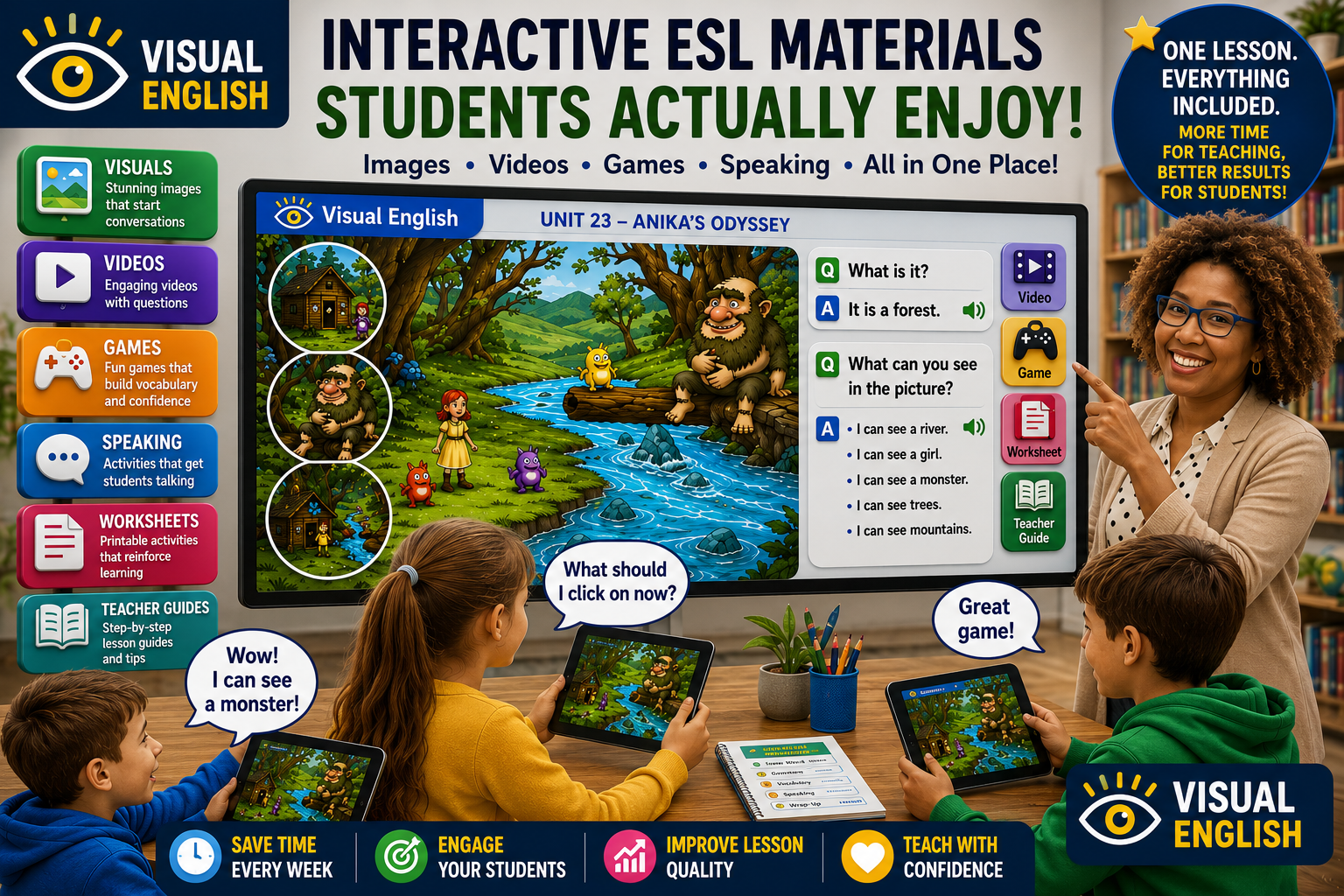
Interactive ESL Materials Students Actually Enjoy
Table of contents(8 sections)ShowHide
Interactive materials are not simply colourful worksheets or a quiz on a screen. They give students a reason to look, choose, predict, explain or speak. That purpose changes the classroom dynamic. Students are not waiting for the teacher to reveal the answer; they are using English to complete something.
What Counts as Interactive?
An activity is interactive when students must do more than recognise a correct answer. They might:
- Ask a partner for missing information
- Choose what happens next in a story
- Describe an image their partner cannot see
- Sort, match or remember vocabulary
- Defend an opinion or solve a problem
- Create a short story, plan or dialogue
The interaction can be physical, spoken, visual or digital. The important part is that students produce language.
Five Activities That Work in Any Classroom
1. Picture questions
Display an image and ask “What can you see?”, “What is happening?” and “What might happen next?” Follow one-word answers with “Why?” or “Tell me more.” A single picture can support vocabulary, grammar and extended speaking.
2. Information gap
Give partners different versions of a picture, timetable or shopping list. They must ask questions and listen carefully to complete the missing information. Students need the language, so the speaking has a genuine purpose.
3. Guessing and describing
One student describes a person, object or place without naming it. Their partner guesses. Add a rule such as “Use three adjectives” or “Ask one follow-up question” to make the language more demanding.
4. Role-play with a problem
Give students a situation—buying a present, planning a trip or solving a classroom problem—and assign roles. A problem is better than a script because students must react to what their partner says.
5. Choice-based video or game
Pause at a decision point. Students vote, explain their choice and predict the result before you continue. The game is the context; the speaking and reasoning are the learning.
A 45-Minute Interactive Lesson
Here is a repeatable structure for almost any topic:
- 5 minutes — Notice: show two or three visuals and elicit what students already know.
- 8 minutes — Model: teach the target words or sentence pattern with the images.
- 10 minutes — Practise: use a matching, memory or sorting game.
- 12 minutes — Communicate: run an information gap, survey or role-play.
- 7 minutes — Challenge: ask students to solve a problem, tell a story or justify a choice.
- 3 minutes — Review: students say one new sentence or explain one decision.
This keeps the pace moving while giving students several chances to reuse the same language.
How Visual English Supports This Flow
Visual English is designed around visual prompts and speaking from the start. Its 10 books and 178 units give teachers a clear progression instead of a collection of disconnected activities. Within a unit, teachers can combine:
- Slides with custom visuals and questions
- Vocabulary and pronunciation practice
- Teacher guides with suggested lesson flow
- Interactive games and Vocabulary Hub activities
- Unit videos for listening and discussion
- Printable materials and homework tools
For example, a teacher can open Book 2’s “Let’s Go Shopping” lesson, model the shopping language with visuals, practise prices in a game and finish with a buyer–shopkeeper role-play. The same structure works with Book 1’s “My Family” lesson: show the family visual, practise the vocabulary, then ask students to describe and compare families.
Keep the Interaction, Not Just the Technology
An interactive whiteboard does not automatically create interaction. A digital worksheet can still be passive if students only click answers. Use technology to increase communication:
- Pause and ask students to predict.
- Hide an image and make students describe it.
- Let pairs compare answers before revealing the solution.
- Ask students to explain why an answer is correct.
- Turn a quiz result into a follow-up question.
The screen is a prompt. The teacher–student and student–student conversation is the lesson.
Adapt for Age and Level
Younger beginners may point, choose, repeat and answer short questions. Older or stronger learners can justify opinions, negotiate a decision, retell a story or create their own questions. Keep the visual context constant and change the language demand. This makes differentiation easier without preparing a completely separate lesson.
Check Whether Students Are Really Participating
After class, ask:
- Did most students speak, or only the quickest few?
- Did the activity require the target language?
- Could students explain a choice?
- Did partners listen to one another?
- What language should be recycled next lesson?
Enjoyment matters, but participation and purposeful language use are the stronger measures.
Conclusion
Students enjoy interactive materials when the activity gives them something worth communicating. Visual prompts create curiosity, games provide purposeful repetition, and information gaps and role-plays make speaking necessary. Visual English connects these pieces in ready-made units, so teachers can spend less time assembling materials and more time responding to the students in front of them.
Explore all Visual English lesson topics → See plans and access options →
Frequently asked questions
What makes an ESL activity interactive?
Students must do something purposeful with English: ask for information, make a choice, solve a problem, describe an image or respond to a partner.
Which interactive activity should I try first?
Start with picture questions or an information gap. They need very little equipment and give every student a reason to speak.
Do interactive activities work online?
Yes. Shared visuals, breakout-room information gaps, polls, chat predictions and choice-based videos can all create online interaction.
How does Visual English support interactive lessons?
Its 10 books and 178 units connect visual slides, speaking prompts, guides, games, videos, Vocabulary Hub practice, printables and homework tools.
How do I adapt an activity for different levels?
Keep the same visual context but change the language demand: pointing and short answers for beginners, then descriptions, reasons, negotiation or storytelling for stronger learners.