How to Teach Emotions and Feelings Vocabulary in ESL (2026)
Table of contents(7 sections)ShowHide
Every student already has feelings -- what they often lack is the English words for them. Emotions vocabulary closes that gap, and because it's tied to real, current experience, it tends to produce more genuine, less scripted speaking than almost any other topic.
Why Emotions Works So Well
Unlike vocabulary for objects or places, emotions are something students are actively experiencing during the lesson itself. Asking "How are you feeling right now?" gets a real, in-the-moment answer -- not a rehearsed one.
Core Vocabulary
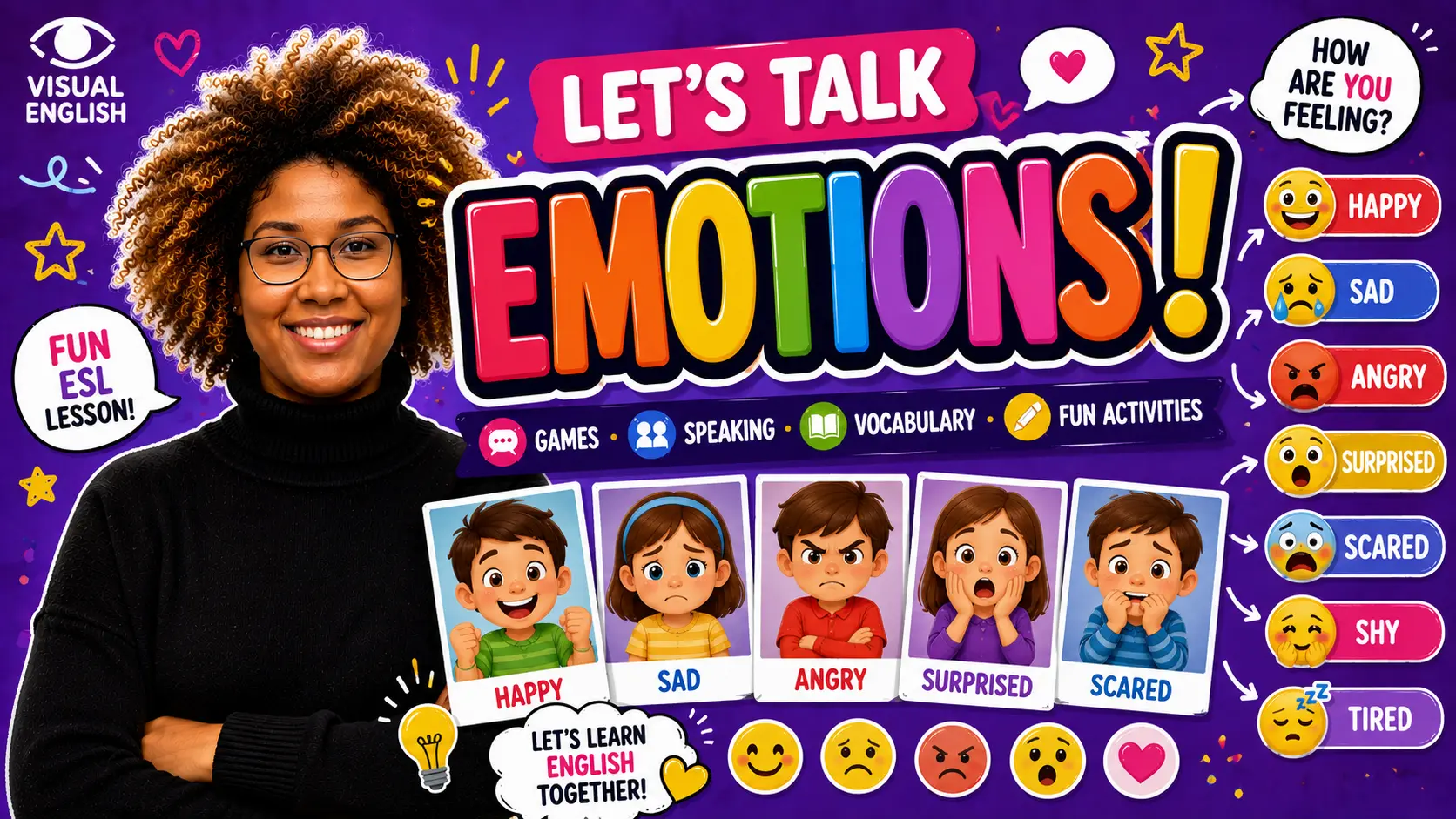
Start with the essentials: happy, sad, angry, tired, hungry, scared, excited. These cover the vast majority of everyday classroom situations. Add more nuanced words (bored, nervous, proud, embarrassed) once the basics are automatic.
The Grammar That Pairs Naturally
"How are you?" / "I'm happy" is the entry point, extending naturally into "Why are you sad?" / "I'm sad because..." -- an excellent, low-pressure way to introduce because clauses.
Speaking Activities That Work
1. Emotion check-in. Start every lesson with a quick round: "How do you feel today?" Builds routine and gives constant low-stakes practice. 2. Face match. Show emotion faces (drawn or photographed), students name the feeling -- simple, visual, works at any level.
3. Why are you...? Pair students to ask and answer "why" for a given emotion, practising cause-and-effect language. 4. Emotion charades. One student acts out a feeling without speaking; classmates guess and name it.
Common Mistakes to Watch For
- Confusing "bored" and "boring" (a very common -ed/-ing adjective mix-up across many emotion words)
- Overusing "sad" or "happy" as defaults when a more specific word exists (worth gently expanding vocabulary once basics are solid)
- Mixing up "feel" and "feel like" ("I feel tired" vs "I feel like sleeping")
Ready-Made Emotions Lessons
Visual English weaves emotions throughout the early curriculum:
- Happy Sad Robot -- Book 0B, first emotion introductions
- How Are You? -- Book 1, feelings and social phrases
- Make A Face -- Book 0C, expressions and feelings
See the full set on the Emotions topic page.
Conclusion
Emotions vocabulary turns something every student is already experiencing into a speaking opportunity. Build routine check-ins around it, and it becomes one of the lowest-prep, highest-authenticity topics in your rotation.
Frequently asked questions
Is this topic appropriate for very young learners?
Yes -- in fact it's often taught earlier than most vocabulary topics, since feelings are something even the youngest students already understand conceptually.
How do I handle sensitive emotions (scared, angry) in class?
Keep it light and normalised -- frame it as useful vocabulary for everyday situations rather than a deep discussion, especially at lower levels.
Does this topic support social-emotional learning goals too?
Yes, and many schools value that overlap -- giving students the words for their feelings has value well beyond language acquisition.