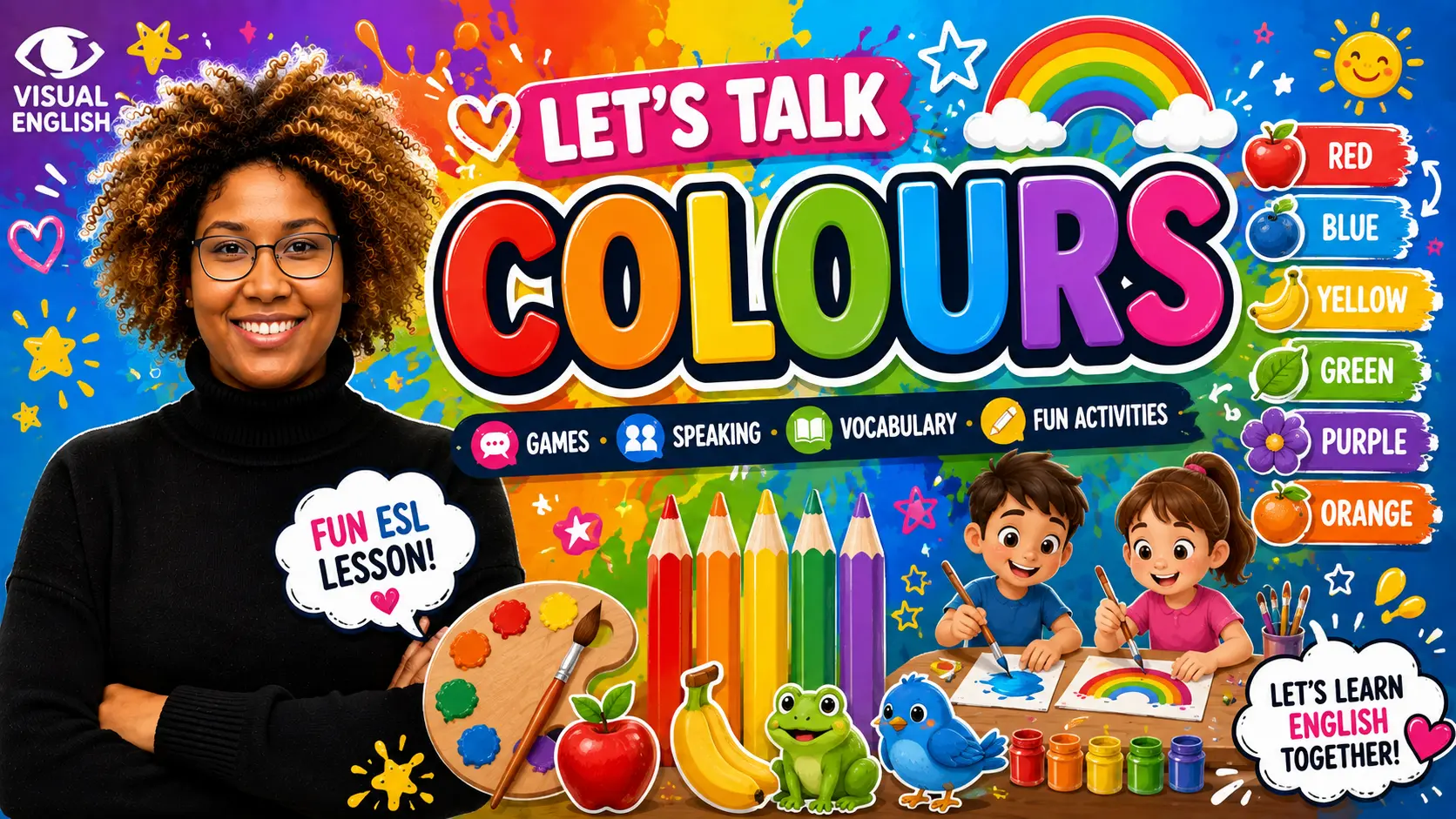
How to Teach Colours to Young ESL Learners (2026)
Table of contents(7 sections)ShowHide
Colours are often the first substantial vocabulary set a young learner meets in English. How they are taught can set the tone for everything that follows. Done well, colours become more than a memorised list—they become the first building blocks for useful sentences.
Why Colours Work So Well
Every object in the classroom has a colour, so teachers have an endless supply of free practice material. Colours also combine naturally with animals, clothes, food, toys and school objects, making them one of the most reusable vocabulary sets in the curriculum. The key is to move quickly from naming to communicating:
- Red.
- It's red.
- It's a red pencil.
- My pencil is red.
- What's your favourite colour?
Core Colour Vocabulary
Begin with four to six clearly different colours. Add more only when students can recognise and use the first set confidently. A practical progression is:
- First set: red, blue, yellow and green
- Second set: orange, purple, pink and brown
- Later additions: black, white and grey
Leave shades such as navy, turquoise and beige until the common colours are automatic.
The Grammar That Pairs Naturally
Start with the question-and-answer pattern: What colour is it? — It's red. Then combine colours with nouns:
- a red car
- a blue ball
- a yellow pencil
This is often a child's first experience of combining two words into a meaningful English phrase. Once that pattern is secure, introduce preferences with What's your favourite colour? and descriptions with My school bag is blue.
Four Speaking Activities That Work
1. I Spy
Say I spy something red. Students scan the room and guess using complete sentences: Is it the red book? or I think it's the pencil case.
2. Colour Hunt
Call out a colour and ask students to find, touch or point to something that colour. Follow with What is it? so the activity practises both colours and object vocabulary.
3. Rainbow Build
Students name colours in sequence while drawing, arranging cards or building a rainbow. Pause to ask What colour comes next? and Which colour is missing?
4. What Colour Is My...?
Point to classroom objects, clothes or toys and ask for their colours. Let students take over and ask the questions themselves.
Common Mistakes to Watch For
- Students answer with one word when they can produce It's blue.
- Similar words such as green/grey or pink/purple may be confused.
- Students may place the adjective after the noun: a car red instead of a red car.
- Too many colours are introduced before the first set is secure.
Model the correct phrase naturally and keep the conversation moving.
Ready-Made Visual English Colour Lessons
Visual English introduces and revisits colour language across several levels:
- I See Blue — Book 0A: a simple single-colour introduction
- I See Pink — Book 0A: recognition, repetition and early speaking
- My Favourite Colours — Book 0B: colour preferences for young learners
- What Is Your Favourite Colour? — Book 1: complete questions, answers and personal conversation
You can also browse all colour lessons to choose the right level for your students.
Conclusion
Colours are a small vocabulary set with enormous teaching value. They can be reused in almost every later topic, from animals and clothes to classroom objects and food. Teach a manageable set, combine colours with real nouns and encourage students to answer in complete phrases. The language will keep returning throughout the curriculum.
Frequently asked questions
What's the ideal age to start colours?
As early as English instruction begins -- it requires no prior vocabulary and gives an immediate sense of achievement.
How many colours should a first lesson cover?
Four to six is plenty. More than that and retention drops sharply for very young learners.
How do I keep colours interesting across a full curriculum?
Combine it with other topics rather than teaching it in isolation more than once -- "colour + object" phrases stay fresh far longer than a standalone colours unit repeated.