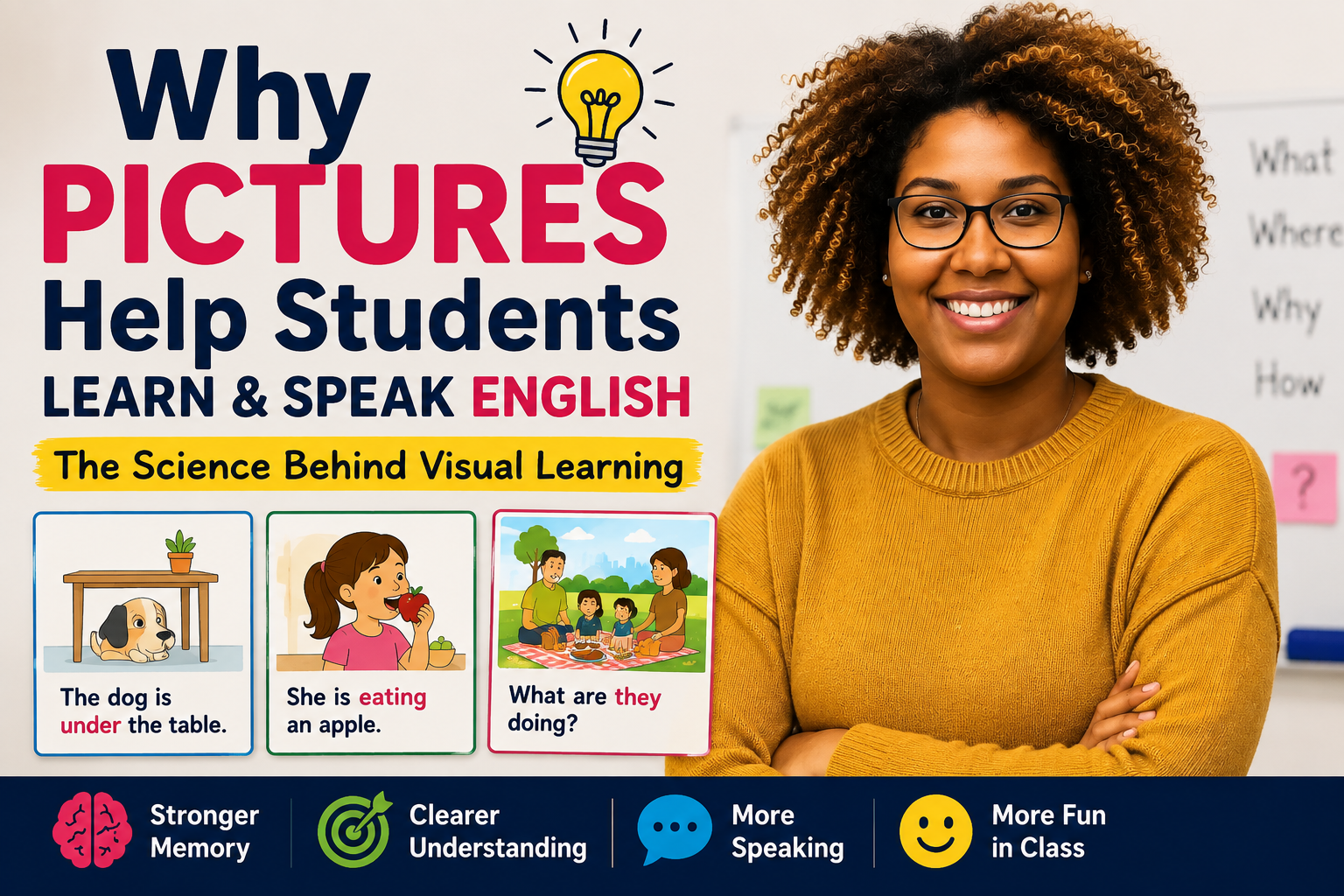
Why Visual Learning Helps Students Remember and Speak English
Table of contents(13 sections)ShowHide
Why Visual Learning Works So Well in English Lessons
Imagine teaching a beginner the sentence: "The rabbit is under the table." If the learner does not yet know rabbit, under, or table, they may be trying to understand three unfamiliar pieces of language at the same time. Now show them a picture. Suddenly, much of the meaning becomes visible. The student can see the rabbit. They can see the table. They can see the relationship between the two objects.
Cambridge English has highlighted how visuals can make language less abstract and easier to understand and remember. When words and images are used together, learners receive information through both verbal and visual channels, giving them more than one route to understanding. Teachers College, Columbia University, also discusses the value of images as accessible entry points into learning. Visuals can encourage students to observe, make connections, ask questions, recall previous knowledge and participate more actively.
For English learners this can be especially valuable, because students do not always have enough language to understand a long verbal explanation. Sometimes they need to see the meaning before they can say it.
Pictures Give New Language Meaning
One of the most obvious uses of visuals in ESL is vocabulary. A traditional vocabulary lesson might look like this:
rabbit = lapin / królik
Students translate the word and perhaps repeat it several times. A visual lesson can go much further. Show a picture of a rabbit and ask:
- What is it?
- Is it a rabbit?
- What colour is it?
- Is it big or small?
- Has it got long ears?
- Can it jump?
- Where is it?
- Do you like rabbits?
- Would you like a rabbit as a pet?
Now one image has created an entire conversation. The picture is not simply helping students remember the word rabbit. It is giving them a reason to use English.
This is particularly important in young learner classrooms, where students may understand far more through visual context than through lengthy explanations.
Words and Images Can Strengthen Memory
One reason visuals can support learning is often explained through dual coding. The basic idea is simple: when learners encounter information through both words and relevant images, they are not relying on language alone. They have the word and the visual representation, and these two forms of information can support one another.
If a student later forgets the word, the image may help trigger the memory. If they remember the image of a dog hiding underneath a chair, that visual memory may help them retrieve the phrase: "The dog is under the chair." This does not mean that every slide should be covered in pictures. Visuals are most useful when they support the learning objective rather than distract from it. The goal is not decoration. The goal is meaning.
Visuals Make Abstract English More Concrete
Some language is difficult to explain with definitions alone. Consider prepositions such as behind, between, under, opposite and next to. A teacher could spend several minutes explaining what behind means. Or the teacher can show a dog clearly positioned behind a chair, then ask: Where is the dog?: "The dog is behind the chair."
Visuals are particularly useful for teaching:
- prepositions
- actions
- emotions
- comparisons
- directions
- sequencing
- descriptions
- grammar situations
- cause and effect
Cambridge English even gives examples of using visual ideas to explain more complex grammar, showing that pictures are not only useful for beginner vocabulary.
Images Create Natural Speaking Opportunities
A vocabulary list usually produces limited language. An interesting picture can produce dozens of questions. Imagine a picture of a family having a picnic in a park. You could ask:
- Where are they?
- Who can you see?
- What are they eating?
- What is the boy doing?
- Is the weather nice?
- How does the girl feel?
- What can you see behind the family?
- What happened before this picture?
- What do you think will happen next?
- Do you like picnics?
- Where do you go with your family?
- What would you take to a picnic?
One image can support vocabulary, grammar, speaking, prediction, storytelling and personal conversation. Teachers College describes a similar approach through visual inquiry, including the See, Think, Wonder routine:
- See: What do you notice?
- Think: What do you think is happening?
- Wonder: What questions do you have?
For English learners this type of visual questioning adapts very naturally: What can you see? → What do you think? → Why? → What will happen next?
Pictures become conversation starters rather than passive illustrations.
The Picture Is Not the Lesson
A beautiful image does not automatically create effective learning. The real value comes from what students are asked to do with the image. Teachers College makes this point clearly: images alone are not the magic. The structure around the visual: prompts, questions and expectations: determines how deeply students interact with it.
A teacher can show an image and say "This is a supermarket." The student repeats "Supermarket." That is useful vocabulary practice. But the same image can produce much more:
- Where are they?
- What can you buy here?
- Do you go to the supermarket?
- Who do you go with?
- What do you usually buy?
- Where is the shopping cart?
- What is the woman holding?
- Is the shop busy?
- What would you buy with €10?
The picture creates the context. The teacher creates the communication.
From Seeing to Speaking
A useful way to think about visual language teaching is:
- See: students first observe the image.
- Understand: the visual gives context to unfamiliar language.
- Answer: the teacher asks structured questions.
- Speak: students produce English responses.
- Repeat: the same vocabulary and structures appear again in different visual situations.
- Use: students begin using the language more independently.
Simply recognising a picture of a dog is not the final objective. We want students to move toward language such as: It is a dog. → The dog is brown. → The dog is running. → The dog is running in the park. → I have a dog at home. → My dog loves running in the park because…
The image helps students enter the language at their current level and then gradually build more complex communication.
Why Visual Learning Is Especially Powerful for Children
Young learners often have limited English, but they have plenty of ideas. A child may understand what is happening but not yet have enough English to explain it. Visual prompts help bridge that gap.
Show a picture of a child eating an apple:
- Early level: Is he eating?: "Yes."
- Later: What is he eating?: "He is eating an apple."
- Later: Does he like apples?: "Yes, he does."
- Later: What do you usually eat for breakfast?: "I usually eat cereal and fruit."
The same visual concept can support increasingly sophisticated language. Pictures grow with the learner.
Visuals Can Teach Much More Than Vocabulary
Visual learning is sometimes mistakenly associated only with flashcards. But images can support almost every area of language learning. Vocabulary: students connect words with objects, actions, people and situations: dog, supermarket, tired, running, airport.
Grammar: visual situations make grammar easier to understand. A boy running now: What is he doing?: "He is running." A boy who runs every morning: What does he do every morning?: "He runs." The visual context helps students understand why different structures are used. Prepositions: pictures clearly demonstrate on, under, behind, next to, between, opposite.
Storytelling: sequence several pictures and ask: What happened first? What happened next? Then what happened? How did the story end?
Pronunciation: visual elements make pronunciation more noticeable through colour, larger letters, syllable divisions, arrows, underlining, symbols and stress marks. Cambridge English discusses similar techniques for making word and sentence stress more visible. Critical thinking: ask: Why do you think this happened? What could happen next? What would you do? Which option is better? How are these pictures different? What problem can you see? Students are now using English to think, not simply repeat.
How Teachers Can Use Images More Effectively
The visual does not need to be complicated. You can use photographs, illustrations, flashcards, icons, diagrams, maps, drawings, screenshots, emojis or simple stick figures. Even a quick whiteboard drawing can be enough.
Visual aids should be intentional: images that serve no learning purpose may distract rather than support learners. A useful rule is that every image should give students something to notice, understand, remember or talk about.
Ask Better Questions
The quality of the questions matters just as much as the quality of the picture.
- Start simple: What is it? Who is this? What colour is it? Where is it?
- Then expand: What is happening? How does she feel? Why? What do you think? What happened before? What will happen next?
- Finally, personalise: What about you? Do you like this? Have you ever done this? What would you do? Which one would you choose?
This moves the learner from identification to communication.
Reuse Visuals
Students may first see an image while learning vocabulary. Later, the same picture can be reused for grammar, speaking, revision, storytelling, writing and memory retrieval. Returning to visuals during a unit reinforces learning and encourages students to reflect on what they now understand.
Repetition is essential in language learning: but repetition does not have to mean asking the same question ten times. The same image can generate increasingly sophisticated language.
How Visual English Uses Visual Learning
Visual English was built around this principle. Pictures should not simply decorate an English lesson. They should drive the lesson.
Across the Visual English curriculum, teachers use visual prompts to introduce vocabulary, ask questions, practise grammar, develop speaking and encourage students to express their own ideas. The platform includes:
- 10 structured books
- 178 ready-made units
- 20,000+ custom illustrations
- guided speaking questions
- interactive lessons, games and videos
- printable worksheets
- Teacher Guides
- structured progression across levels
Example: Teaching Pets
A traditional lesson might teach dog, cat, rabbit, hamster, fish, then a matching exercise. With a visual speaking approach, those same words become conversations. Show a rabbit and ask: What is it? What colour is it? Has it got long ears? Can it jump? What does it eat? Do you have a pet? What pet do you have?
The vocabulary becomes useful because students immediately connect it with questions, sentences and their own experiences.
Example: Teaching Places
Show a town map and ask: Where is the hospital? What is next to the school? Is the bank opposite the supermarket? How do I get to the train station? Turn left or right? What places are near your house?
Students are no longer memorising isolated prepositions. They are using them to navigate a visual world.
Example: Teaching Emotions
Show a child with a clearly visible facial expression and ask: How does she feel? Is she happy? Why is she sad? What happened? When do you feel like this? What makes you happy?
An image makes an abstract emotion immediately understandable and opens the door to personal conversation.
Visual Learning and Real Communication
The purpose of an English lesson is not for students to identify pictures correctly. The goal is communication. Visuals provide a shared context between teacher and learner: both people can see the same thing. That means the teacher can ask questions without translating every word.
Students can infer meaning. They can make predictions, describe, compare, disagree, tell stories and connect the picture with their own lives. And eventually, they can begin speaking without needing the picture at all.
Conclusion
Pictures can make English clearer, more concrete and easier to talk about. But the real power of visual learning does not come from putting colourful images on a slide. It comes from what happens next.
A teacher asks: What can you see? Then: What is happening? Then: Why? Then: What about you? Gradually, the learner moves from recognising English to actually using it. That is the principle behind Visual English. The goal of visual teaching is not simply to help students see English: it is to give them something meaningful to talk about.
Explore Visual English
Discover ready-made visual ESL lessons designed to get students speaking from the very first lesson: visualenglish.pl.
Further Reading
This article was informed by educational material and discussions on visual learning from Cambridge English, Teachers College Columbia University, Twinkl, and the European Investment Bank's coverage of Aprendices Visuales.
Frequently asked questions
Are pictures only useful for young learners?
No. Visuals can support learners at almost every level. Beginners may use pictures to understand basic vocabulary, while intermediate and advanced students can use photographs, diagrams, maps and visual prompts for discussions, grammar, storytelling, debate and critical thinking.
Should teachers translate vocabulary as well?
Translation can sometimes be useful, but a clear visual may allow students to understand meaning without immediately relying on their first language. This can encourage learners to connect English directly with concepts and situations.
Are flashcards enough?
Flashcards are useful, but visual teaching can go much further. An image becomes much more powerful when students are asked to describe, compare, predict, explain or connect it with their own experiences.
Can visuals help students remember vocabulary?
Relevant images can provide additional memory cues when paired with language. Using words and visuals together can support stronger connections than relying on isolated text alone.
Do students have to be visual learners?
No. The idea that every learner belongs to one fixed learning-style category is too simplistic. Visuals can support many learners because they provide additional context and representation alongside spoken and written language.
Can pictures improve speaking?
Yes, when they are combined with effective questioning. A rich picture can generate vocabulary practice, descriptions, opinions, predictions, storytelling and personal conversation.