What Is the Direct Method? How Visual English Teaches Kids to Think in English
Table of contents(11 sections)ShowHide
Introduction
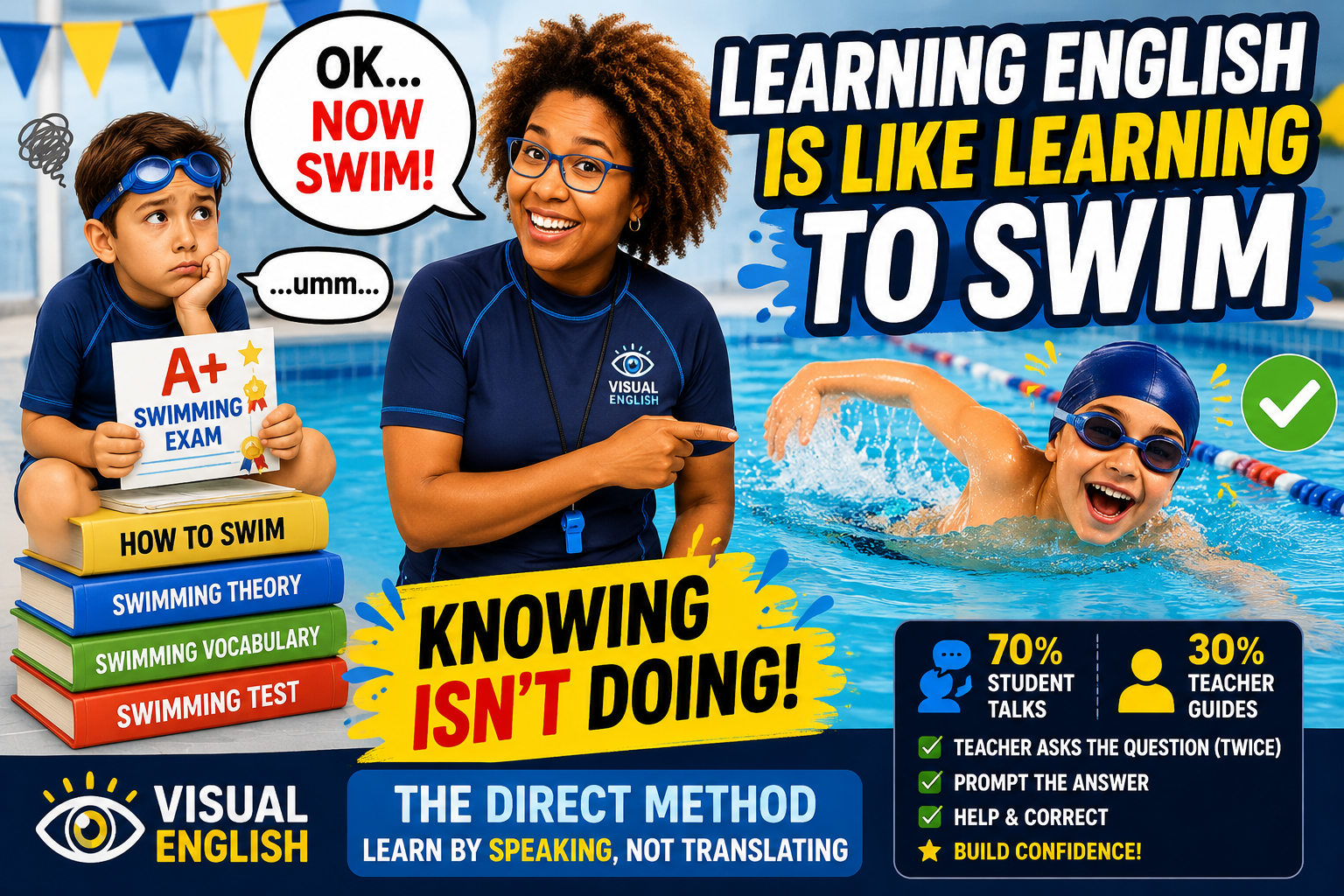
Imagine signing your child up for swimming lessons. For six months, the instructor never lets them enter the water. Instead, they study:
- Swimming vocabulary
- Swimming theory
- Swimming techniques
- Swimming diagrams
- Swimming worksheets
At the end of the course, they pass every test. Then the instructor points to the pool and says: "OK... now swim."
Most children would panic. Why? Because knowing about swimming is not the same as swimming.
The same thing happens in many English classrooms. Students learn English for years. They memorize vocabulary. They complete grammar exercises. They pass tests. Yet when someone asks a simple question, they struggle to answer.
The problem is simple: they learned about English. They didn't spend enough time using English.
What Is the Direct Method?
The Direct Method is a language teaching approach based on a simple idea: students learn English by using English. Instead of translating words into the student's native language, teachers create situations where students understand English directly. Teachers use:
- Pictures
- Objects
- Actions
- Questions
- Demonstrations
- Conversation
Rather than saying "Dog = Pies", the teacher shows a picture and asks: "What is it?" — Student: "It is a dog." The meaning comes from the image, not from translation.
Why Many Students Get Stuck
Many traditional lessons look like this:
English → Translation → Understanding
When students want to speak:
Idea → Native Language → English → Speaking
This creates a bottleneck. Every sentence requires extra processing. Students hesitate. They lose confidence. They worry about mistakes. The result is a student who knows English but struggles to use English.
Learning English Is Like Learning to Swim
Nobody learns to swim by reading books. Swimming requires practice. You enter the water. You try. You make mistakes. You improve.
Language learning works exactly the same way. Students learn to speak English by:
- Speaking English
- Listening to English
- Responding to English
- Making mistakes
- Receiving feedback
The more students communicate, the faster fluency develops.
The 70/30 Rule
One of the biggest misconceptions in language teaching is that the teacher should do most of the talking. The opposite is true. A good speaking lesson often follows a simple rule:
- 70% Student Talking
- 30% Teacher Talking
The teacher's role is not to deliver long lectures. The teacher's role is to guide communication. Think of a swimming coach. The coach does not swim for the student. The coach guides the student. The same principle applies in language learning.
What Does a Direct Method Lesson Look Like?
The teacher shows a picture. A jungle appears on the screen.
Teacher: "What is it?" Student: "Jungle." Teacher: "Good. It is a jungle. What is it?" Student: "It is a jungle." Teacher: "Excellent. Is it a city?" Student: "No." Teacher: "Is it a jungle?" Student: "Yes." Teacher: "What colour is it?" Student: "Green."
Notice what the teacher is doing:
- ✅ Asking questions
- ✅ Prompting answers
- ✅ Repeating key language
- ✅ Correcting gently
- ✅ Building confidence
The student is doing most of the speaking.
Why Repetition Matters
Many people hear repetition and think it sounds boring. In reality, repetition builds automatic responses. Children learn their first language through repetition. Athletes improve through repetition. Musicians improve through repetition. Language learners improve through repetition.
The goal is not mindless repetition. The goal is meaningful repetition. Every question helps strengthen the connection between meaning and language.
How Visual English Uses the Direct Method
Visual English takes Direct Method principles and combines them with visual learning. Instead of long explanations, students interact with pictures, scenes, questions, and conversations. A single image can generate dozens of questions. For example, a picture of a jungle invites:
- What is it?
- What can you see?
- Are there many trees?
- What animals live there?
- Is it dangerous?
- Would you like to visit?
One image becomes an entire conversation.
Why Visuals Work So Well
Pictures eliminate the need for translation. Students understand meaning instantly. Instead of:
English → Translation → Meaning
Students process:
Picture → Meaning → English
This makes communication faster and more natural. It also increases participation because students always have something to discuss.
The Visual English Difference
Visual English was built around one goal: help students think in English instead of translating English. The platform currently includes:
- 10 books
- 178 ready-made units
- 20,000+ custom visuals
- Teacher guides
- Videos
- Worksheets
- Interactive games
- Speaking activities
Every lesson is designed around communication, not memorization.
Conclusion
Learning English is a lot like learning to swim. You can read books. You can study theory. You can pass tests. But eventually, you have to get into the water.
The Direct Method helps students do exactly that. By focusing on questions, answers, visuals, repetition, and communication, students stop translating and start using English. Because the goal is not to know English. The goal is to speak it.