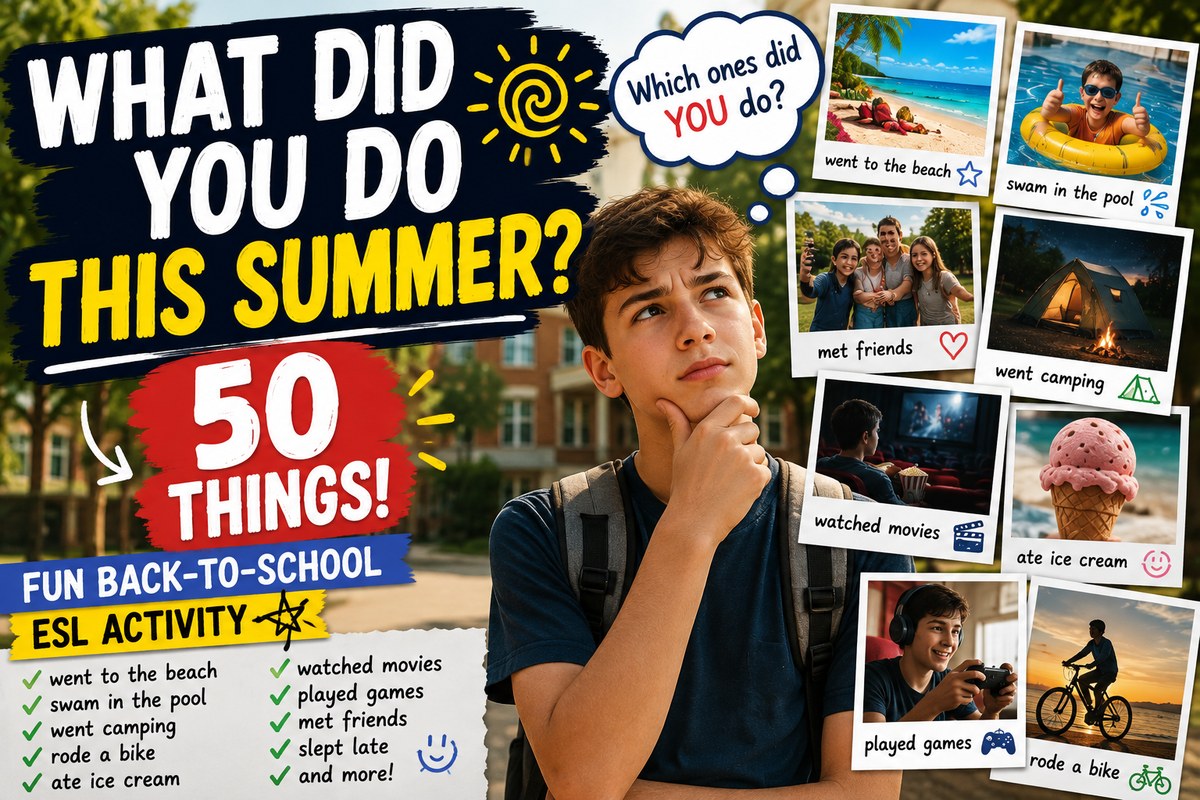
FREEBIE! What Did You Do This Summer? 50 Past Simple Prompts + 2 ESL Worksheets
Table of contents(16 sections)ShowHide
It's the beginning of September. Your students are back, everyone is talking about the holidays, and sooner or later you ask the obvious question:
"So... what did you do this summer?"
You expect stories. Instead, you get:
"Nothing." "I don't know." "I play games." "I go to beach."
And then someone tells you, in great detail, what they did all summer... in their first language. It happens every year.
After several weeks away from English, students often have plenty to talk about, but suddenly can't find the words to say it. And "What did you do this summer?" is actually quite a big question. They have to remember several weeks, choose something to talk about, find the vocabulary and work out the Past Simple, all at the same time.
So this year, I wanted to make that first conversation a little easier. Instead of asking one big question, I created 50 little visual answers. A beach. A bicycle. A tent. A cinema. Ice cream. Friends. Video games. Staying up too late. Doing absolutely nothing.
Students simply look through the pictures and think:
"Yes, I did that." ✓
And suddenly they have something to say.
This Is Exactly Why We Built Visual English
The idea behind this worksheet is the same idea behind Visual English: give students something to see, and give them a reason to speak. Instead of starting with a grammar explanation or asking students to produce language from nothing, we give them a visual starting point. A student sees a tent:
I went camping.
You ask: Where did you go? Who did you go with? Did you sleep in a tent? What did you do there? Did you like it? One little picture has already become a conversation. Another student sees an airport:
I travelled by plane.
And another conversation begins. The picture isn't the lesson.
It's the starting point for the conversation.
And once students have started talking about what they actually did during the summer, there's no reason to stop with one sentence.
Where Did Their Summer Take Them? ☀️
Use their answers to decide where the conversation goes next. If they went camping, talk about camping. If they travelled by plane, take them to the airport. If they spent half the summer watching films, there's a lesson for that too.
These are ready-made Visual English topics you can continue with:
🏕️ Went camping or explored nature?
Continue with Camping, Book 4 Unit 9. Talk about tents, camping equipment, outdoor activities and experiences in nature.
🏙️ Visited a new city or famous landmark?
Continue with Let's Go Sightseeing, Book 5 Unit 15. Use their trip as the starting point for talking about places, landmarks and sightseeing.
🏖️ Stayed somewhere new or already dreaming about the next holiday?
Continue with Dream Vacation, Book 7 Unit 4. Students can talk about accommodation, destinations and where they'd love to travel next.
✈️ Travelled by plane?
Continue with At The Airport, Book 6 Unit 13. Move naturally from "I travelled by plane" into airport vocabulary and travel conversations.
🐄 Visited a farm?
Continue with At The Farm, Book 4 Unit 12. Perfect for students who spent time in the countryside, visited animals or stayed on a farm.
🎬 Watched films or binge-watched a series?
Continue with What's On Screen?, Book 7 Unit 1. Ask what they watched, what they liked and what they'd recommend to their classmates.
🎉 Went to a party or celebration?
Continue with Let's Celebrate, Book 7 Unit 15. Talk about parties, celebrations, special occasions and memorable moments. The idea is simple:
Start with something the student actually did, then use it to open the next conversation.
That's how Visual English lessons work too. The visual gives students a starting point, but the real goal is always speaking.
🎒 And Now They're Back at School...
Of course, there's one experience everyone in the classroom suddenly has in common: summer is over and school has started again. So after talking about holidays, you can move naturally from: What did you do this summer? to: Did you miss your friends? Are you happy to be back? What's different this year? What are you looking forward to? Visual English Book 3, Unit 1: Back to School is free, so you can open it and use it straight away. Try the FREE Back to School Visual English Lesson → No preparation. Open the lesson and start speaking.
🎁 Now Choose Your Free Summer Worksheet
I made two versions, because the same activity isn't going to work equally well with a seven-year-old and a fourteen-year-old.
☀️ 50 Things I Did This Summer
For younger learners: 50 visual summer prompts for vocabulary, Past Simple and speaking.
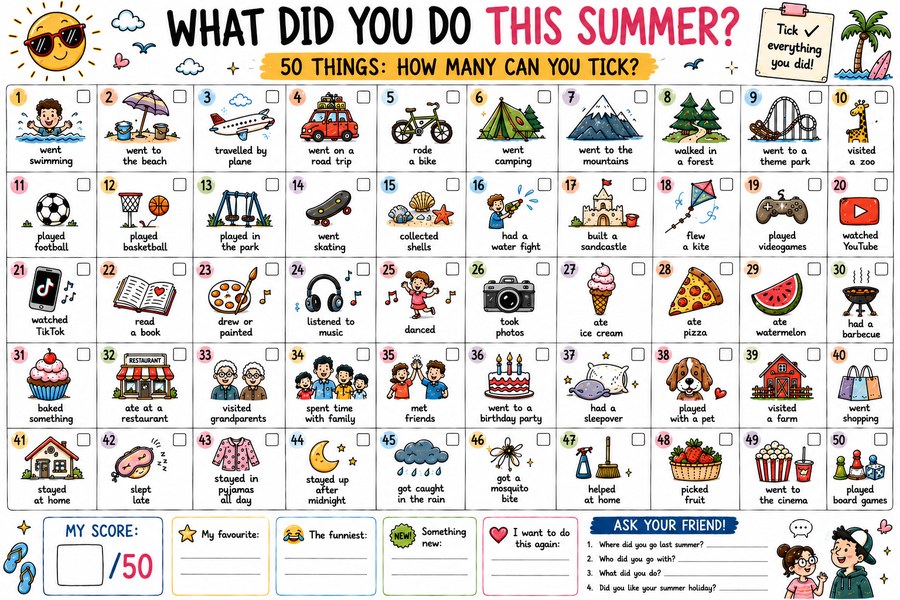
Download the FREE 50 Things Worksheet →
🎧 Teen Edition
For teenagers: teen-friendly experiences, opinions and discussion prompts.
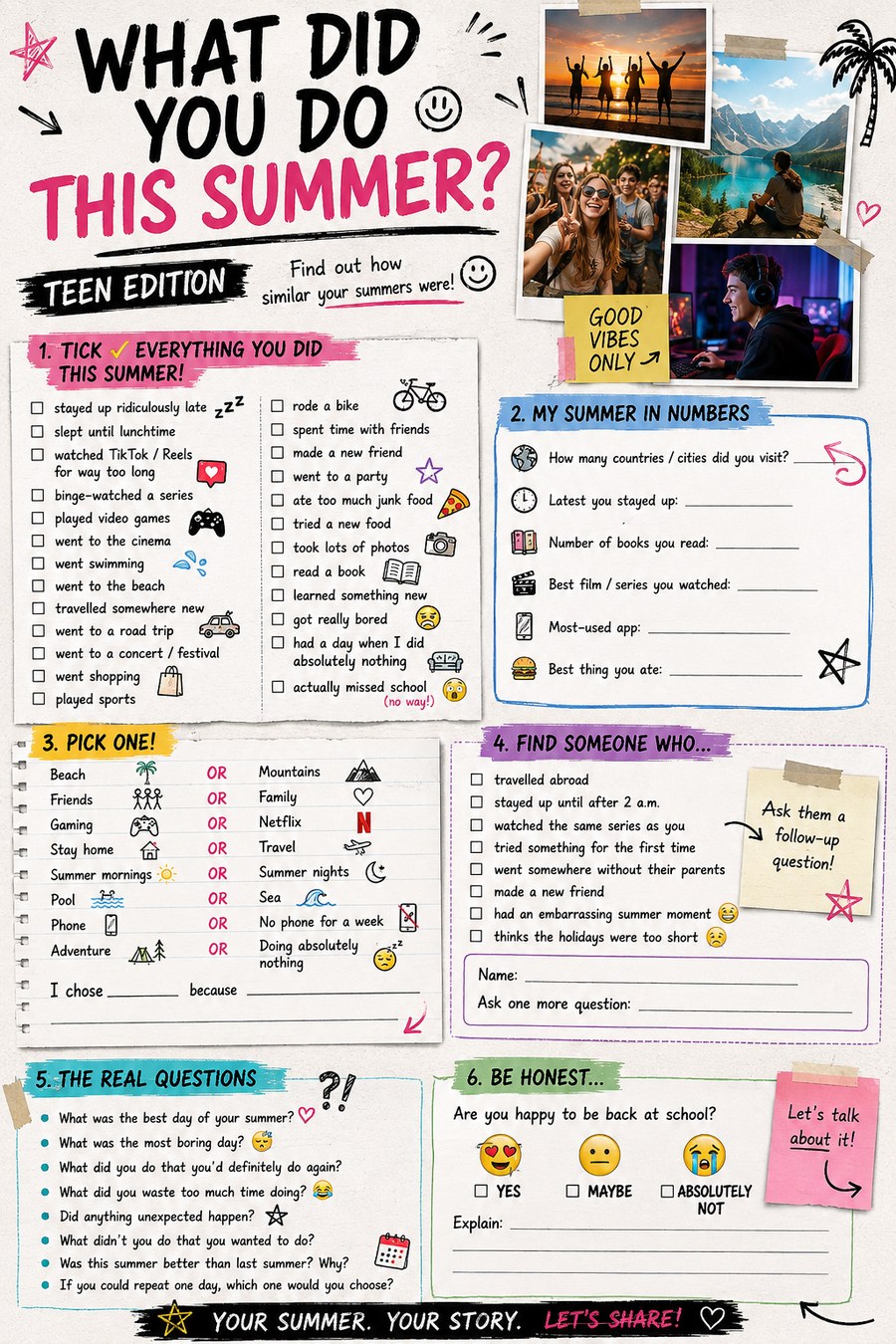
Download the FREE Teen Edition → Already downloaded them? Keep reading. Here are some simple ways to turn the worksheets into a complete first lesson back.
Why Visual Prompts Work So Well After the Summer Break
When you ask:
"What did you do this summer?"
students have to generate everything themselves. But show them pictures of a beach, tent, bicycle, cinema, ice cream or video game and you've already given them somewhere to start. The picture triggers the memory.
The memory gives them something to say. And once they have the idea, you can focus on helping them say it correctly. Instead of:
Tom ______ (go) to the beach.
you get:
I went to the beach.
Instead of:
Complete the sentence using the Past Simple.
you get:
Did you go to the beach?
Yes, I did.
The grammar is still there. It's just being used for a real reason.
A Quick Past Simple Review
Before students start interviewing each other, spend a few minutes reviewing the verbs they'll need. Keep this compact.
| Useful Regular Verbs | Useful Irregular Verbs |
|---|---|
| play → played | go → went |
| watch → watched | eat → ate |
| visit → visited | meet → met |
| dance → danced | ride → rode |
| help → helped | have → had |
| stay → stayed | take → took |
| read → read |
Then go straight back to speaking.
5 Ways to Use the Summer Worksheet
You don't need to use every possible activity. These five are enough to turn the printable into a full speaking lesson.
1. Tick Everything You Did ✓
Give students a few minutes to look through all the pictures. Their first task is simple:
Tick everything you did this summer.
Don't worry about complete sentences yet. Let them look, remember and compare. Then ask:
How many did you tick? Which one was your favourite? Did anyone tick more than 20? You'll usually find students start comparing their answers before you even ask them to.
2. Tell Your Partner Five Things
Now students choose five of their checked activities. They make five Past Simple sentences:
I went to the beach.
I rode my bike.
I met my friends.
I watched TikTok.
I ate ice cream.
For stronger students, ask them to add details:
I went to the beach with my family.
I rode my bike almost every day.
I ate far too much ice cream.
Now you're moving beyond simply practising verb forms.
3. Turn the Pictures Into Questions
Next, students interview each other. Teach or review:
Did you + base verb...?
Did you go to the beach? Did you play football? Did you visit your grandparents? Did you go camping? Students answer: Yes, I did. or: No, I didn't. This is also a good moment to catch one of the most common Past Simple mistakes: ❌ Did you went to the beach? ✅ Did you go to the beach? After did, we use the base form.
4. Don't Stop at "Yes, I Did"
This is where the real conversation starts. Give students one simple rule:
If your partner says YES, ask one more question.
For example: Did you go camping? Yes, I did. Then: Where did you go? Who did you go with? How long did you stay? What did you do there? Did you enjoy it? Three questions are particularly useful:
Where did you go? · Who did you go with? · What did you do?
Students can use them again and again throughout the lesson.
5. Play Find Someone Who... 🔎
Choose six to eight activities from the worksheet. Students walk around the classroom and find someone who:
| 🏕️ went camping | 🐚 collected shells |
| 👯 met friends | 🍓 picked fruit |
| 🎬 went to the cinema | 🌙 stayed up after midnight |
| 👵 visited grandparents | ✈️ travelled by plane |
They have to ask questions to find the right person. Did you go camping? Did you collect shells? Did you travel by plane? When somebody answers yes, write their name down. For stronger groups, add another rule:
You must ask one follow-up question before moving to the next person.
Suddenly the classroom is full of students repeatedly using the Past Simple without completing a traditional grammar exercise.
What About the Things They Didn't Do?
The unchecked pictures are useful too. Ask:
What didn't you do this summer?
Students choose three:
I didn't go camping.
I didn't travel by plane.
I didn't visit a farm.
Now you can quickly highlight:
didn't + base verb
❌ I didn't went camping. ✅ I didn't go camping. With the same worksheet you've now practised: I went... I didn't go... Did you go...? No separate grammar worksheet required.
🎧 Teaching Teenagers? Use the Teen Edition
Teenagers need a slightly different version. They can still talk about beaches, travel and summer holidays, but their summer might also have involved:
| staying up ridiculously late | sleeping until lunchtime | watching TikTok/Reels |
| binge-watching a series | playing video games | going to the cinema |
| travelling somewhere new | spending time with friends | making a new friend |
| going to a party | eating too much junk food | trying a new food |
| taking lots of photos | getting really bored | doing absolutely nothing |
And perhaps:
Actually missing school. 😱
The Teen Edition is designed to lead into longer conversations rather than stopping at a checklist.
My Summer in Numbers
Numbers are an easy way to get teenagers comparing answers. Ask them to complete:
| Countries/cities visited: ___ | Latest I stayed up: ___ |
| Books I read: ___ | Best film/series: ___ |
| Most-used app: ___ | Best thing I ate: ___ |
Then compare. Who stayed up the latest? Did anyone read more than three books? Who used the same app as you? Did anyone visit the same place?
Pick One
Give students two choices and make them choose.
| 🏖️ Beach | OR | ⛰️ Mountains |
| 👯 Friends | OR | 👨👩👧 Family |
| 🎮 Gaming | OR | 📺 Netflix |
| 🏠 Stay home | OR | ✈️ Travel |
| ☀️ Summer mornings | OR | 🌙 Summer nights |
| 🏊 Pool | OR | 🌊 Sea |
| 📱 Phone | OR | 🚫 No phone for a week |
| 🏕️ Adventure | OR | 😴 Doing absolutely nothing |
But choosing isn't enough. Add:
Why?
I chose the beach because...
I'd rather travel because...
I prefer summer nights because...
One little word turns a vocabulary activity into a speaking activity.
Ask Teenagers the Real Questions
Once they're warmed up, move beyond the checklist. Ask: What was the best day of your summer? What was the most boring day? What did you do that you'd definitely do again? What did you waste too much time doing? Did anything unexpected happen? What didn't you do that you wanted to do? Was this summer better than last summer? Why? If you could repeat one day, which one would you choose?
And finally:
Are you happy to be back at school?
😍 YES · 😐 MAYBE · 😭 ABSOLUTELY NOT Ask them to explain.
A Ready-Made 45-Minute First Lesson Back
If you don't want to plan anything else, here's a simple lesson:
| Time | Activity |
|---|---|
| 5 min | Summer vocabulary warm-up |
| 8 min | Tick the worksheet |
| 8 min | Make five Past Simple sentences |
| 10 min | Partner interview + follow-up questions |
| 9 min | Find Someone Who |
| 5 min | Favourite/funniest summer memory |
For teenagers, replace the final activity with My Summer in Numbers or Pick One. And if the class gets particularly interested in one topic, follow it. Someone went camping? Camping.
Half the class travelled? At The Airport or Let's Go Sightseeing. Everyone spent August watching Netflix? What's On Screen?
You already know what they want to talk about.
🎲 Have Five Minutes Left?
Use Roll to Speak for a quick speaking activity at the end of the lesson. Students roll, get a prompt and have to produce a complete English sentence. Play Roll to Speak for FREE →
🎁 Download the Worksheets
If you haven't downloaded them yet:
☀️ What Did You Do This Summer? 50 Things
For younger learners, with 50 visual summer prompts for vocabulary, Past Simple and speaking. Download the FREE 50 Things Worksheet →
🎧 What Did You Do This Summer? Teen Edition
For older students, with teen-friendly prompts, opinions and conversation activities. Download the FREE Teen Edition →
Start September With Speaking
The first English lesson after the holidays doesn't need to begin with a long grammar review. Your students already have weeks of stories, experiences and opinions to talk about. Sometimes they just need something to help them remember the English.
So give them a picture. Ask:
"Did you do this?"
Listen to the answer. Then ask one more question. And see where the conversation takes you.
Frequently asked questions
What is the best first English lesson after the summer holidays?
Start with visual prompts instead of grammar. Students tick summer activities they recognise, then use those pictures to build Past Simple sentences and answer Did you...? questions.
Are the summer worksheets free to download?
Yes. Both the 50 Things picture worksheet for children and the Teen Edition are free PDF downloads in this article.
Which worksheet should I use with teenagers?
Use the Teen Edition. It replaces the picture grid with prompts teens relate to, plus My Summer in Numbers, Pick One choices and honest discussion questions.
How do these worksheets teach the Past Simple?
Students talk about real finished events, so regular and irregular past forms, Did you...? questions and negative forms all appear naturally instead of in a gap-fill.
What if a student stayed at home all summer?
Staying home counts. The worksheet includes slept late, watched TikTok, played video games and stayed at home, so every student has something to say.
What should I teach after the summer activity?
Move into the new school year with Visual English Book 3, Unit 1: Back to School, a free lesson on school routines and new-term conversation.