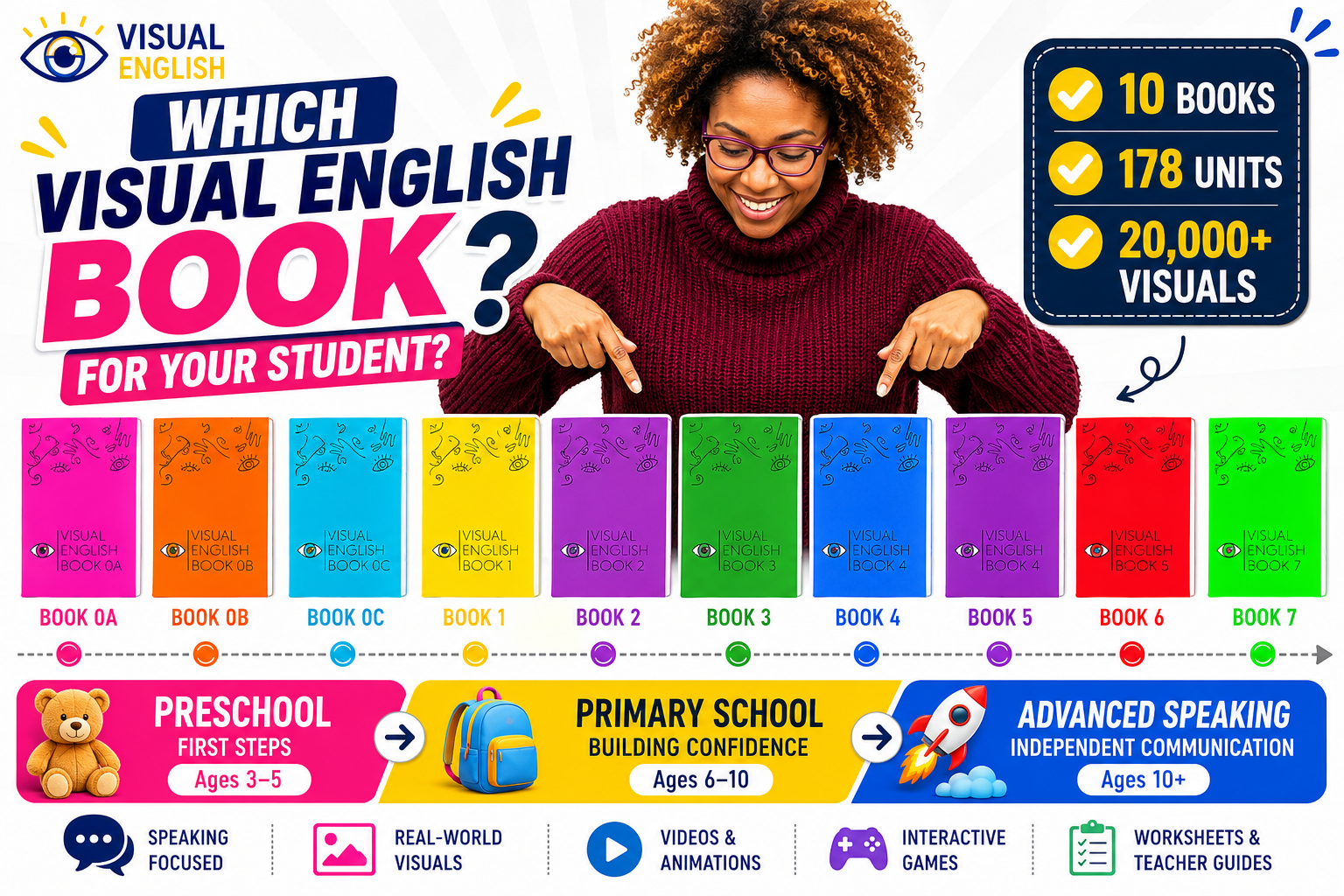
Visual English Books 0A–7: Which Level Is Right for My Student?
Table of contents(13 sections)ShowHide
One of the most common questions parents, teachers, and school directors ask is:
"Which Visual English book should my student start with?" Visual English is a complete speaking-focused curriculum containing 10 books, 178 units, and over 20,000 custom visuals. Each level builds naturally on the previous one, helping students progress from first words to confident communication.
🩷 Book 0A: First English Through Play (20 Units)
Designed for ages 3–5, Book 0A introduces English through songs, movement, repetition, and visual learning. Topics: Peek A Boo, One Potato, Traffic Lights, Autumn, My Face, I See Blue, I See Pink, Make a Circle, Brush Your Teeth, My Family, 5 Little Monkeys, Winter Snowflake, My Toys, Yummy Berries, To The Moon!, Bugs, Yummy Ice Cream, Halloween (5 Little Monsters), Merry Christmas, Easter Time.
🟧 Book 0B: Building Early Communication (20 Units)
Students begin answering simple questions and using short spoken responses. Topics: Let's Say Hello, Left and Right, Ten in the Bed, My Favourite Colours, Happy Sad Robot, How Is The Weather?, What Time Is It?, Winter Clothes, My Body, Dinosaurs, Can You Jump?, Driving My Car, Rain Rain Go Away, At The Zoo, Barn In The Farm, Yummy Ice Cream, Halloween, Merry Christmas, I Love You!, Easter Time.
🟦 Book 0C: From Words to Sentences (20 Units)
Students learn to talk about themselves, their family, and everyday life using complete sentences. Topics: Good Morning, What's Your Name?, How Are You?, My Family, My School Bag, Shapes, Make A Face, How Old Are You?, Do You Have A Pet?, How's The Weather?, Winter Clothes, Rooms In The House, Let's Go To School, Yummy Yucky, At The Farm, Scary Bugs, When I Grow Up, Trick And Treat!, Merry Christmas!, Easter Time!
🟨 Book 1: Everyday English (18 Units)
Students build practical classroom and everyday communication skills. Topics: Let's Say Hello, May I Borrow Your...?, Class Rules, How Are You?, My Family, What Is Your Favourite Colour?, How Old Are You?, Shapes, Make A Face, I Have Crazy Hair!, Seasons Of The Year, Home Sweet Home, Do You Have A Pet?, Where Is The Spider?, Fruit, Vegetables, How Is The Weather?, Can You Fly?
🟪 Book 2: Expanding Vocabulary (18 Units)
Students develop confidence discussing everyday topics and situations. Topics: Days Of The Week, My Classroom, Numbers 1–20, What Are You Wearing? (Clothes), I Want To Eat And Drink, Let's Go To The Zoo, What Do You Want To Be?, Let's Go Shopping, My Body, When Is Your Birthday?, Things In My House, What Is The Matter?, What Are You Doing?, Sports, The Farm, In The Garden, Where Are You From?, How Do You Go To School?
🟩 Book 3: Speaking About the World (18 Units)
Students begin expressing opinions, discussing experiences, and exploring bigger topics. Topics: Back To School, My Daily Routine, Fairytales, Free Time, The Seven Continents, When Is Your Birthday?, The Solar System, How Much Is It?, Let's Eat Out, My Favourite Subject, Get Well Soon!, What Do You Look Like?, Wild Animals, Excuse Me, Where Is...?, Bugs, Sports And Equipment, Let's Clean The House!, Movie Time!
🟦 Book 4: Communication and Culture (16 Units)
Students develop stronger descriptive language and communication skills. Topics: What Is Your Nationality?, Everyday Gadgets, Home Sweet Home, My Family, Personality, My Collections, I Am Fashion Crazy!, Enjoy Your Meal, At The Campsite, Mother Nature, Daily Routines, At The Farm, At The Playground, What Can You Do?, At The Circus, Free Time Activities.
🟪 Book 5: Real-Life Communication (16 Units)
Students use English in practical situations and begin working with past tense communication. Topics: School Tour, Household Chores, Are You A Gamer?, Where Were You Yesterday?, Winter Fun, What's Your Nationality?, Get Well Soon, What Did You Do Yesterday? Part 1, Emotions!, At The Supermarket, Where Are You Going?, How Did You Get Here?, What Did You Do Yesterday? Part 2, Movie Time!, Let's Go Sightseeing, Sounds Of Music.
🟥 Book 6: Critical Thinking and Problem Solving (16 Units)
Students begin discussing future possibilities, solving problems, and sharing opinions. Topics: Jobs, Household Appliances, Life In The Future, Animal Planet, At The Theme Park, Let's Get Cooking, Our Amazing Body, Free Time, What Happened?, Are You Tech Savvy?, Extreme Sports, Let's Be Green, At The Airport, Are You A Survivor?, Fashion Accessories, City Life.
🟩 Book 7: Independent Communication (16 Units)
The most advanced Visual English level focuses on real-world communication, opinions, and discussion. Topics: What's On Screen?, Crazy Looks, Crime Doesn't Pay, Dream Vacation, School Is Cool, Money, Can You DIY?, Let's Get Entertained, My Dream Job, Sports, Natural Disasters, Healthy Lifestyle, Places In The City, Social Problems, Let's Celebrate, Eating Out.
Which Book Should My Student Choose?
- Books 0A–0C: Ages 3–6, beginners, first exposure to English.
- Books 1–3: Ages 5–9, students developing everyday speaking confidence.
- Books 4–5: Ages 8–11, students ready for longer conversations and real-life communication.
- Books 6–7: Ages 10+, students capable of discussing ideas, opinions, and more advanced topics.
The journey is simple:
- 🩷 Book 0A → First Words
- 🟧 Book 0B → Simple Communication
- 🟦 Book 0C → Full Sentences
- 🟨 Book 1–2 → Everyday English
- 🟩 Book 3–5 → Confident Communication
- 🟥 Book 6–7 → Independent Speaking
No matter where students begin, the goal remains the same: See it. Say it. Speak it.