FREEBIE! Summer Bucket List ESL Activities + Free Worksheets
Table of contents(11 sections)ShowHide
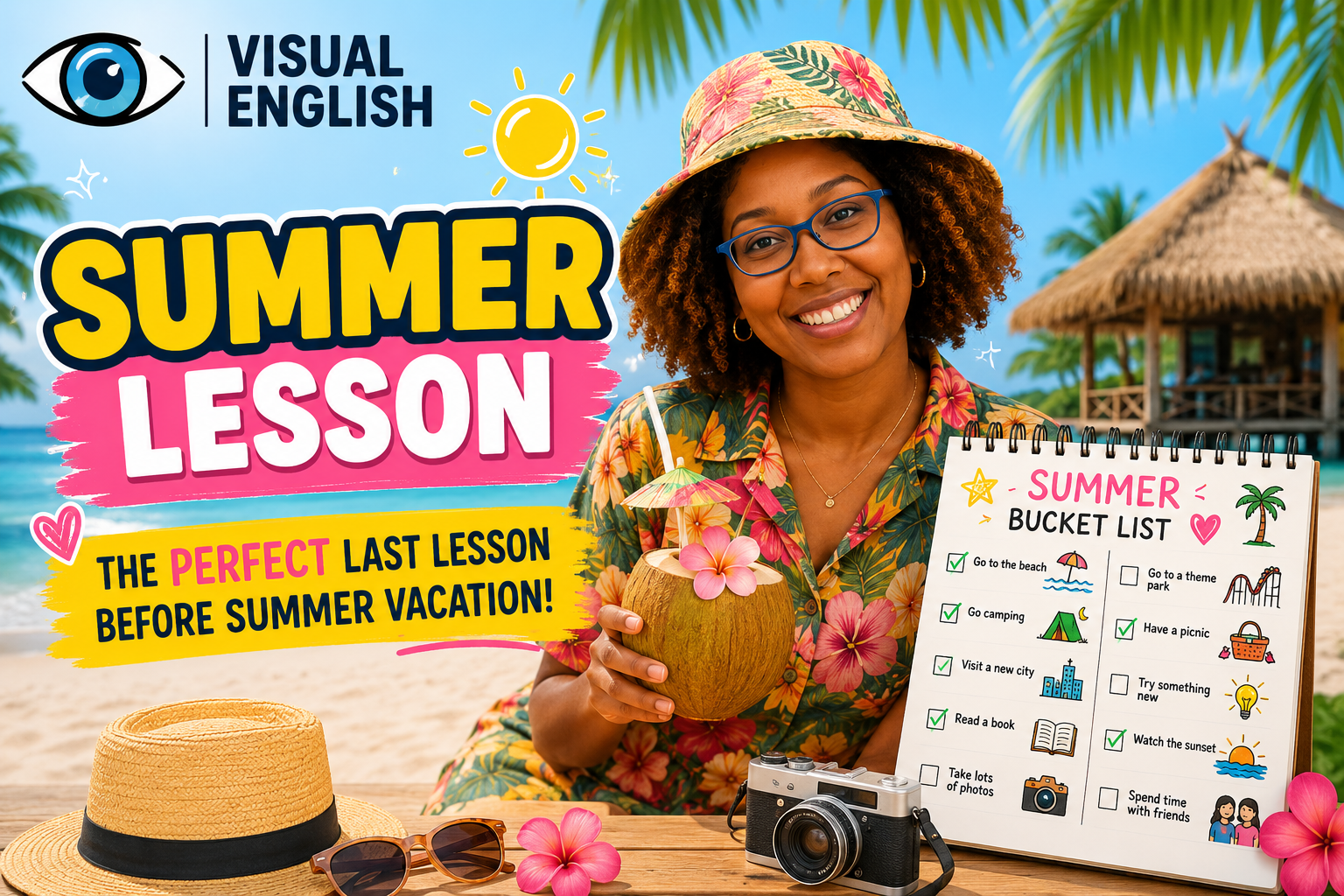
Looking for the perfect end-of-year ESL lesson? Summer Bucket Lists are one of the most engaging ESL speaking activities for helping students reflect on the school year while practicing English conversation skills. Combining visual learning, discussion questions, goal setting, and real-life communication, this activity works equally well with young learners, teenagers, and mixed-level English classes.
Unlike traditional ESL worksheets, Summer Bucket Lists encourage students to use English naturally. Students discuss experiences, future plans, dreams, and personal goals while interacting with colorful visual prompts. This makes the activity ideal for ESL teachers looking for interactive end-of-year lesson plans that focus on speaking rather than memorization.
Why Summer Bucket Lists Are So Popular
As the school year comes to an end, many teachers look for activities that are fun, reflective, and conversation-focused. One of the most popular end-of-year ESL classroom activities is the Summer Bucket List. A bucket list is simply a collection of experiences, adventures, and goals that people would like to complete. Students love them because they are personal.
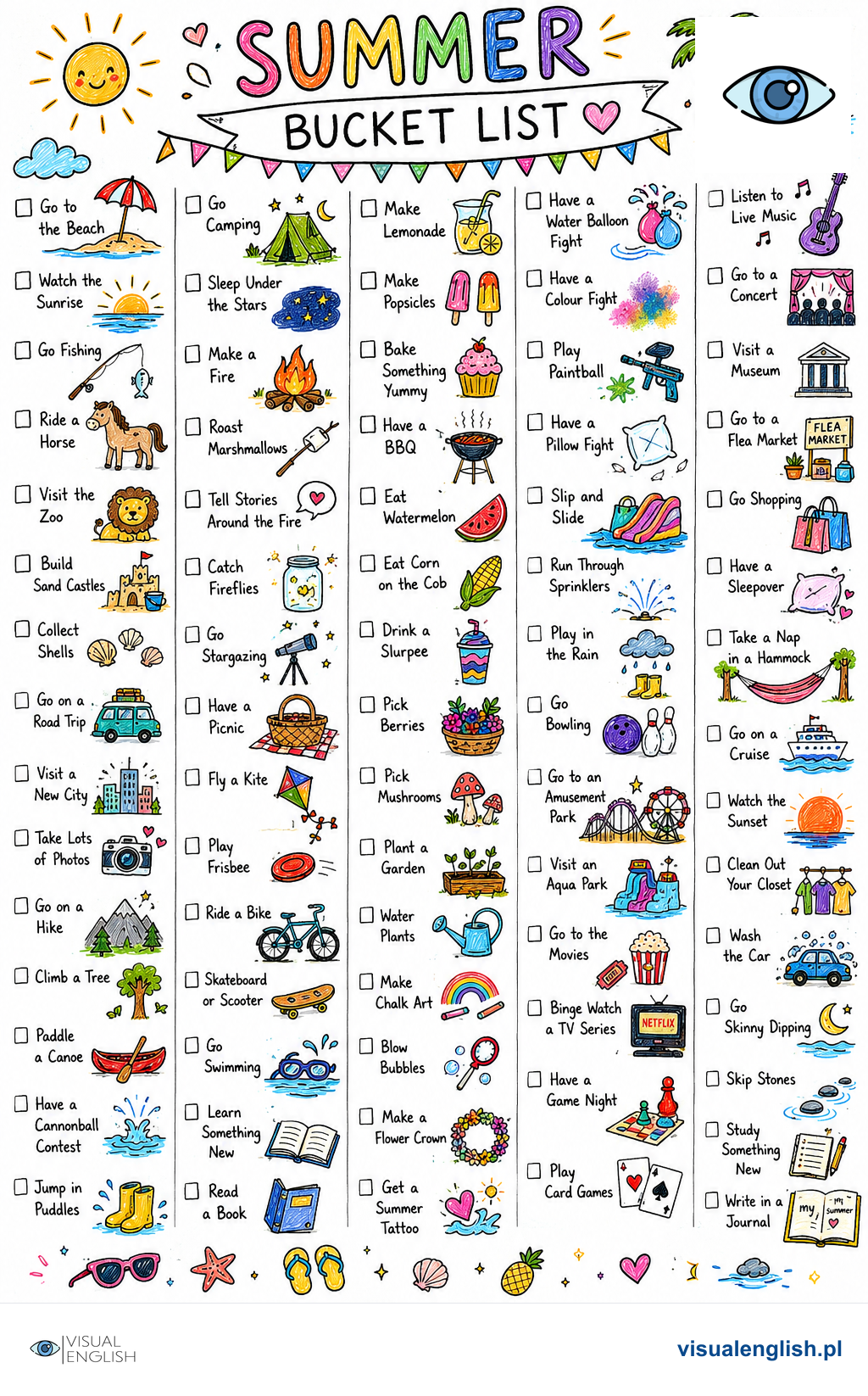
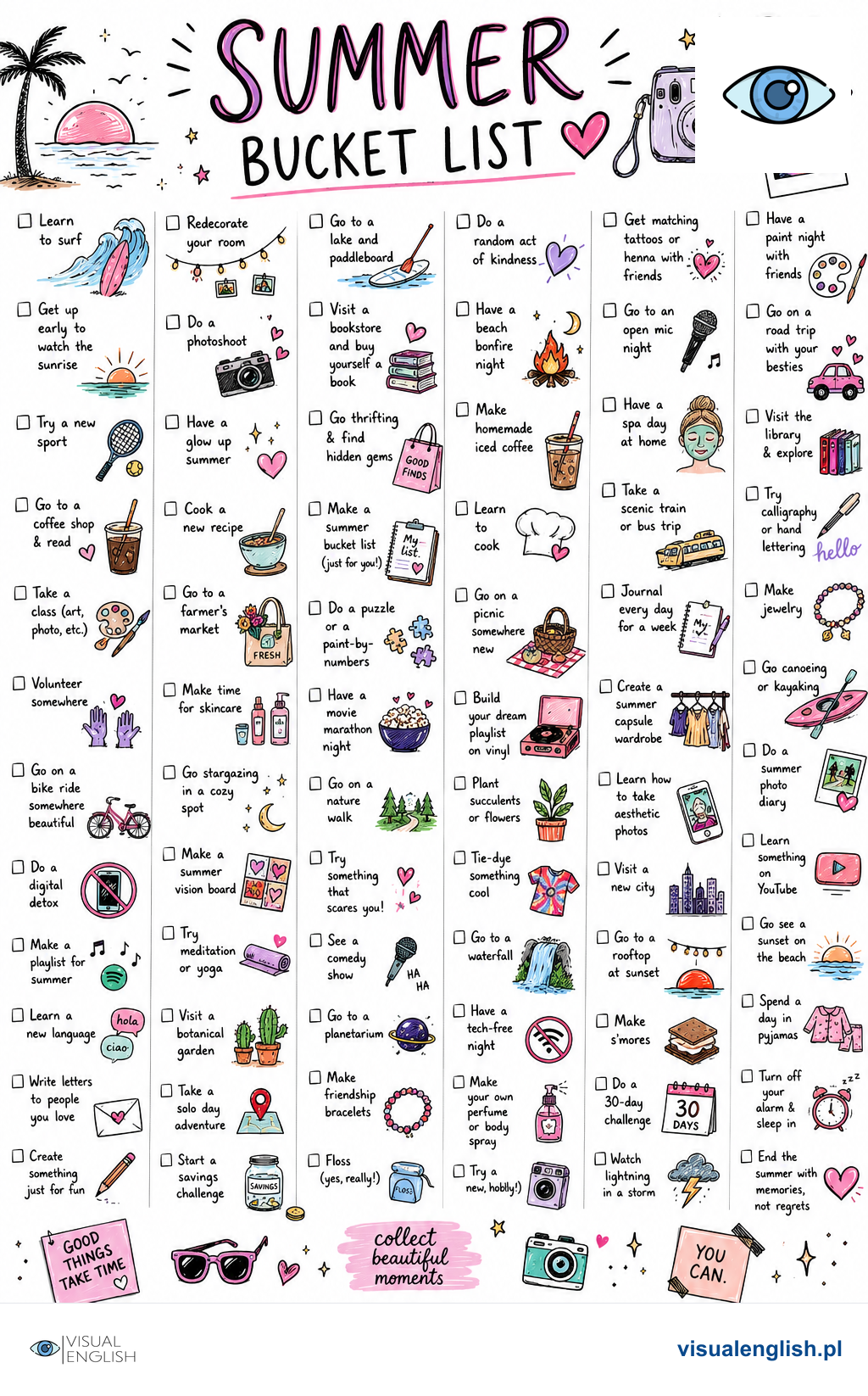
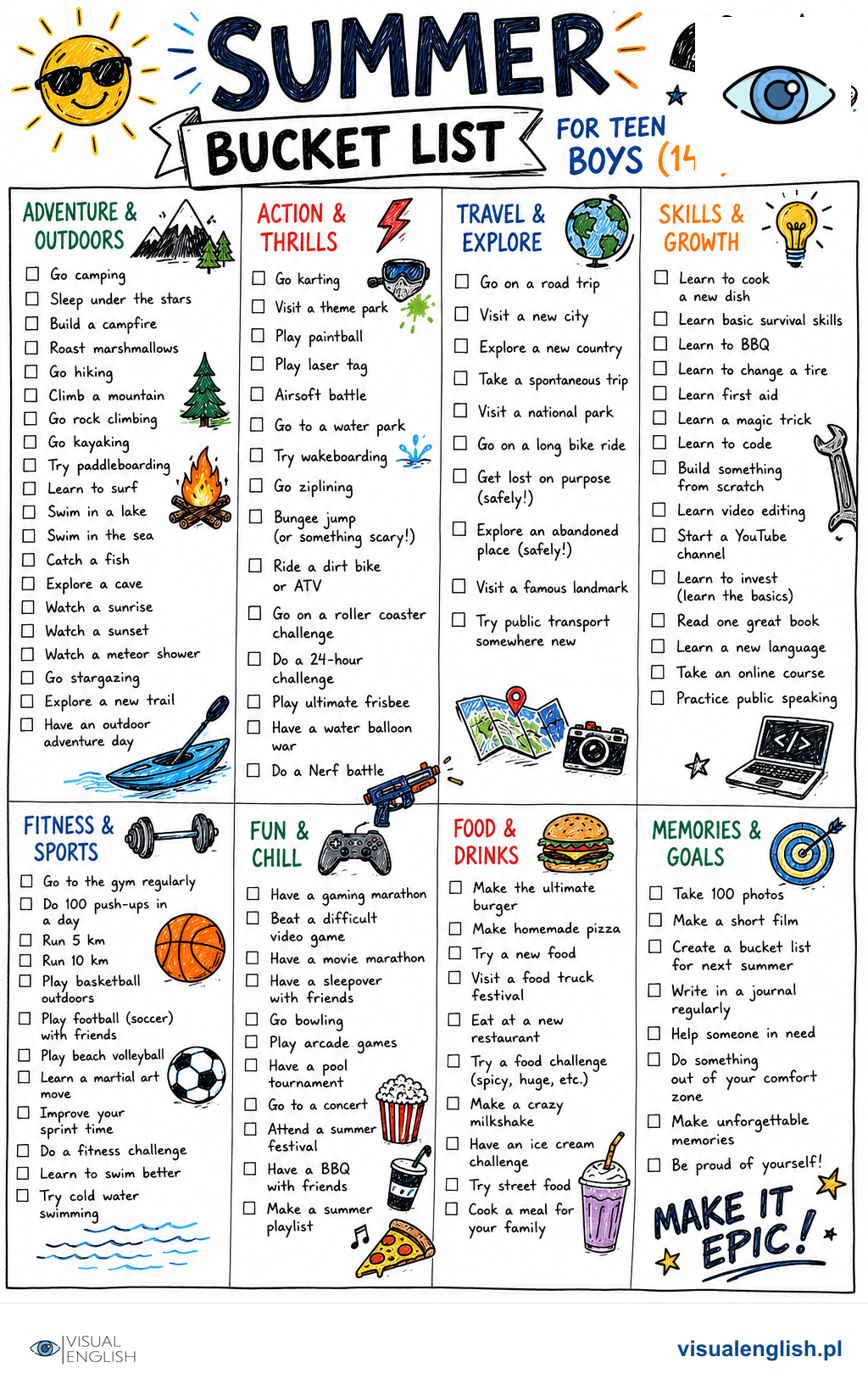
Some students dream about going to the beach, visiting a theme park, camping with friends, learning a new skill, travelling somewhere new, reading books, playing sports, or taking photographs. The pictures immediately create excitement because students start imagining themselves doing those activities. But there is something even more powerful happening.
The Psychology Behind Ticking Boxes
Have you ever noticed how satisfying it feels to tick something off a list? Our brains love progress. Every time we complete a task and place a tick beside it, our brain receives a small reward.
That is why people enjoy to-do lists, achievement badges, video game rewards, fitness trackers, and bucket lists. A page full of empty boxes feels unfinished, while a page full of ticks feels successful. Students enjoy seeing their progress because it turns ideas into achievements. This simple visual system motivates people to take action.
Why Pictures Are More Powerful Than Words
Imagine if the Summer Bucket List only contained words. Would it be as exciting? Probably not.
Pictures help us understand faster, remember longer, create emotions, imagine experiences, and start conversations. When students see a picture of a beach, they immediately think about holidays, swimming, sunshine, and family trips. When they see a campfire, they remember stories, forests, tents, and friends.
Pictures activate memories. Words often require explanation. Images create understanding instantly. This is one reason visual learning has become increasingly popular in education.
Why Summer Bucket Lists Are Excellent ESL Speaking Activities
One of the biggest challenges in English language learning is getting students to speak confidently. Summer Bucket Lists solve this problem because every image naturally generates conversation. Students practice ESL speaking skills, English conversation practice, future tense, present perfect, opinion language, describing pictures, storytelling, and personal responses. This makes Summer Bucket Lists one of the most versatile ESL classroom activities available.
Turning Images Into Conversations
A single image can generate dozens of questions. For example, imagine a picture of a student kayaking. A teacher might ask whether the student has ever gone kayaking, whether they would like to try it, where they would go, who they would go with, whether it is dangerous or exciting, and what equipment they would need.
One image becomes a conversation. The goal is not simply learning the word "kayak." The goal is communicating ideas. This is how language develops naturally.
A Summer Bucket List Speaking Activity
For each picture, students mark ✅ if they have done it, ⭐ if they want to do it this summer, and 🔥 if it is one of their top goals. Then discuss whether they have ever done this, when they did it, whether they enjoyed it, whether they would do it again, why they want to do it, who they would go with, and what would make the activity memorable. Students quickly discover that every picture contains a story.
Final Challenge
Students count how many activities they have already completed, how many stars they have, and which three activities are their biggest goals. The class can then compare answers and discuss their dream summer plans.
Why This Connects to Visual English
This activity demonstrates the core idea behind Visual English. Traditional language learning often starts with vocabulary lists. Students see words like beach, camping, kayaking, theme park, or picnic, then memorize definitions.
Visual English works differently. Students start with an image. The image creates curiosity. Curiosity creates questions. Questions create conversation. Conversation creates language.
The picture becomes the starting point for communication. Instead of memorizing isolated words, students connect English to experiences, memories, emotions, and real-life situations.
How Visual English Uses the Same Visual Learning Principles
Visual English was built around a simple idea: students learn language more effectively when they can see it. Research consistently shows that visual learning improves comprehension, vocabulary retention, and speaking confidence. That is why Visual English uses more than 20,000 custom visuals across 178 ready-made ESL lesson plans.
Just like a Summer Bucket List, every Visual English lesson starts with images that generate ESL speaking activities, English conversation practice, vocabulary development, critical thinking, discussion questions, and real-world communication. Rather than memorizing vocabulary lists, students learn English through pictures, questions, answers, stories, and experiences.
From Pictures to Communication
At the beginning of the year, many students could only name basic objects. By the end of the year, they can describe scenes, express opinions, tell stories, make predictions, share experiences, ask questions, and hold conversations. The picture remains the same. What changes is the student's ability to communicate. This is why Visual English uses thousands of visual prompts, scenes, characters, stories, and real-life situations. A single image can generate vocabulary, grammar, speaking practice, critical thinking, storytelling, and discussion. One picture can create an entire lesson.
Reflection Before the Holidays
Before students leave for summer, ask them what their favourite lesson this year was, what new words they learned, what conversation they remember most, which Visual English unit they enjoyed the most, and what they are looking forward to this summer. Then ask one final question:
If September arrived tomorrow, what would you regret not doing this summer?
Students often give thoughtful and memorable answers. It is a perfect way to end the school year.
Conclusion
Summer Bucket Lists are much more than a holiday activity. They show how powerful images can be for learning, memory, motivation, and communication. A simple picture can create a memory. A memory can create a story. A story can create a conversation. And conversation is where language learning truly happens.
That idea sits at the heart of Visual English. Because students do not learn English by memorizing words. They learn English by looking, thinking, speaking, and sharing experiences.
So this summer, try turning as many ⭐ stars into ✅ ticks as possible. Then come back in September with new stories, new memories, and new English to share.
FREEBIE! Free Summer Bucket List Worksheets — Download & Print
Three ready-to-use, printable Summer Bucket List worksheets, free for your classroom. Click any thumbnail below to download the full-size version.