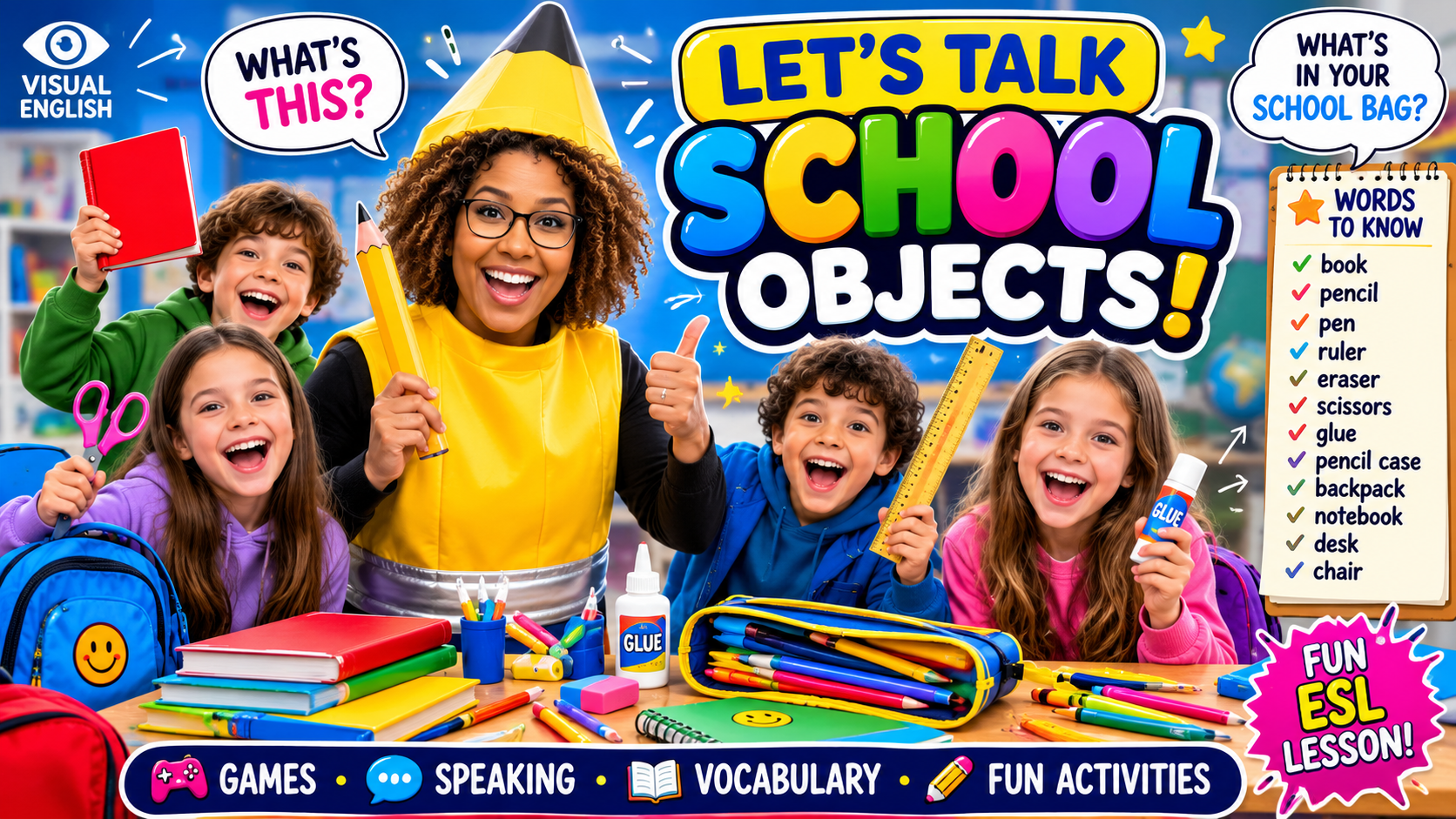
Let’s Talk School Objects! How to Teach Classroom Vocabulary Through Speaking & Games (2026)
Table of contents(8 sections)ShowHide
School objects are a perfect back-to-school ESL topic. Pencils, books, rulers and school bags are already around your students, so children can immediately connect new English with objects they can see and touch. But there is a difference between knowing the word “pencil” and being able to talk about a pencil in English.
Here’s how to combine Visual English slides, real classroom objects, speaking games, videos and interactive activities to get children using School Objects vocabulary in real conversations. Want to teach this topic directly from the screen? Open the Book 1 School Objects lesson for visual prompts, guided questions and ready-made activities.
School Objects Vocabulary
For young beginners, start with the objects children actually use: pencil • pen • book • notebook • ruler • rubber/eraser • school bag/backpack • pencil case • crayons • scissors • glue • sharpener You can later add desk, chair, board, marker, paper, folder, calculator and other classroom vocabulary. Don't try to introduce too many words at once. Six to ten new objects gives children more time to actually use the vocabulary.
From Vocabulary to Speaking
Don't stop at: Pencil. Build the language gradually:
- It's a pencil.
- It's a yellow pencil.
- I've got a yellow pencil.
- Have you got a pencil?
- Yes, I have.
Then expand with questions: What's this? What colour is it? Is it a pencil or a pen? Have you got one? Where is your pencil? What's in your school bag? The vocabulary hasn't changed, but the child has moved from recognising a word to communicating with it.
Teaching School Objects with Visual English Slides
Visual English slides give teachers a visual starting point for conversation. The important thing is not to simply click through the slides.
One Slide. More Than One Question.
If a pencil appears on the screen, you might start with: What's this? What colour is it? Is it a pencil or a ruler? Have you got a pencil? What colour is your pencil? Where is your pencil? One image can generate vocabulary, grammar and several speaking opportunities.
Take It From the Screen to the Classroom
After showing the pencil on the Visual English slide, say: Show me your pencil! Now continue with the children's real objects: What colour is your pencil? Who has a blue pencil? Put your pencil on your book. Put your pencil under your book. Put your pencil in your pencil case. The progression becomes:
Visual → Vocabulary → Question → Real Object → Movement → Speaking
You can also turn the Visual English slides themselves into quick games. Flash an image for a second and ask “What did you see?”, deliberately name an object incorrectly and let children correct you, or show an object and challenge everyone to find the same thing in their school bag.
6 School Objects Games That Get Kids Speaking
1. Mystery School Bag 🎒
Put several classroom objects inside a bag. A student feels one without looking and asks: Is it a pencil? Is it a ruler? The class answers until the student guesses correctly. For stronger students, ask them to describe the object before guessing.
2. What's Missing? 👀
Place six to eight school objects on a table. Students look at them, close their eyes, and you remove one. Ask:
What's missing? Beginners: The ruler! Stronger students: The blue ruler is missing.
3. Have You Got...? ✏️
Give students different objects and let them discover who has what. Have you got a pencil? No, I haven't. Have you got a ruler? Yes, I have! Students repeat the target structure because they actually need the information.
4. Teacher Says
Turn Simon Says into a School Objects game: Pick up your pencil. Open your book. Show me your ruler. Then make it harder: Put your pencil on your book. Put your ruler under your chair. Put your rubber next to your pencil case. Now students are practising vocabulary, listening, movement and prepositions together.
5. Describe and Guess 🕵️
Describe an object without naming it: It's long. It's yellow. We use it to measure. Students answer: A ruler! Once children understand the game, let them give the clues.
6. Where's My Pencil? 🔎
Hide classroom objects around the room. When students find them, they describe their locations: The pencil is under the chair. The book is on the table. The ruler is next to the school bag. This creates a natural bridge between School Objects and Places & Locations.
Teaching Prepositions with School Objects
Once children know the vocabulary, reuse the same objects for: in • on • under • next to • behind • in front of • between Give instructions using real objects: Put the pencil ON the book. Put the ruler UNDER the book. Put the rubber IN the pencil case. Then let students give you the instructions. Deliberately get some wrong. If a student says “Put the pencil under the book”, put it on top instead and let the class correct you.
Grammar practice suddenly becomes a game.
Videos & Interactive Games for School Objects
After students have practised the vocabulary through Visual English slides and real objects, a short video or interactive game gives them another way to hear and recognise the same language. The goal isn't to replace conversation. The digital resource should give students another reason to speak.
🎮 Visual English Wordwall Games
School Objects: Find the Match
Practise sharpener, school bag, ruler, pencil case, pencil, pen, notebook, glue, eraser, crayons, book and scissors. 🎮 Play School Objects: Find the Match After every match, add a speaking question: What's this? What colour is yours? Have you got one?
Back to School: Anagram
This activity moves students from recognising School Objects to spelling them. 🎮 Play Back to School: Anagram Use one simple rule: Solve it. Then use it.
If students solve PENCIL, they must make a sentence or question: I've got a pencil. or: Have you got a pencil?
🎬 School Objects Songs & Videos
For younger learners, songs provide repetition without making the lesson feel like drilling. Try using:
Watch → Pause → Ask → Find → Speak
Pause when an object appears and ask “What's this?”, “Have you got one?” or “Can you find one?”
Do You Have a Crayon? | Super Simple Songs
Useful for introducing and practising “Do you have...?” ▶️ Watch Do You Have a Crayon? Afterwards, use real objects and ask: Have you got a crayon? Have you got a pencil? Have you got scissors?
School Supplies Song
Use this as a quick listening and vocabulary review. ▶️ Watch the School Supplies Song Pause occasionally and ask: What's this? Do you have one? Can you find one in the classroom?
Mr. Blackboard | Back to School Supplies Song
A fun option for a September lesson and a short listening or movement break. ▶️ Watch Mr. Blackboard
What's in Your Bag?
This video leads naturally into one of the most useful questions in the topic: What's in your school bag? ▶️ Watch What's in Your Bag? After watching, use the children's actual bags. What's in your school bag? I've got a pencil. I've got two books. I've got a blue pencil case. Then let students interview each other.
A Ready-Made 45-Minute School Objects Lesson
Here's one simple way to put everything together:
- 0–5 min: Greetings and warm-up
- 5–12 min: Introduce 6 to 8 objects with Visual English slides
- 12–17 min: What's this? / What colour is it? / Have you got...?
- 17–22 min: Find the real objects in students' school bags
- 22–27 min: One short YouTube song or video
- 27–32 min: Mystery Bag, What's Missing? or Teacher Says
- 32–36 min: Prepositions with real objects
- 36–40 min: One Wordwall game with speaking questions
- 40–45 min: Return to Visual English slides for a final speaking review
The lesson moves naturally through:
SEE IT → HEAR IT → FIND IT → MOVE IT → PLAY WITH IT → TALK ABOUT IT
You don't need to use every video, game or activity in one lesson. Choose the resources that best fit your students and save the others for review.
Conclusion
School Objects may look like a simple beginner vocabulary topic, but a pencil can become much more than one new word. Ask: What's this? What colour is it? Have you got one? Where is it? Whose is it? What do you use it for? By combining Visual English slides, real classroom objects, movement, games, videos and Wordwall activities, students encounter the same language in different ways while continuing to speak. Don't just teach the names of the things around them. Get children talking about them.
Frequently asked questions
How many school objects should I teach in one lesson?
For young beginners, 6 to 10 core objects is usually enough. It is better to reuse a smaller vocabulary set in several questions and activities than introduce 25 words students barely practise.
Should I use slides or real objects?
Both. Visual English slides provide the visual lesson structure, while real classroom objects allow children to touch, move and talk about the vocabulary.
What grammar works with School Objects?
This topic works naturally with this/these, a/an, plurals, colours, have got, possessives, prepositions of place, classroom instructions and there is/there are.
What is the best School Objects game for young learners?
Mystery School Bag, What's Missing?, Have You Got...? and Teacher Says are particularly easy because they require almost no additional preparation.
Should I use YouTube and Wordwall in every lesson?
No. They are additional tools. Five purposeful minutes can be more useful than 20 minutes of passive watching or clicking. Always bring the activity back to speaking.