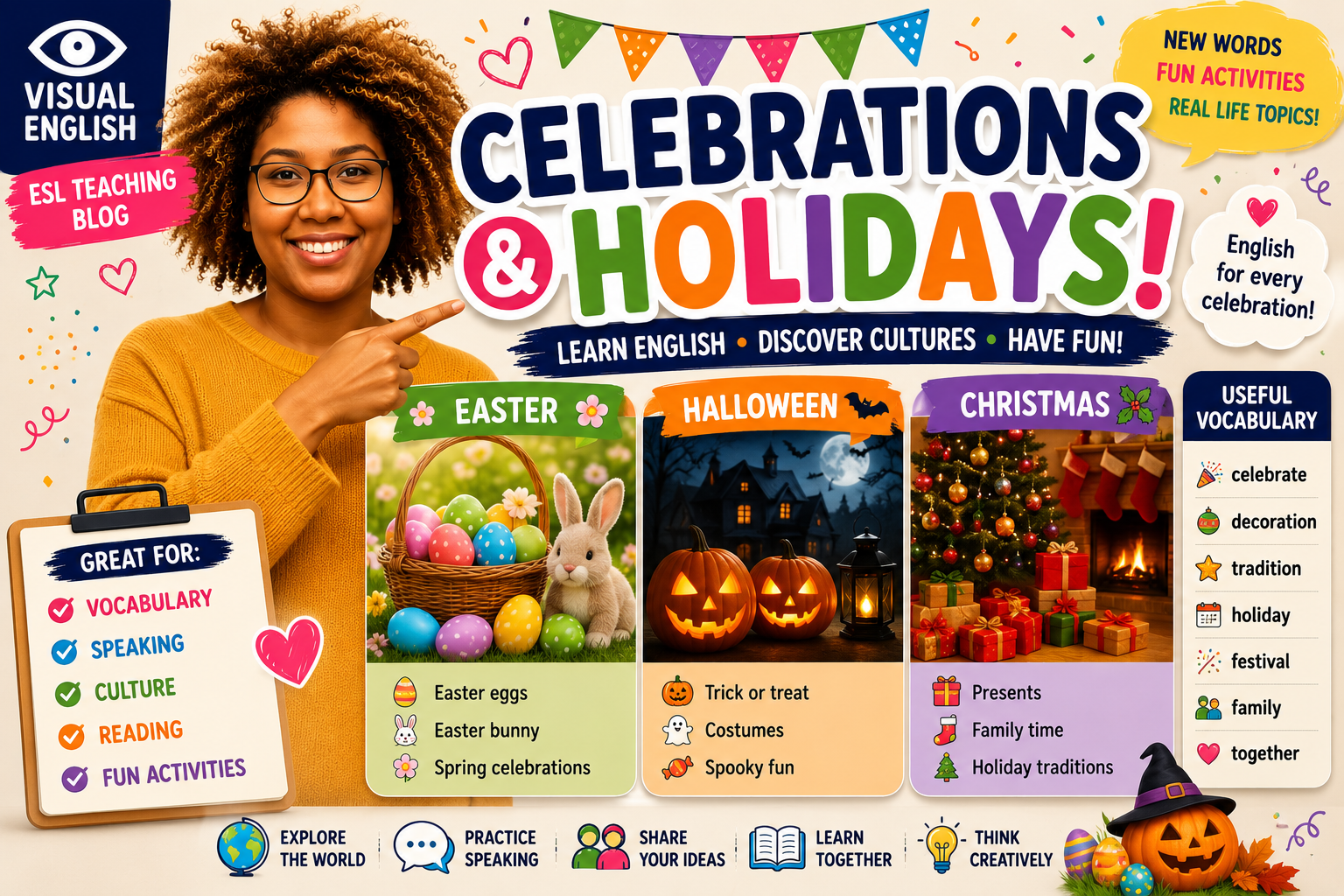
How to Teach Holidays and Festivals Vocabulary in ESL (2026)
Table of contents(7 sections)ShowHide
Holiday lessons have a natural advantage that no other topic can fully replicate: students arrive already excited, because the lesson lines up with something happening in their actual lives. That built-in energy is worth using deliberately, not just as a once-a-year novelty.
Why Holidays Works So Well
Seasonal timing does a lot of the motivational work for you -- a Halloween lesson taught in late October lands very differently than the same vocabulary taught in March. Students also often already know the cultural context, freeing up class time for language rather than explanation.
Core Vocabulary
Each holiday brings its own set: for Halloween -- costume, pumpkin, spooky, trick or treat; for Christmas -- presents, tree, Santa, snow; for Easter -- eggs, bunny, hunt, spring. Keep each holiday's vocabulary self-contained rather than mixing several at once.
The Grammar That Pairs Naturally
Holidays work well with future forms ("What will you do for...?") and simple past for recounting after the fact ("What did you do for...?"). They're also a natural fit for comparing traditions ("In my country, we...") with older students.
Speaking Activities That Work
1. Holiday plans. Before a holiday, ask what students are planning to do -- genuine, current-events speaking practice. 2. Costume/craft show and tell. If a craft or costume was made in class, a short description activity reinforces vocabulary with something tangible.
3. Compare traditions. For mixed-nationality or older classes, compare how a holiday is celebrated differently in different places. 4. Holiday vocabulary bingo. A quick, low-prep way to drill seasonal vocabulary in the lead-up to a holiday lesson.
Common Mistakes to Watch For
- Assuming every student celebrates the same holidays -- worth framing lessons as "Halloween is a holiday some people celebrate" rather than assuming universal participation
- Overloading vocabulary for a single lesson (holiday units tend to have a lot of unique, low-frequency words -- pace it out)
- Confusing past tense forms when recounting holiday activities after the fact
Ready-Made Holiday Lessons
Visual English includes seasonal lessons across the curriculum:
- Halloween -- Book 0A
- Merry Christmas -- Book 0B
- Easter Time -- Book 0C
- Let's Celebrate -- Book 7, comparing celebration traditions for older students
See the full set on the Holidays topic page.
Conclusion
Holiday lessons borrow motivation from the calendar itself -- timed well, they're some of the easiest lessons to get genuine enthusiasm for. Keep vocabulary manageable and framing inclusive, and they become a highlight rather than a novelty.
Frequently asked questions
Should holiday lessons be mandatory in a curriculum?
They're a strong option when timed seasonally, but framing them as optional or culturally comparative avoids assuming shared background among all students.
How much vocabulary should one holiday lesson cover?
Six to ten words is usually enough -- holiday vocabulary tends to be low-frequency outside the season, so depth matters less than a fun, memorable core set.
What's the best way to use holiday timing?
Teach a couple of weeks before the actual holiday so students can use the language while the event is still upcoming and relevant.