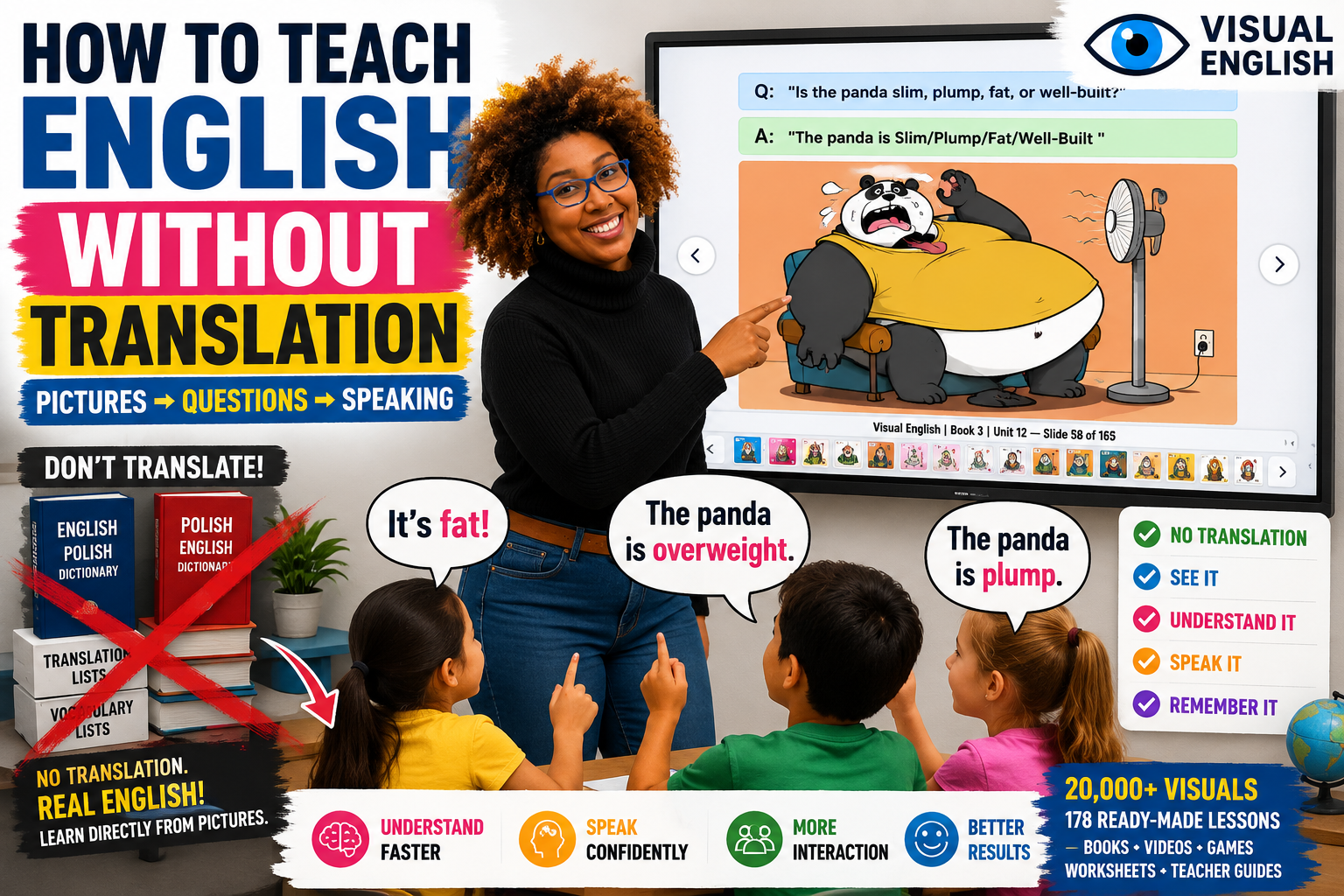
How to Teach English Without Translation
Table of contents(12 sections)ShowHide
Walk into many English classrooms around the world and you'll hear a familiar pattern: "Apple means jabłko." "Dog means pies." "Chair means krzesło." Students memorize translations, complete exercises, and pass vocabulary tests. Yet after years of studying English, many students still struggle to speak naturally.
Why Translation Dominates Many English Classrooms
Why do students who can recite translations still struggle to speak? Because knowing a translation is not the same as understanding a word. Language is not a dictionary. Language is communication.
Is Translation Actually Necessary?
Translation can sometimes be useful, especially for complex concepts or advanced learners. However, many everyday words do not require translation at all. Imagine teaching apple, dog, car, run, sleep, happy, or sad. Do students really need a translation, or could they understand instantly from a picture? Most of the time, the answer is obvious. A picture communicates meaning faster than a translation.
How Children Learn Their First Language
Think about how babies learn. Parents do not constantly translate. Instead they point, they show, they repeat, they ask questions. A child sees a dog and hears "Look! A dog!" Eventually the image and the word become connected, and no translation is required. This natural process can also be used when teaching English.
The Power of Visual Learning
Visual learning allows students to connect English directly to meaning. Instead of English → Native Language → Meaning, students learn English → Meaning directly, which is much faster. When students see a picture of a beach, they immediately understand beach, sand, sea, sun, and holiday, no translation necessary. The brain processes images far faster than text. This is why visual teaching has become increasingly popular in modern ESL classrooms.
Using Questions Instead of Translation
One of the simplest ways to avoid translation is to ask questions. Instead of saying "Bakery means piekarnia," show a picture and ask what it is, whether it's a bakery or a pharmacy, what you can buy there, whether they have a bakery near their house, and what their favourite bakery product is. The lesson immediately becomes interactive. Students discover meaning rather than receiving it.
Building Meaning Through Context
Context is one of the strongest teaching tools available. For example, show a picture of a boy carrying an umbrella in heavy rain, then ask what the weather is like, whether it's sunny or raining, whether he's wet, and why he's carrying an umbrella. Students naturally understand the target vocabulary through the situation. No translation needed.
Teaching Vocabulary Without Translation
Vocabulary becomes easier to remember when students see it, hear it, and use it. With picture prompts, show the image first, then introduce the word. With real objects, bring classroom items like a pen, book, bag, or phone. With gestures, act out actions like run, jump, sleep, cry, or laugh. With visual stories, students infer meaning through images and sequences.
The more visual support available, the less translation becomes necessary.
Teaching Grammar Without Translation
Many teachers assume grammar requires translation. In reality, grammar can often be taught visually. For present continuous, show images of a girl reading, a dog sleeping, or a boy eating, then ask what she is doing, whether she's reading or writing, and what the dog is doing. Students begin noticing patterns naturally.
For past simple, show a sequence of pictures: waking up, eating breakfast, going to school. Students describe what happened. Grammar emerges from communication.
Common Mistakes Teachers Make
Explaining too quickly: students often need time to observe. Translating immediately: many teachers translate before students even try to understand. Talking too much: students should be speaking more than teachers. Using too few visuals: images create understanding faster than explanations.
The Direct Method and Visual English
The philosophy behind Visual English is heavily influenced by the Direct Method. Instead of translating vocabulary lists, students interact with images. Every lesson begins with visual prompts and questions.
Students learn through pictures, conversation, repetition, storytelling, observation, and speaking practice. With more than 20,000 custom visuals, 178 ready-made units, and 10 structured books, Visual English helps teachers create English-only classrooms where meaning comes from context rather than translation. A typical Visual English lesson follows a simple pattern: show the image, ask questions, encourage answers, expand the conversation, and build confidence through repetition. Students learn English the way language is naturally acquired, through meaningful communication.
Benefits of Teaching English Without Translation
Teachers who reduce translation often notice faster vocabulary retention, better speaking confidence, more classroom interaction, greater student engagement, improved listening skills, and stronger thinking directly in English. Over time, students stop translating in their heads and begin responding automatically. That is where real communication starts.
Conclusion
Translation is not the enemy. But it should not be the foundation of language learning. The most successful English lessons focus on meaning, context, visuals, and communication.
When students connect English directly to images, experiences, and conversation, learning becomes more natural and more memorable. Instead of asking "What does this word mean in my language?", students begin asking "How can I use this word to communicate?" And that is the moment language learning truly begins. Explore 178 ready-made ESL lesson plans, teacher guides, interactive games, videos, worksheets, and 20,000+ visual prompts with Visual English.