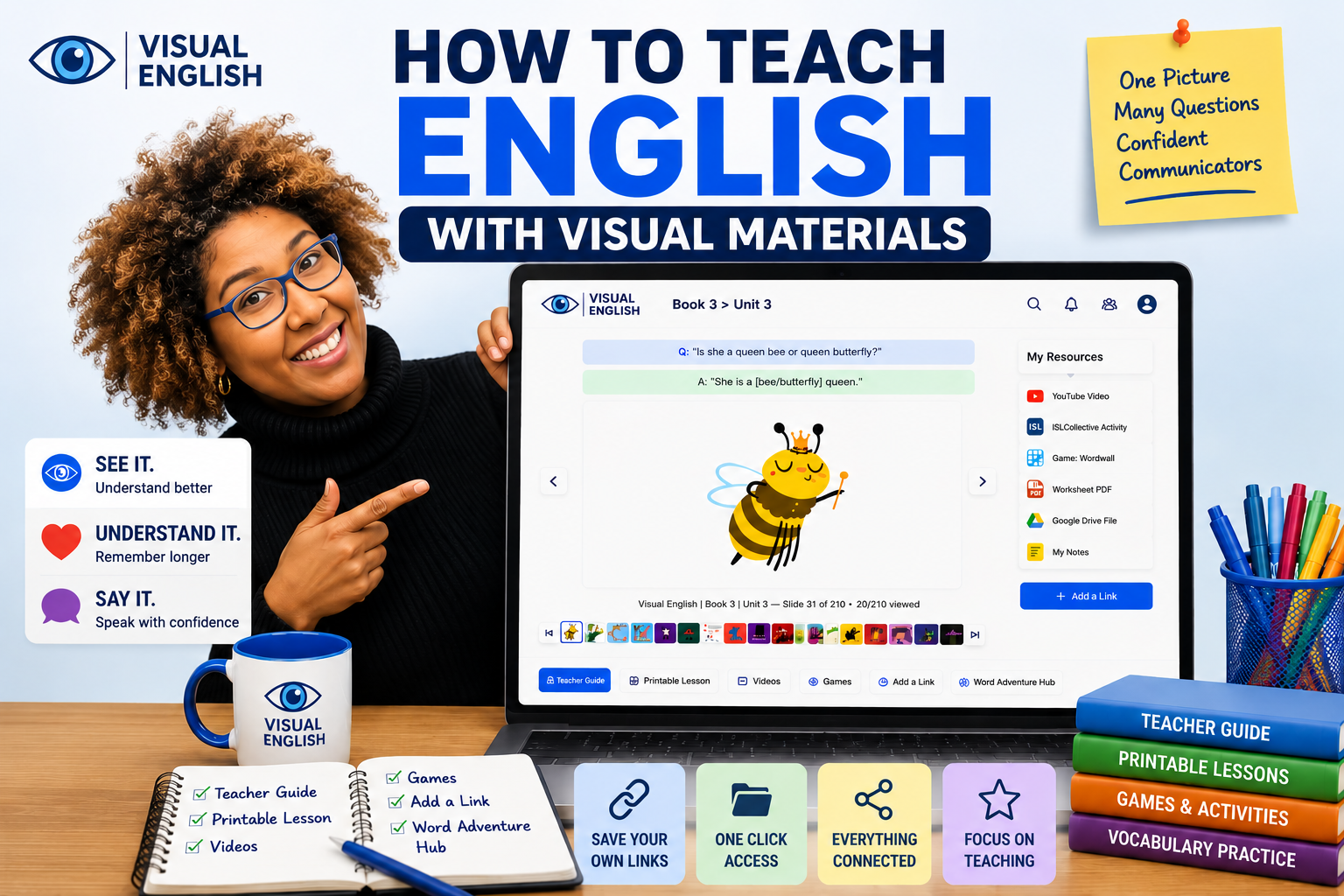
How to Teach English with Visual Materials
Table of contents(12 sections)ShowHide
Why Visual Materials Are So Effective
Children learn best when they can see what they are talking about. That is why visual materials have become one of the most powerful tools in modern English language teaching. Instead of translating words, teachers can show meaning directly through images. Students understand faster, participate more actively, and gain confidence using English in real situations.
A single picture can generate dozens of questions, answers, and conversations. As the saying goes:
A picture is worth a thousand words.
In language learning, a picture can create a thousand conversations.
Start with One Clear Language Goal
Before selecting an image, decide what you want students to learn. For example: Vocabulary
- Animals
- Food
- Clothes
- Transport Grammar
- Present Simple
- Present Continuous
- Comparatives Speaking
- Describing pictures
- Giving opinions
- Asking questions The image should support the language objective directly. If you are teaching actions, choose pictures showing clear actions. If you are teaching clothing, choose images that highlight clothing items.
Keep the focus simple.
Use Images to Create Conversation
Many teachers use pictures as decoration. The most effective teachers use pictures as conversation starters. For example, show a jungle scene.
Ask: What is it? Students answer: It is a jungle. Then continue: What can you see in the jungle? Students answer:
- I can see a gorilla.
- I can see trees.
- I can see bugs.
One image can generate an entire speaking lesson.
Use Short Teacher-Led Prompts
Visual lessons work best when the teacher controls the pace.
- Point to the image.
- Model the answer.
- Ask the question.
- Repeat.
- Expand.
For example: Teacher: What is she doing? Students: She is camping. Teacher: Where is she camping? Students: She is camping in the mountains. Teacher: Would you like to go camping?
Now the conversation becomes personal and meaningful.
Move from Recognition to Production
Students should not be expected to speak fluently immediately. Build confidence step by step. Step 1: Recognition
- Point to the picture
- Match words
- Identify objects
Step 2: Controlled Practice
- Repeat sentences
- Answer simple questions Step 3: Production
- Describe the image
- Give opinions
- Ask questions
- Create conversations This gradual progression makes speaking less intimidating.
Recycle Language Across Activities
Children need repeated exposure before language becomes automatic. The best lessons reuse the same language through multiple activities. For example:
- Visual Slide — What can you see?
- Speaking Activity — Describe the image.
- Video — Watch and discuss.
- Game — Review vocabulary.
- Worksheet — Practice writing.
Students encounter the same language in different ways, helping them remember and use it confidently.
Add Videos and Interactive Activities
Images are powerful, but combining them with videos and games creates even stronger lessons. Teachers can:
- Show a visual scene
- Ask questions
- Watch a related video
- Play an interactive game
- Complete a speaking activity Each activity reinforces the same language objective. This keeps students engaged while reducing preparation time.
Everything in One Place
One challenge for teachers is that resources are often scattered across different websites. A lesson may require:
-
Slides from one source
-
Videos from another
-
Games from somewhere else
-
Worksheets stored in folders This can make lesson preparation time-consuming. Visual English was designed to solve this problem. Each unit can include:
-
✅ Visual lesson slides
-
✅ Questions and answers
-
✅ Teacher guides
-
✅ Printable lessons
-
✅ Videos
-
✅ Interactive games
-
✅ Speaking activities
-
✅ Homework resources
Everything is connected around the same topic and learning objectives.
Save Your Own Resources
Every teacher discovers useful materials over time. Perhaps you find:
- A YouTube video
- An educational game
- A TikTok activity
- A PDF worksheet
- A speaking exercise Visual English allows teachers to save these resources directly inside the unit they are teaching. Instead of searching through hundreds of bookmarks later, everything remains attached to the lesson where it belongs.
Your personal teaching library grows every year.
Keep Parents Informed
Visual learning also makes communication with parents easier. Parents can clearly see:
- What vocabulary was taught
- What images were used
- What activities students completed
- What homework should be practised When parents understand what their child is learning, they can provide better support at home.
A Practical Classroom Sequence
A simple visual lesson might look like this:
- Show the image.
- Introduce the target language.
- Ask simple questions.
- Allow students to answer.
- Expand the conversation.
- Watch a related video.
- Play a game or complete a worksheet.
- Finish with speaking practice.
This structure keeps students active, engaged, and communicating throughout the lesson.
Final Thoughts
Visual materials are most effective when they are used as teaching tools, not decorations. The goal is not simply to show pictures. The goal is to create communication.
When combined with questions, videos, games, and speaking activities, visual materials become one of the fastest and most effective ways to teach English. Because students do not learn English by memorizing language. They learn English by using language.
And every great conversation starts with something worth talking about.
Frequently asked questions
Why are visual materials effective for teaching English?
Images show meaning directly, so students understand faster, participate more, and gain confidence using English without relying on translation.
How do I turn a picture into a speaking activity?
Start with simple questions like What is it? and What can you see?, then expand into personal questions to build longer conversations.
Should I use videos and games alongside images?
Yes. Combining slides, videos, and games around the same language objective reinforces vocabulary and keeps students engaged.
How can I keep all my teaching resources in one place?
Visual English lets teachers attach their own videos, games, PDFs, and links directly inside each unit, so resources stay with the lesson.