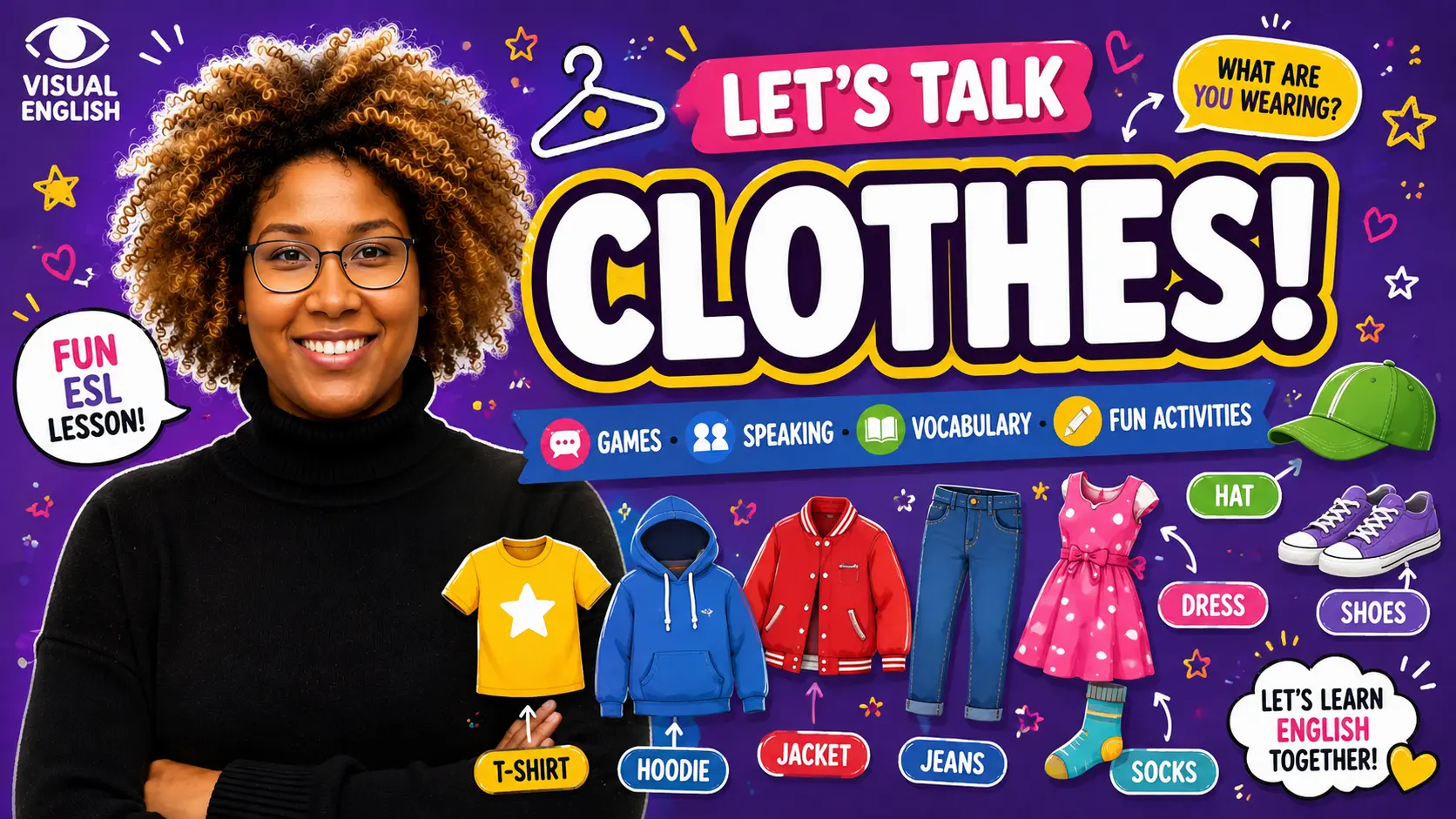
How to Teach Clothes Vocabulary in ESL Classrooms (2026)
Table of contents(7 sections)ShowHide
Ask any class "What are you wearing?" and you have instant, unscripted content -- every student is wearing an answer. That immediacy is what makes clothes one of the most naturally communicative topics in the ESL curriculum.
Why Clothes Works So Well
Unlike topics that require imagination or memory, clothes vocabulary is visible in the room. Students can point at their own clothes, a classmate's clothes, or clothes in a picture -- there's always a real referent.
Core Vocabulary
Start with everyday items: shirt, trousers, dress, shoes, socks, jacket, hat. Add weather-specific items (coat, scarf, boots, gloves) once basics are solid -- this also creates a natural bridge into the weather topic.
The Grammar That Pairs Naturally
Clothes is one of the best contexts for present continuous: "What are you wearing?" / "I'm wearing a blue shirt." It's also useful for colour + noun combinations ("a red dress," "black shoes"), reinforcing colours vocabulary at the same time.
Speaking Activities That Work
1. What are you wearing? Circle. Go around the room, everyone answers in a full sentence. Fast, guarantees 100% participation.
2. Guess who. One student describes a classmate's outfit without naming them; others guess who it is. 3. Dress the character. Using cut-out clothes or a drawing, students "dress" a character and describe the outfit out loud.
4. Fashion show narration. Pairs take turns "walking" while a partner narrates what they're wearing -- a fun way to practise fluency under light pressure.
Common Mistakes to Watch For
- Confusing singular/plural for items that are always plural in English (trousers, shorts, pyjamas, glasses)
- Mixing up "wear" and "put on" (wear = state, put on = action)
- Overusing "has" instead of "is wearing" ("She has a red dress" vs "She is wearing a red dress" -- both are fine, but students often avoid the continuous form entirely)
Ready-Made Clothes Lessons
Visual English covers clothes at multiple levels:
- Winter Clothes -- Book 0B, seasonal clothing basics
- What Are You Wearing? -- Book 2, present continuous practice
- I Am Fashion Crazy! -- Book 4, style and fashion vocabulary
See the full set on the Clothes topic page.
Conclusion
Clothes is one of the few topics where every student is already holding the answer -- literally, on their body. Build lessons around present continuous and real description, and you'll get consistently high engagement with minimal prep.
Frequently asked questions
Can this topic work without real clothing props?
Yes -- pictures work just as well, though having students describe their own actual clothes adds authenticity and personal stakes.
What's the best grammar entry point?
Present continuous ("I'm wearing...") -- it's natural, immediately useful, and gives every student a true answer.
How do I extend this for older students?
Move into opinions and preferences ("I prefer...", "I never wear...") and shopping-related language, which bridges naturally into the shopping topic.