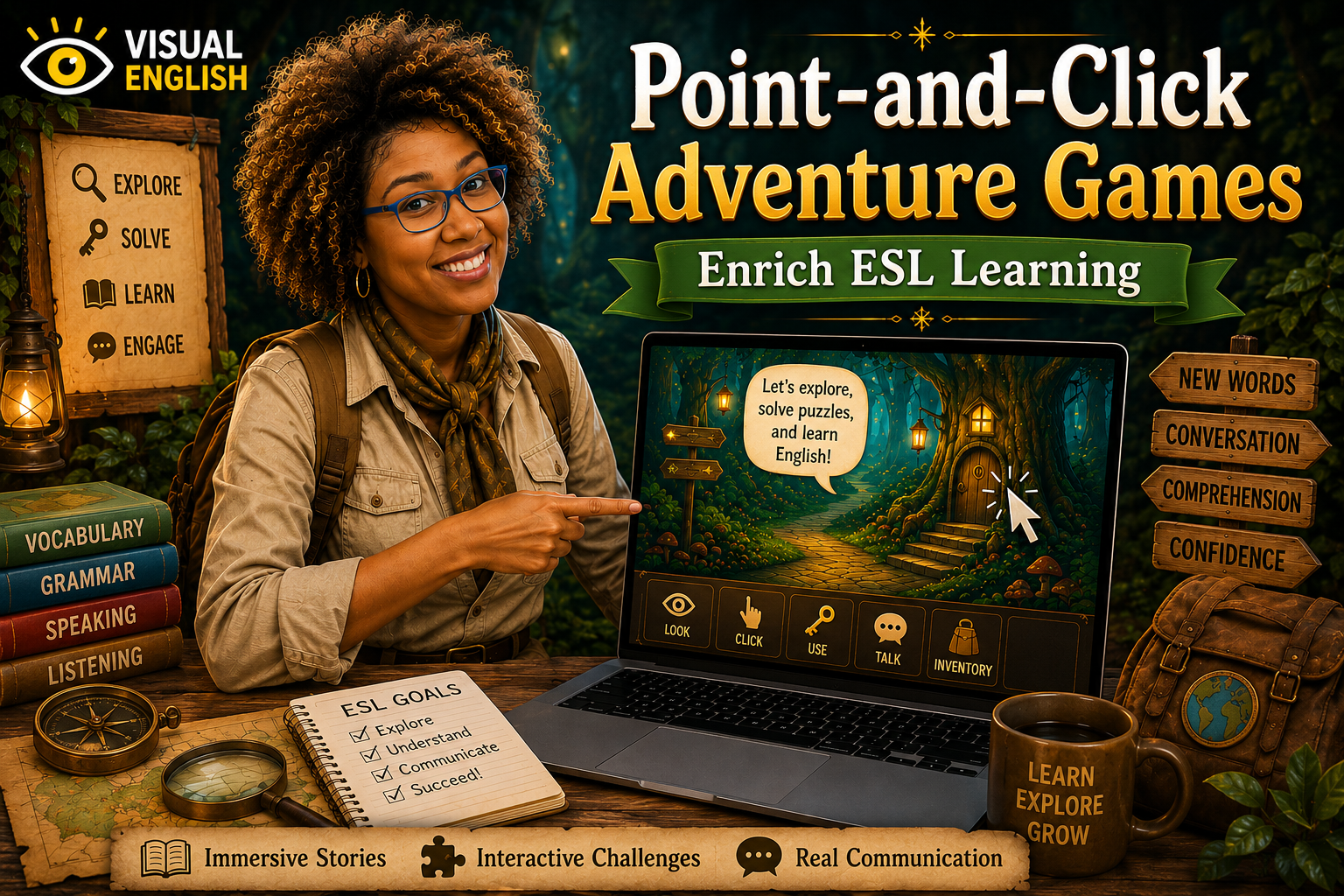
How Point-and-Click Adventure Games Enrich ESL Learning
Table of contents(6 sections)ShowHide
How Point-and-Click Adventure Games Enrich ESL Learning
Point-and-click adventure games aren't just nostalgic fun. They are immersive storytelling tools, full of problem-solving and visual prompts that naturally drive conversation and critical thinking. For ESL teachers, these games offer a goldmine of interactive language practice.
Why Point-and-Click Games Work in ESL
These games centre on exploration, sequencing, and discovery. Students must give instructions, describe scenes, and predict outcomes — all key language skills. They encourage:
Directions vocabulary. Whether guiding characters left, right, up, or down, students naturally use direction-based language. Games like Lost in Play require students to guide characters through whimsical worlds, which is perfect for practising location phrases like "Go to the garden" or "Enter the house." Problem-solving language. In games like Machinarium, students must solve puzzles. They practise phrases like "We need a key" or "Try opening that door."
Descriptive language. Students describe scenes: "The robot is next to the pipe" or "Anika is crossing the river." Games like Anika's Odyssey or Monkey Go Happy are rich in unique scenes, perfect for speaking practice. Sequencing. Games naturally involve step-by-step actions, so students practise sequencing language: "First, find the toolbox. Then, fix the machine."
Examples of Great ESL-Friendly Point-and-Click Games
1. Lost in Play
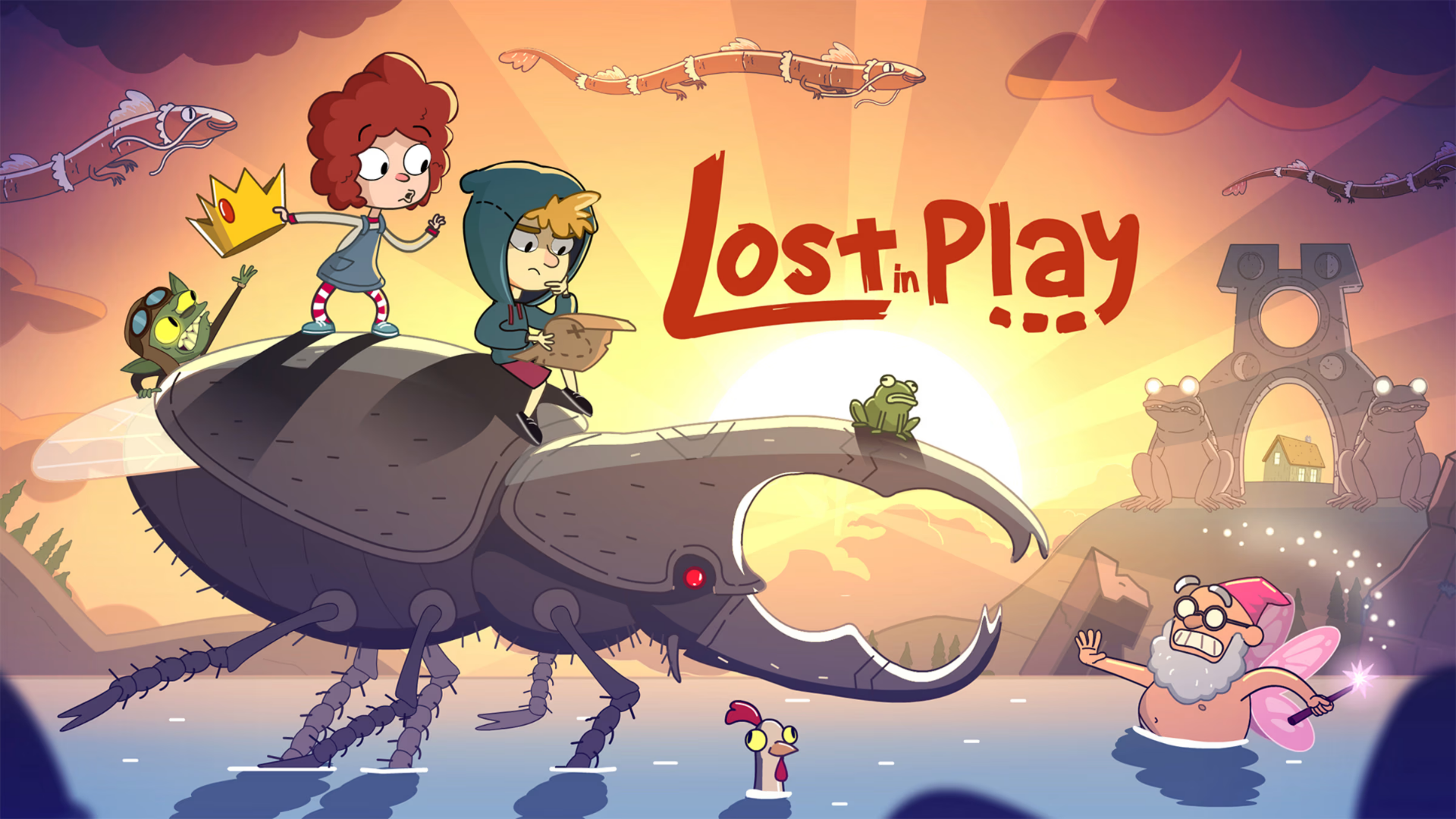 Play: store.steampowered.com/app/Lost_in_Play Best for: Ages 7+ This modern adventure game encourages storytelling and directions vocabulary as students help siblings navigate fantasy worlds. Almost no written text, so it works beautifully for ESL learners of any first language. Excellent for teaching: storytelling, directions, prediction, describing scenes, sequencing.
2. Machinarium
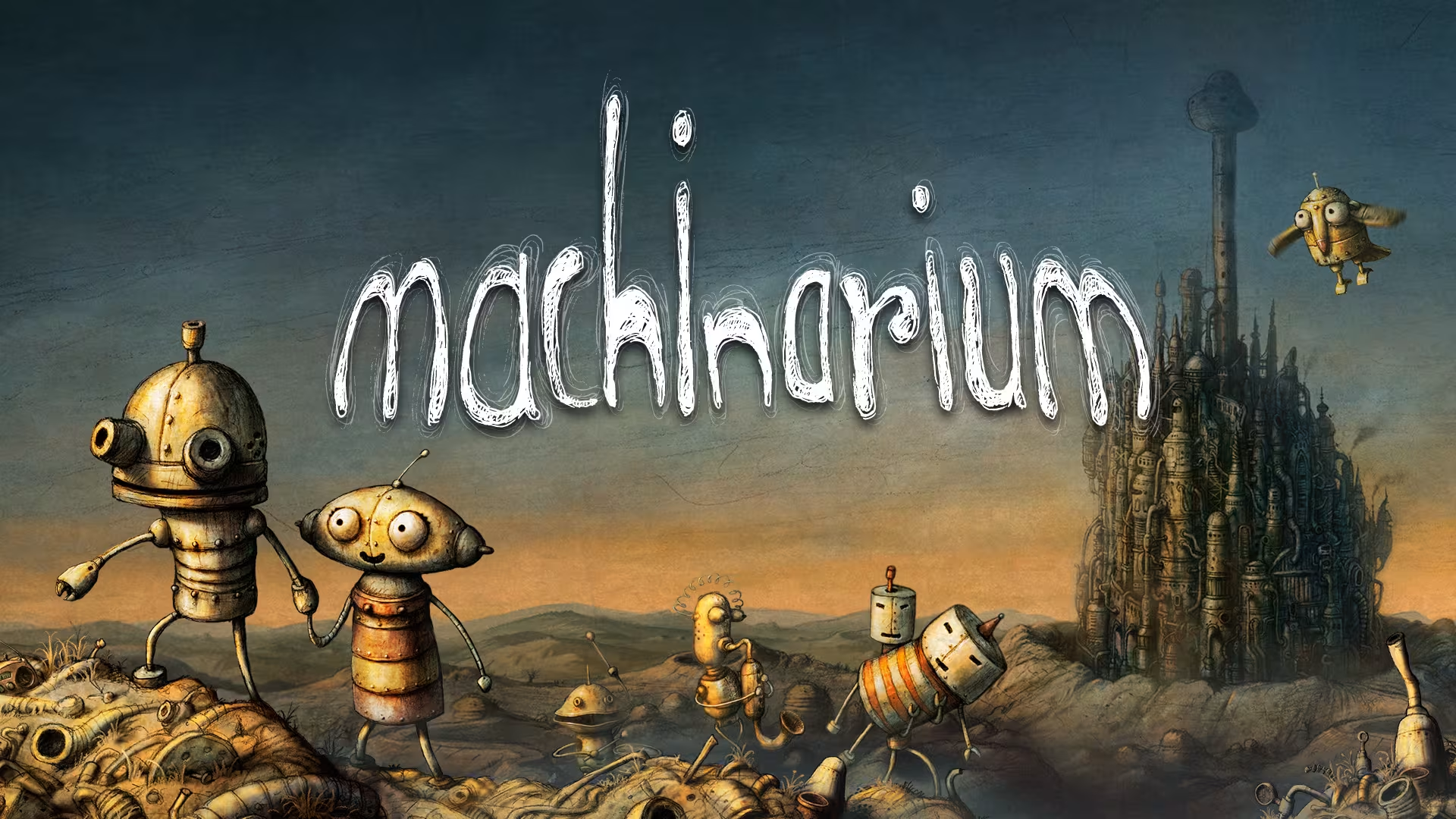 Play: amanita-design.net/games/machinarium Best for: Ages 9+ With a charming robot protagonist, students get immersed in puzzle-solving, describing mechanical objects, and crafting sequential instructions. Excellent for teaching: problem solving, describing objects, giving instructions, sequencing.
3. Samorost
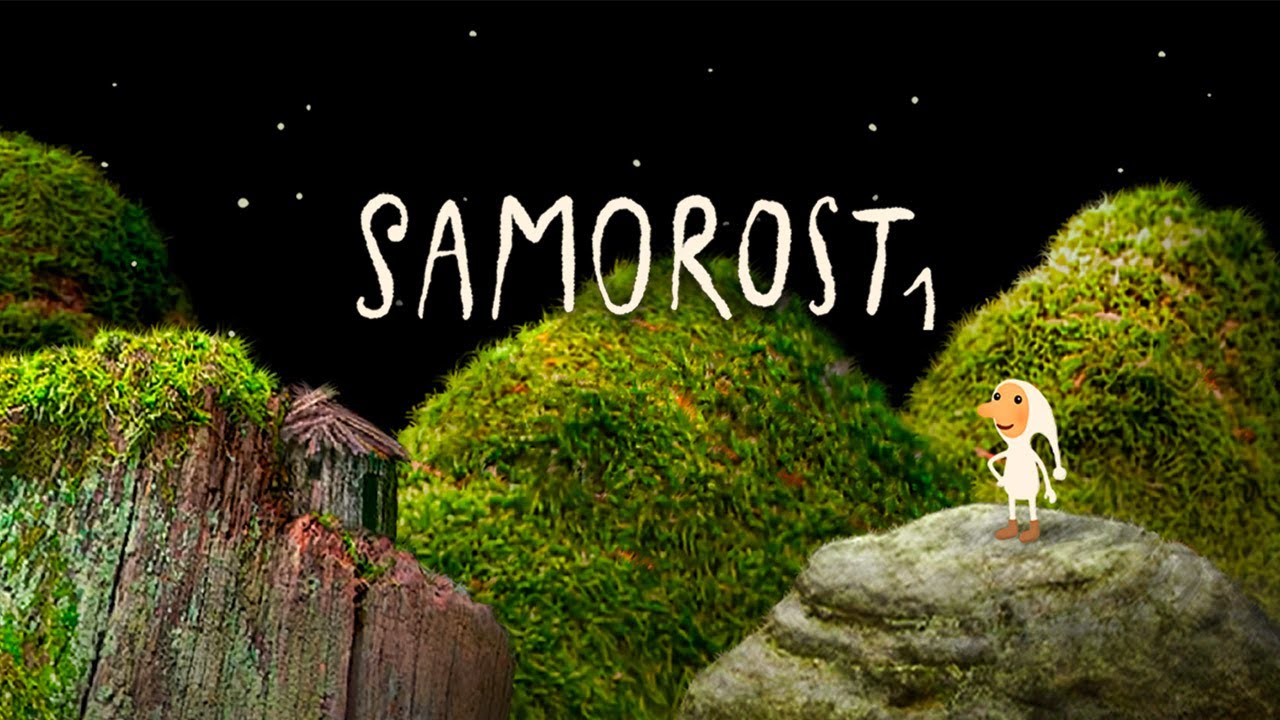 Play: amanita-design.net/games/samorost-1 Best for: Ages 8+ A short, dialogue-free surreal adventure set on tiny mossy planets. Perfect for describing scenes and predicting what happens next. Excellent for teaching: nature vocabulary, prediction, describing scenes, storytelling.
4. Anika's Odyssey
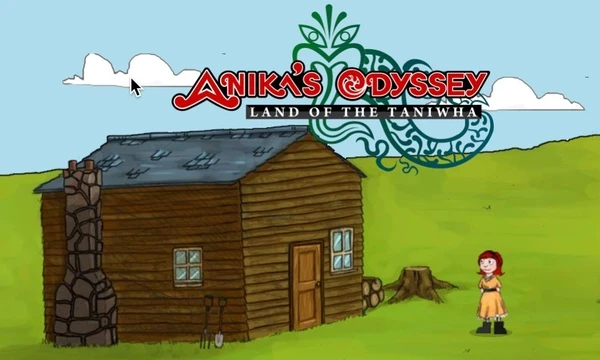 Play free: miniplay.com/game/anikas-odyssey Price: Free · Best for: Ages 6+ Anika's Odyssey follows a young girl whose beloved rabbit is carried away by a giant eagle. Students help Anika travel through colourful forests, villages, caves, and tropical landscapes as she searches for her pet and overcomes a series of imaginative puzzles. The game contains very little text, making it ideal for ESL learners. Students can focus on describing what they see, making predictions, and telling the story in their own words.
Excellent for teaching: animals, nature vocabulary, emotions, storytelling, sequencing, giving directions, describing scenes.
5. Monkey Go Happy
 Play free: miniplay.com/game/monkey-go-happy Best for: Ages 5+ Short, cheerful puzzles that spark vocabulary and quick problem-solving. Ideal warm-up for younger learners. Excellent for teaching: everyday objects, colours, actions, quick problem solving.
6. Secret of the Necromancer
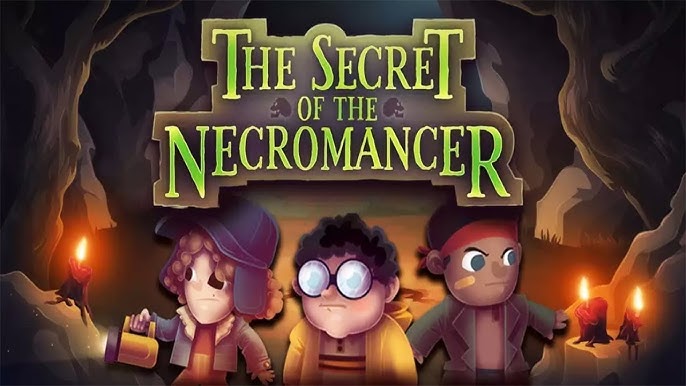 Play free: miniplay.com/halloween-2016 Price: Free · Best for: Ages 9+ In this Halloween-themed adventure, students choose one of several characters and set out to rescue their captured friends from the mysterious Necromancer. Along the way, they solve puzzles, explore spooky locations, collect useful objects, and work through a series of challenges. The game encourages students to make predictions, explain their decisions, and describe each stage of the adventure.
Excellent for teaching: fantasy vocabulary, predictions, problem solving, storytelling, sequencing, giving instructions.
A Tip for Teachers
Before introducing any adventure game in your English lesson, play it yourself first. This allows you to:
- Understand the storyline.
- Learn where the puzzles are.
- Identify useful vocabulary.
- Prepare speaking questions.
- Predict where students may need support.
- Decide which scenes are most suitable for your learners.
Knowing the game beforehand makes the lesson smoother and helps you keep students focused on communicating in English rather than simply trying to complete the game.
Use Screenshots to Encourage Speaking
One of the most effective techniques is to pause the game regularly and discuss individual scenes. Take screenshots of interesting moments and use them as visual prompts. Ask questions such as:
- What can you see?
- Where is the rabbit?
- What should Anika do next?
- Which object do we need?
- Why can't we open the door?
- What do you think will happen next?
- How do you think the character feels?
- What would you do in this situation?
If you're using Visual English, you can upload these screenshots directly into your lesson. Each image becomes a discussion prompt that encourages students to observe carefully, think critically, and communicate naturally in English. This approach transforms a simple adventure game into a complete speaking lesson built around visual storytelling, problem solving, and meaningful communication.
How to Integrate These Games in ESL Lessons
Pre-game vocabulary. Before starting, introduce key words students will encounter — directions, objects, or actions. Guided play. Share your screen and let students guide the character. Ask questions like "What should we do next?" or "Where should we go?"
Post-game discussion. Summarise the story. Ask students to retell what happened, what they found difficult, and what they enjoyed.
Conclusion
When students are immersed in stories and puzzles, they naturally use English to solve problems. Point-and-click games transform ESL lessons from passive to interactive. Whether it's exploring Lost in Play or solving puzzles in Machinarium, these adventures keep students engaged and speaking.
With tools like Visual English, you can combine the magic of storytelling with structured language learning.