ESL Survival Games: The Speaking Activity Students Never Forget
Table of contents(9 sections)ShowHide
🎮 ▶ PLAY ESL SURVIVAL GAMES NOW
Free. No signup. Works on any device.
What Are ESL Survival Games?
Imagine telling your students: "The world has been overrun by zombies. You can only save five people and take five items. Who survives?"
Suddenly every student wants to speak. Survival games transform ordinary English lessons into exciting adventures where students must solve problems, make decisions, defend opinions, and work together. Instead of practicing isolated vocabulary words, learners use English to survive impossible situations.
The result is natural communication, laughter, debate, and genuine engagement.
Why Students Love Survival Challenges
Traditional speaking activities often feel artificial. Students know they are practicing English. Survival games change the focus completely. Students become interested in:
- Solving problems
- Protecting their team
- Choosing useful items
- Deciding who survives
- Preparing for future challenges
English becomes a tool rather than the goal. When students forget they are learning English, fluency often improves naturally.
How Survival Games Develop Speaking Skills
Every round encourages students to use practical communication skills. Giving Opinions
- "I think we should take the doctor."
- "The pilot is more useful." Agreeing and Disagreeing
- "I agree."
- "I don't think that's a good idea." Persuasion
- "We need the rope because…"
- "The flashlight will help us survive." Problem Solving
- "How can we get food?"
- "What should we do next?" These are real communication skills that students use outside the classroom.
The Power of Crazy Situations
The best survival games are slightly ridiculous. Why? Because unusual situations encourage creativity.
Students become more willing to participate when discussing:
- Zombie attacks
- Alien invasions
- Desert islands
- Frozen wilderness
- Space emergencies
The more unusual the scenario, the more memorable the lesson becomes.
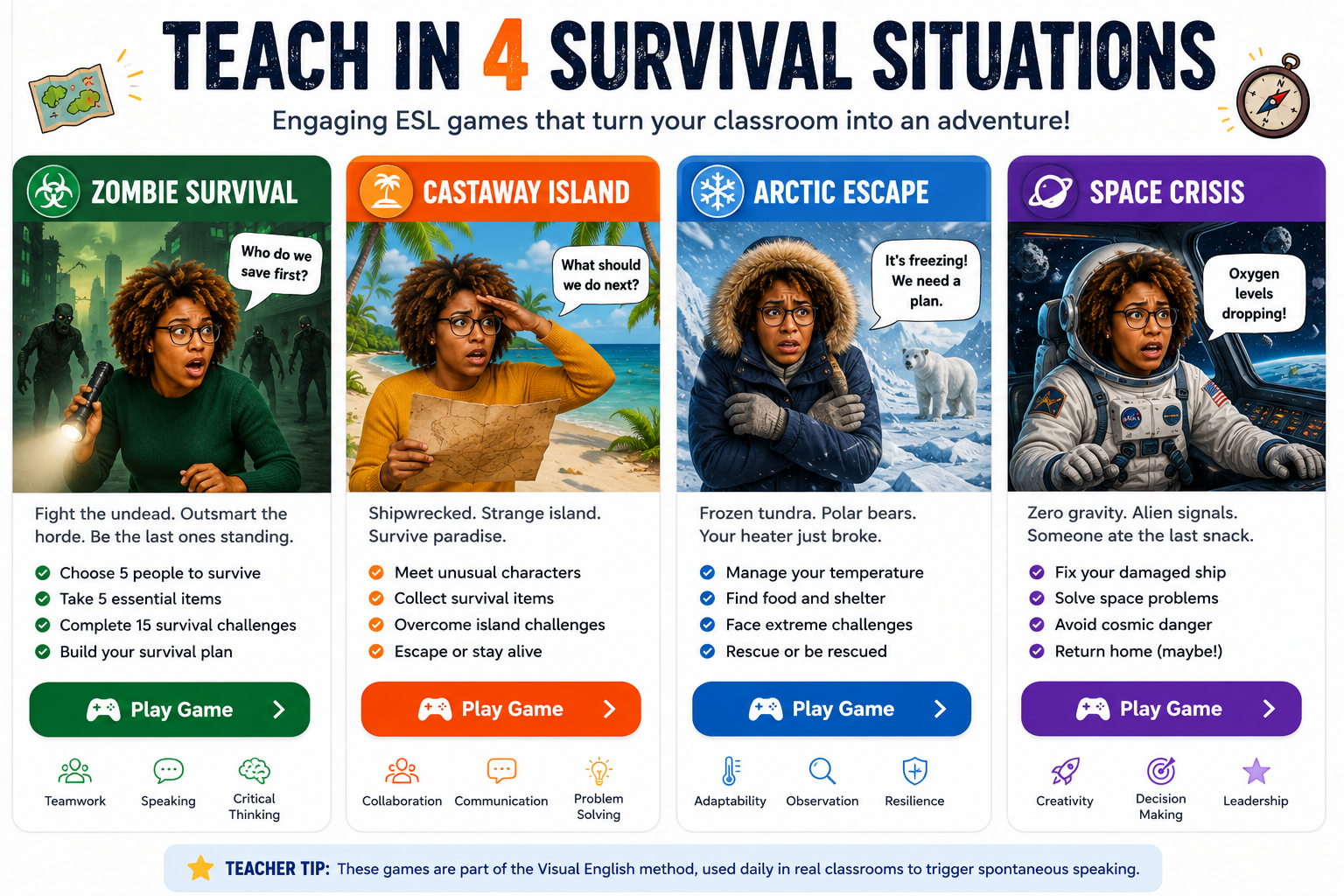
Four Survival Adventures Inside Visual English
Visual English Survival Games challenge students to choose five people, five items, and survive fifteen increasingly difficult challenges. Every game creates a completely different experience.
🧟 Zombie Survival
The original classroom favorite. Students face a zombie outbreak and must decide:
- Who joins the survival team?
- Which items should be saved?
- How will the group stay alive?
Every choice matters. One wrong decision could mean disaster. ▶ Play Zombie Survival
🏝️ Castaway Island
A tropical paradise becomes a survival nightmare. Students must deal with:
- Shipwrecks
- Strange islands
- Limited supplies
- Unusual characters
- Dangerous challenges
This scenario encourages discussions about food, shelter, transportation, and teamwork. ▶ Play Castaway Island
❄️ Arctic Escape
The temperature is dropping. A storm is approaching. The heater has stopped working.
Students must work together to survive in an extreme frozen environment. Topics naturally include:
- Weather
- Clothing
- Emergency planning
- Survival strategies
🚀 Space Crisis
One of the most imaginative adventures. Students wake up aboard a damaged spaceship. Challenges include:
- Oxygen shortages
- Alien signals
- Technical failures
- Space survival decisions
This game encourages creativity while introducing science-fiction vocabulary and problem-solving language. ▶ Play Space Crisis
Skills Students Practice
Survival games develop far more than speaking. Students also practice:
- Critical thinking
- Decision making
- Creativity
- Teamwork
- Leadership
- Listening
- Negotiation
These skills transfer directly into real-world communication.
Why Survival Games Work for Mixed Levels
One of the biggest challenges for teachers is teaching classes where students have different English abilities. Survival games naturally solve this problem. Stronger students can provide detailed explanations. Weaker students can contribute simpler ideas. Everyone participates at their own level.
Because there is no single correct answer, all students can contribute successfully.
Classroom Tips for Maximum Engagement
To make survival games even more effective: Let Students Debate. Don't rush decisions. Allow students to defend their choices. Ask Follow-Up Questions. Why? What happens next? Are you sure? What if that doesn't work?
Encourage Team Decisions. Students learn more when they must reach a group agreement. Use Visuals. Pictures help students understand situations instantly and reduce the need for translation.
Conclusion
Survival games turn speaking practice into an adventure. Students stop worrying about grammar mistakes and start focusing on solving problems together. Whether they are escaping zombies, surviving a shipwreck, crossing the Arctic, or repairing a spaceship, they are constantly using English for a meaningful purpose.
That is why survival games remain one of the most effective and memorable speaking activities for ESL classrooms. Choose five people. Take five items. Survive fifteen challenges. The conversation begins immediately.
🎮 ▶ PLAY ESL SURVIVAL GAMES NOW
Free. No signup. Works on any device.