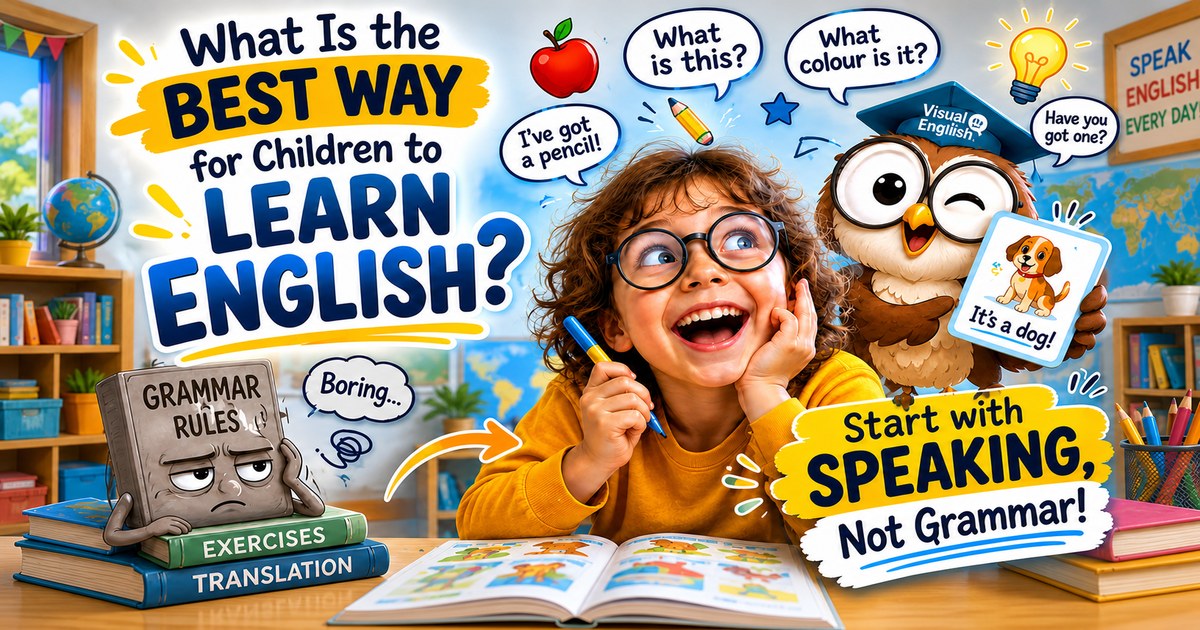
What Is the Best Way for Children to Learn English? Start With Speaking, Not Grammar
What is the best way for a child to learn English? Should they study grammar? Memorise vocabulary? Watch cartoons? Use an app? Learn with flashcards? Take lessons with a teacher?
There isn't one activity that teaches everything. Children benefit from pictures, movement, games, stories, songs, repetition and meaningful interaction. Younger learners especially need language connected to things they can see, hear and do.
But there is one thing that should connect all of these activities: Children need opportunities to actually use English. A child can know hundreds of English words and complete grammar exercises correctly but still struggle to answer a simple question. That's why we believe English learning should start with understanding and speaking, with grammar developing through meaningful language rather than dominating the lesson.
How Do Children Learn English Best?
Children don't learn languages in exactly the same way adults do. For young learners especially, long explanations about grammar rules are rarely the best starting point. They need to connect English with meaning.
Show a child a picture of a dog while saying “dog”, and the image provides meaning. Point to the dog and ask: “Is it a dog or a cat?” Now the child has to listen and make a choice. Ask:
“What colour is the dog?” Now vocabulary is becoming communication. Add: “What is the dog doing?” and the same picture can introduce verbs and sentence structures. The language grows around something the child already understands.
This is why picture-based learning, actions, short routines and meaningful question-and-answer activities are so useful with children. Move children from visual input to choices and then speech rather than expecting immediate unsupported production.
Why Speaking Should Start Early
One of the biggest mistakes in language learning is waiting too long before asking children to speak. Children may spend months learning: dog
cat
house
mother
blue
happy But knowing individual words isn't the same as being able to communicate. Instead, vocabulary should quickly become useful language:
- It's a dog.
- The dog is brown.
- I like dogs.
- Have you got a dog?
- Yes, I have.
- What's your dog's name?
The child doesn't need perfect English before speaking. Speaking is part of how they learn English. This is also why low-pressure conversation matters. Children who are reluctant to speak can begin with choices and sentence frames before moving toward independent answers.
Why Visual Learning Works So Well
Children live in a visual world. Pictures give language immediate context. If a child sees:
🐘 the teacher doesn't need a long explanation of what an elephant is. The image provides the meaning. The teacher can concentrate on the English:
- What's this? — It's an elephant.
- Is it big or small? — It's big.
- What colour is it? — It's grey.
- Can an elephant fly? — No, it can't!
This is one of the foundations of the Visual English method.
SEE → UNDERSTAND → HEAR → ANSWER → SPEAK → REPEAT
The image isn't decoration. It's the starting point for communication.
One Picture Can Become a Conversation
A good visual shouldn't be used once and forgotten. Imagine a picture of a girl eating an apple. For a beginner, ask:
Is it a boy or a girl? Is it an apple or a banana? Then: What is she eating? What colour is the apple? Later: Does she like apples? Do you like apples? What's your favourite fruit? And with stronger students: What do you think she is going to eat next? The same image can support students at different levels. That's an important difference between showing vocabulary and teaching visually. The goal isn't:
Picture → Word → Next Picture It is: Picture → Understanding → Question → Answer → New Question → Conversation
The Problem Isn't Always Vocabulary
Children sometimes know more English than they appear to know. The problem is that they haven't had enough opportunities to retrieve and use it. A child might recognise school bag, pencil, ruler, book and scissors perfectly on a worksheet.
Then someone asks: “What's in your school bag?” and the child freezes. Why? Recognition and communication are different skills.
That's why vocabulary needs to move through stages: Recognise it → Understand it → Answer with it → Use it independently A vocabulary item shouldn't disappear as soon as the child has identified it correctly. Keep using it.
Repetition Matters, But It Shouldn't Feel Repetitive
Children need repetition. But repetition doesn't have to mean saying the same word ten times. Suppose the target word is pencil.
You can practise it through: What's this? Is this a pencil? What colour is the pencil? Have you got a pencil? Where is your pencil? Put your pencil under your book. Whose pencil is this? The child encounters pencil repeatedly, but each repetition has a slightly different purpose. This is much closer to meaningful language use than mechanical drilling. Regular exposure also matters. Short, repeated practice across the week can be more manageable for children than occasional long sessions.
Games, Songs and Movement Have a Real Purpose
Games shouldn't simply fill the last five minutes of a lesson. Used properly, they create reasons to listen and communicate. Take What's Missing?
Show six objects. Students close their eyes. Remove one.
Ask: “What's missing?” Suddenly children have a reason to remember and produce vocabulary. Or play Teacher Says: Touch your nose. Pick up your pencil. Stand behind your chair. Put your book on the table. Children are listening for meaning because they need to respond physically. Songs can do something similar. They provide repeated exposure to sounds, words and sentence patterns, particularly for younger learners.
The key is what happens after the song or game. If children sing “Do you have a pencil?”, ask them the real question afterwards: “Have you got a pencil?” Then let them ask each other. The activity becomes a bridge to communication.
What About Grammar?
Grammar matters. But grammar doesn't always need to come first. Consider:
I have a dog. She has a dog. A child can hear and use these patterns repeatedly before being asked to explain the grammatical rule. Later, as learners get older and their English develops, teachers can help them notice the pattern. This approach is particularly useful with younger children, while older learners can gradually handle more explicit correction and language analysis.
Grammar should help children say more accurately what they already want to communicate, rather than become a barrier that prevents them from speaking.
Should Children Translate Everything?
Translation can sometimes be useful, particularly when a quick explanation prevents confusion. But children shouldn't need to translate every sentence before understanding it. If a teacher shows a picture of a child swimming and asks:
“Is he swimming?” the picture already carries much of the meaning. If the child can connect: English → image → meaning rather than always: English → first language → meaning they gradually become more comfortable processing familiar English directly. Visuals, gestures, objects, actions and context all help make that possible.
Different Ages Need Different Approaches
A four-year-old and a fourteen-year-old shouldn't have identical English lessons.
Ages 4–6
Use plenty of: pictures • songs • movement • puppets • actions • short questions • repetition • simple games Speaking may begin with one-word answers and choices. Red or blue? Cat or dog? Yes or no? That's fine. Those answers can gradually grow into sentences.
Ages 7–10
Children can handle more structured speaking: What have you got? What do you like? Where is it? What is happening? Games, role play and visual storytelling can help extend answers.
Ages 11–15
Older learners need more than childish vocabulary games. Use: opinions • problem solving • role play • stories • projects • descriptions • comparisons • real-life situations Instead of simply: “What's this?” ask: “Which would you choose and why?” “What do you think will happen next?” “Do you agree?” The method develops, but the principle remains: Give the learner a reason to speak. Age-appropriate variation is important. Younger children generally benefit more from action, rhythm and pictures, while older learners can work with longer tasks, projects and more explicit feedback.
Correction Without Stopping the Conversation
Children need correction, but correcting every mistake can make conversation feel like a test. Imagine a child says: “She have a dog.” Instead of stopping everything for a grammar explanation, the teacher can respond naturally: “Yes, she has a dog.” The child hears the correct form while the conversation continues. This kind of recast is particularly useful with younger learners. Older students can increasingly be encouraged to notice and repair errors themselves.
Correct what matters, model the right English, and keep the conversation moving.
What Should a Good English Lesson Look Like?
There isn't one perfect lesson structure, but a strong children's English lesson should usually contain several elements.
1. Visual Input
Give students something meaningful to look at.
2. Listening
Let them hear the target language clearly and repeatedly.
3. Guided Questions
Begin with easier questions that children can successfully answer.
4. Speaking
Move toward longer and more independent responses.
5. Movement or Interaction
Give children something to do with the language.
6. Games or Stories
Reuse the target language in a new context.
7. Review
Bring previously learned language back. This creates a cycle rather than a one-time vocabulary presentation.
How Visual English Brings These Elements Together
Visual English was built around a simple idea:
Children should spend English lessons using English.
The visual slides provide context. The teacher provides questions. Students provide answers.
Vocabulary returns in different situations. Games provide repetition. Images remove unnecessary explanation.
Questions become progressively more demanding as students develop. A simple lesson might begin: What's this? Then progress to: What colour is it? Then: What is it doing? Then: Do you like it? Why?
And eventually: What do you think is going to happen next? The teacher isn't simply presenting information. The teacher is creating a continuous conversation. And because the lesson is visually structured, the teacher doesn't have to spend hours preparing pictures, questions, slides and activities from scratch. Teachers can explore all Visual English lesson topics when they are ready to use complete lessons.
A Simple Principle for Parents and Teachers
If you want to know whether an English activity is genuinely useful, ask yourself:
What is the child doing with the English?
Are they only watching? Only matching? Only repeating?
Only filling gaps? Or are they: listening → understanding → choosing → answering → asking → describing → communicating? Apps, worksheets, songs, games, videos and flashcards can all be useful. But the resource itself isn't the method.
What the child does with the language is what matters.
Conclusion
The best way for children to learn English isn't to choose between pictures, games, songs, stories, grammar or technology. It's to use those tools to create meaningful communication. Let children see the language.
Let them hear it. Help them understand it. Ask them questions.
Give them time to answer. Bring the language back again. And gradually ask them to say more.
SEE → UNDERSTAND → HEAR → ANSWER → SPEAK → REPEAT
Because ultimately, the goal isn't for a child to know the most English exercises. The goal is for them to use English confidently when they have something to say.
Frequently asked questions
What is the best English learning method for children?
A strong approach combines understandable input, visual context, listening, repetition, interaction and frequent opportunities to speak. The balance should change according to the child’s age and level.
At what age should children start speaking English?
Children can begin responding in English from their earliest lessons. Choices, single words and short sentence frames can gradually develop into independent speaking.
Should children learn grammar?
Yes, but grammar does not have to dominate early lessons. Younger children can first encounter patterns through meaningful language and become more conscious of rules as they develop.
Are English-learning apps enough?
Apps can provide vocabulary, listening, repetition and games, but children also need opportunities to answer unpredictable questions, express ideas and interact with another person.
What if a child understands English but does not speak?
Reduce the pressure. Start with choices and sentence frames, then gradually remove the support as confidence develops.
How often should children practise English?
Regular exposure is more useful than occasional marathon sessions. Short, manageable activities throughout the week help children encounter and reuse language repeatedly.