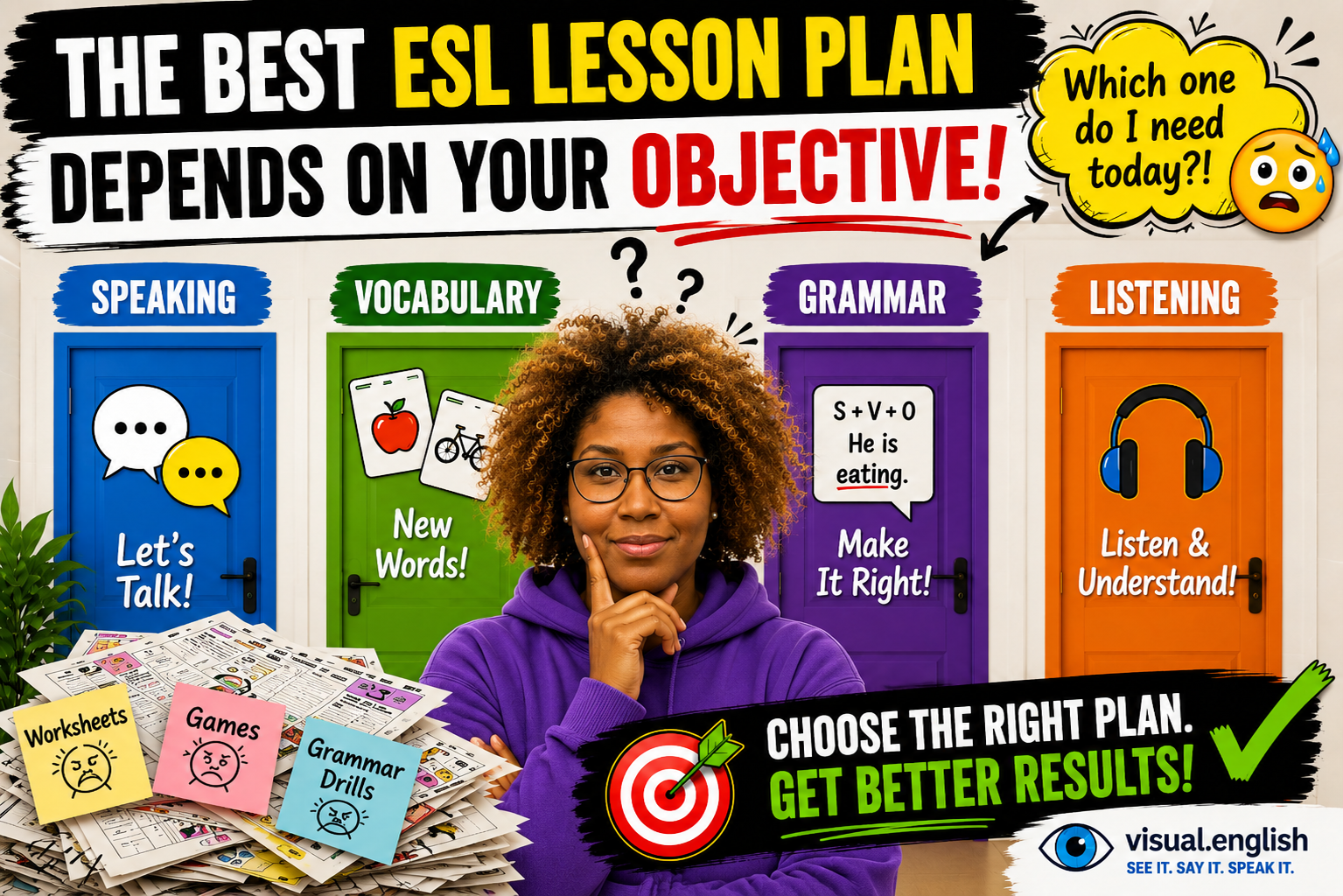
The Best ESL Lesson Plan Depends on Your Objective
Table of contents(11 sections)ShowHide
Many teachers search for the perfect ESL lesson plan. The reality is that there is no single lesson plan that works for every situation. A lesson that works brilliantly for teaching vocabulary may be ineffective for developing speaking fluency. A lesson designed for grammar accuracy may not be suitable for young learners who need movement, visuals, and interaction.
The most effective ESL lesson plans begin with a simple question: What do I want my students to achieve by the end of this lesson? Once the objective is clear, choosing activities and materials becomes much easier.
Start With the End Goal
Before opening Google, Pinterest, or your teaching resource folder, take a moment to define the lesson objective. Ask yourself:
- What skill am I teaching today?
- What should students be able to do after this lesson?
- Am I focusing on fluency or accuracy?
- Is this a speaking lesson, vocabulary lesson, grammar lesson, or listening lesson?
Many teachers make the mistake of choosing activities first and objectives second. Successful teachers do the opposite. They define the destination before planning the journey.
If Your Goal Is Speaking
Speaking lessons should prioritize communication. Students learn to speak by speaking, not by completing grammar exercises or copying vocabulary lists. Effective speaking lessons often include:
- Picture discussions
- Pair work
- Roleplays
- Conversation questions
- Information gap activities
- Group discussions
- Problem-solving tasks
For example, if the lesson topic is food, students might:
- Describe their favorite meals
- Order food in a restaurant roleplay
- Discuss healthy and unhealthy foods
- Compare eating habits in different countries
The teacher's role is to create opportunities for students to use English naturally.
If Your Goal Is Vocabulary Development
Vocabulary lessons should focus on helping students understand, remember, and use new words. Simply giving students a list of words is rarely enough. Effective vocabulary lessons include:
- Images and visual prompts
- Flashcards
- Categorization activities
- Matching exercises
- Games
- Context-based practice
For example, when teaching transport vocabulary, students should not only learn words such as bus, train, plane, and bicycle, but also use them in meaningful sentences and conversations. Visual support is particularly important because students remember words more easily when they connect them with images rather than translations.
If Your Goal Is Grammar Accuracy
Grammar lessons require a different structure. Students need opportunities to:
- Notice patterns
- Practice new structures
- Use grammar in realistic contexts
A strong grammar lesson usually includes:
- Introduction of the target structure
- Guided practice
- Controlled exercises
- Communicative practice
For example, when teaching the Present Continuous, students might look at pictures, describe actions, ask and answer questions, and create their own examples. Grammar becomes much more meaningful when students use it to communicate rather than simply fill gaps on a worksheet.
If Your Goal Is Listening Comprehension
Listening lessons should help students understand spoken English in realistic situations. Good listening lessons often include:
- Prediction activities
- Videos
- Audio recordings
- Listening tasks
- Follow-up discussions
For example, before playing an audio recording, students can predict what they will hear based on a picture or title. After listening, they can discuss the topic using new vocabulary and ideas from the recording. This approach transforms listening from a passive activity into an interactive learning experience.
If Your Goal Is Reading Skills
Reading lessons should go beyond simply answering comprehension questions. Students should learn how to:
- Predict content
- Identify key information
- Understand context
- Infer meaning
- Discuss ideas
A good reading lesson often includes a pre-reading discussion, a reading task, vocabulary exploration, and a follow-up speaking activity. The discussion stage is particularly important because it helps students move from understanding English to using English.
Different Learners Need Different Approaches
The age and level of students also influence lesson design.
Young Learners
Young children benefit from visuals, songs, games, movement activities, and short tasks.
Teenagers
Teenagers often enjoy challenges, competitions, discussions, and real-world topics.
Adults
Adult learners usually prefer practical communication, work-related topics, travel situations, and real-life conversations. The best lesson plan for one group may be completely unsuitable for another.
The Common Mistake Teachers Make
One of the biggest mistakes teachers make is downloading resources simply because they look interesting. A worksheet might be beautifully designed. A game might look fun. A video might seem engaging.
However, if the activity does not support the lesson objective, it may not contribute to student learning. Every activity should answer the question: How does this help students achieve today's learning goal? If the answer is unclear, the activity may not belong in the lesson.
Why Visual Learning Supports Multiple Objectives
One of the reasons visual teaching has become so popular is that it supports nearly every lesson objective. Visual materials can be used for:
- Speaking practice
- Vocabulary acquisition
- Grammar review
- Listening preparation
- Reading discussions
A single image can generate dozens of questions, conversations, and learning opportunities. This flexibility makes visual resources one of the most valuable tools available to ESL teachers.
How Visual English Approaches Lesson Planning
Visual English was designed around clear learning objectives. Instead of presenting isolated worksheets, each unit focuses on helping students communicate through structured visual activities. The platform includes:
- 10 structured books
- 178 ready-made units
- 20,000+ custom visuals
- Teacher guides
- Worksheets
- Videos
- Interactive games
- Speaking activities
Teachers can choose resources based on their objective while maintaining a consistent and engaging learning experience.
Final Thoughts
The best ESL lesson plan is not necessarily the one with the most activities, the longest worksheet, or the most impressive PowerPoint presentation. The best lesson plan is the one that helps students achieve a specific learning objective. Before choosing materials, define the goal. Once the objective is clear, selecting activities becomes much easier, lessons become more focused, and students make faster progress.
Whether you are teaching speaking, vocabulary, grammar, listening, or reading, the key is alignment. When activities support objectives, learning becomes more effective, more enjoyable, and more meaningful for everyone involved.
Explore 178 ready-made ESL units, teacher guides, games, videos, and classroom resources with Visual English. Explore Visual English →
Frequently asked questions
Are ready-made ESL lesson plans worth it?
For most teachers, yes. The time saved each week usually outweighs the cost, especially when you teach multiple levels.
Can beginner teachers use ready-made lesson plans?
Absolutely. They help new teachers build confidence and structure lessons effectively from day one.
Should I only use ready-made materials?
No. The best approach is combining ready-made resources with your own teaching style and supplementary activities.
Do ready-made lessons work online?
Yes. Many modern ESL resources, including Visual English, are designed for both classroom and online teaching.
What is the biggest advantage of ready-made lesson plans?
Saving preparation time while maintaining consistent lesson quality across levels and age groups.