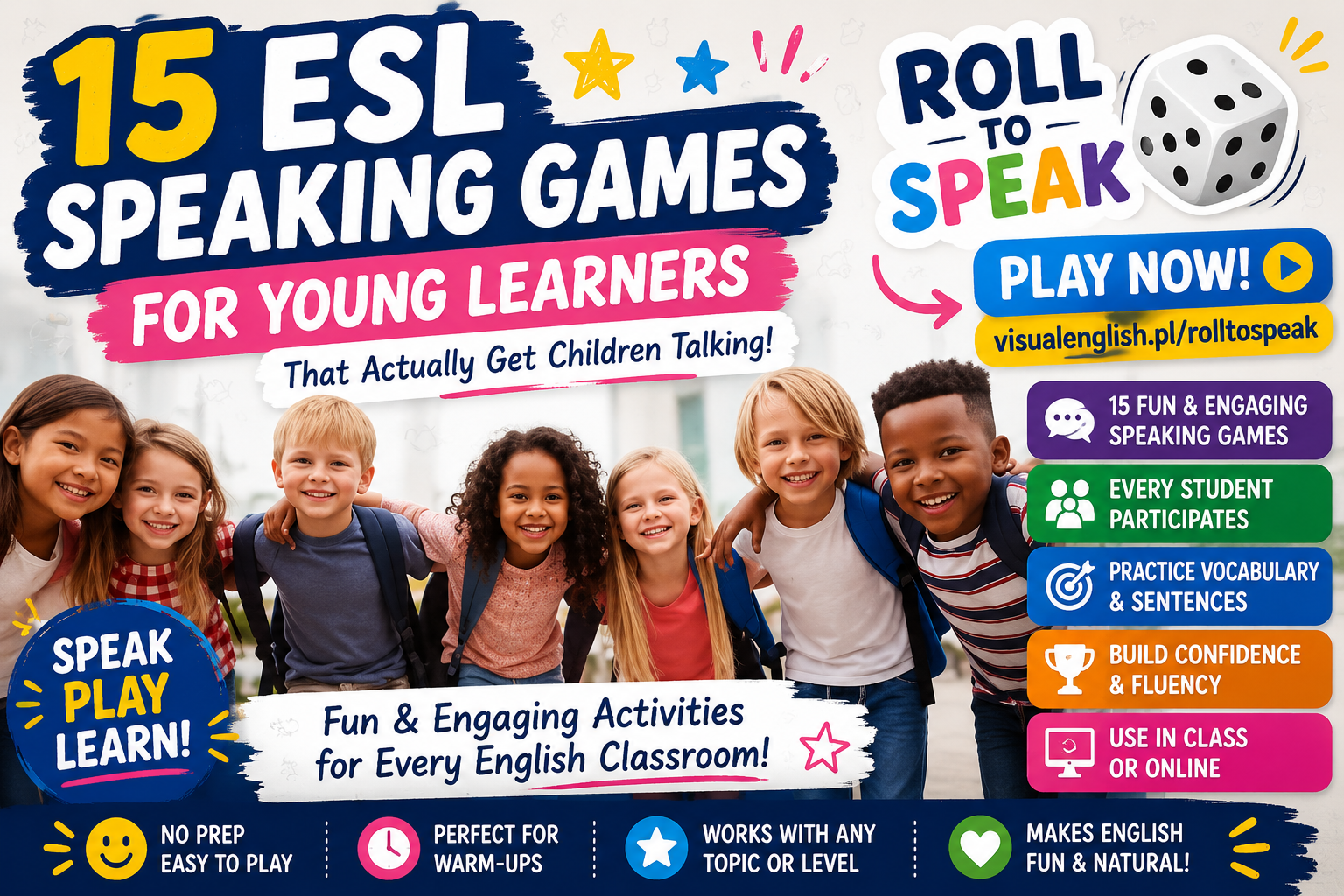
15 ESL Speaking Games for Young Learners That Actually Get Children Talking (2026)
One of the biggest challenges for every ESL teacher is getting children to actually speak English. Many young learners know vocabulary, complete worksheets and score well on grammar exercises — yet when the teacher asks a simple question, the classroom suddenly becomes very quiet.
The problem usually isn''t vocabulary. The problem is confidence. Children need opportunities to speak every lesson, and speaking games remove the fear of making mistakes because children focus on the game instead of worrying about grammar.
What Makes a Great ESL Speaking Game?
- Easy to explain
- Requires little or no preparation
- Gets every student involved
- Encourages complete sentences
- Creates excitement and builds confidence
- Can be adapted for different English levels
Most importantly — they make children want to speak.
1. Roll to Speak ⭐ (FREE)
Best for: Ages 5–14 · Preparation: None
Roll to Speak is one of the newest speaking games created specifically for ESL classrooms. Instead of answering random questions, students build funny stories together.
- Open Roll to Speak.
- Students choose a number from 1–6.
- Roll the virtual dice.
- If the number matches, the student answers the prompt or continues the story.
- Continue until the story is complete.
Features: 8 story themes, Silly Mode, classroom timer, student roster, sound effects, keyboard shortcuts. Works on laptops, tablets and interactive whiteboards.
👉 Try Roll to Speak free today
2. Picture Detective
Display a busy picture and ask: What can you see? How many birds are there? Who is wearing a red hat? What happened before? What will happen next? One image can generate twenty minutes of speaking practice.
3. What''s Missing?
Place six flashcards on the board. Children close their eyes. Remove one. Ask: "What''s missing?" Fantastic for vocabulary review, memory and observation.
4. Mystery Box
Hide an object inside a box. Students ask: Is it big? Is it soft? Can you eat it? Is it an animal? Is it made of plastic?
5. Simon Says
A classic Total Physical Response activity — perfect for action verbs, body parts, listening skills and classroom language.
6. Character Chat
Display an illustrated character and ask: What''s his name? How old is she? What does he like? What is she wearing? Where does she live? What''s her favourite food?
7. Guess the Picture
Reveal only a small part of a picture and ask: What is it? Is it food? Is it an animal? Is it big? Reveal more until someone guesses correctly.
8. Pass the Ball
Play music. Children pass a ball. When the music stops, whoever holds the ball answers a question: What''s your favourite animal? Can you swim? What''s your favourite colour?
9. Treasure Hunt
Hide classroom objects and give clues using prepositions: It''s under… behind… between… next to…
10. Find Someone Who
Students walk around asking: Have you got a brother? Do you like pizza? Can you ride a bike? Have you ever been camping?
11. Spin and Speak
Use a digital spinner with categories like animals, food, weather, school, hobbies and sports. Students answer one question based on where the spinner lands.
12. Describe and Draw
One student describes — the partner draws. Examples: a blue monster; three yellow stars; a big elephant next to a tree.
13. Odd One Out
Show four pictures (🍎 🍓 🍌 🥕) and ask: "Which one is different?" Children explain their answers in complete sentences.
14. Emoji Story
Display emojis (😀 🐶 🌧️ 🍕) and let students create funny stories. No wrong answers — creativity produces language.
15. Classroom Survey
Students ask classmates: What''s your favourite colour? Do you like football? Have you got a pet? Then present results to the class.
Why Visual Speaking Games Work Better
Research consistently shows that children understand pictures much faster than written words. Instead of thinking English → Polish → Meaning, children begin thinking Picture → Meaning → English — exactly how first languages are learned.
Why Visual English Makes Speaking Easier
Visual English was created around one simple philosophy: Children learn English by speaking English. The platform includes 178 ready-made ESL lessons, 10 structured books, 20,000+ custom illustrations, Teacher Guides, Printable Worksheets, Interactive Games, Videos and Speaking Activities — including Roll to Speak.
Conclusion
Children do not become confident English speakers by completing worksheets alone — they become confident by speaking. If you''re looking for a completely free, ready-to-use speaking game that requires no preparation, start with Roll to Speak.